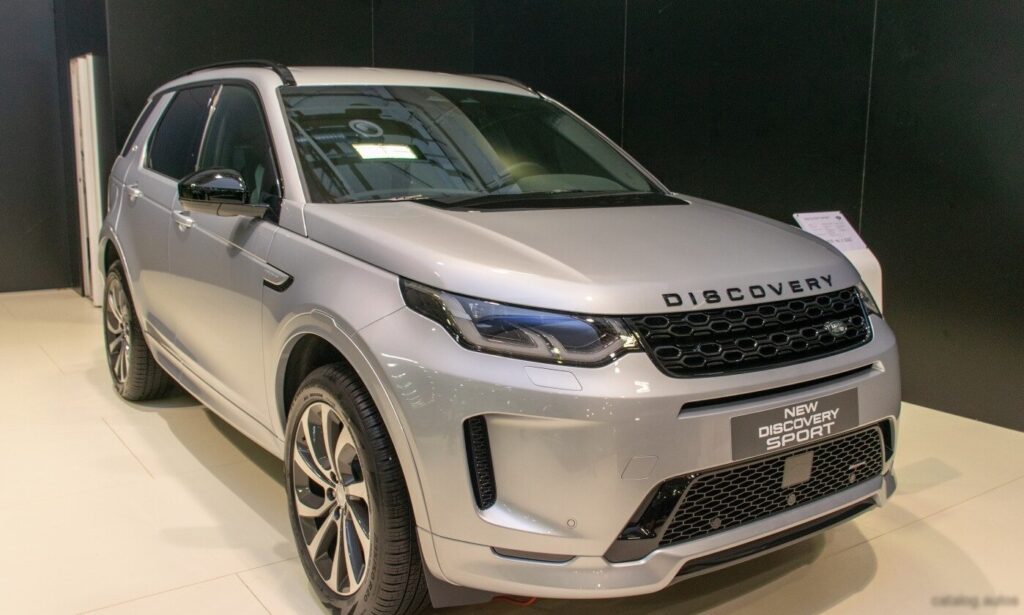
The Land Rover Discovery Sport 2.0 D165 (163 hp) Mild Hybrid AWD Automatic, introduced in August 2020, represents a key variant within the facelifted first generation (L550) Discovery Sport lineup. Positioned as a mid-range offering, this model aimed to balance fuel efficiency with respectable performance and all-weather capability, appealing to buyers seeking a premium compact SUV. It builds upon the foundation of the Discovery Sport, which was originally launched in 2014 as a more accessible entry point into the Land Rover brand, bridging the gap between the Range Rover Evoque and the larger Land Rover Discovery.
Technical Specifications
| Brand | Land Rover |
| Model | Discovery Sport |
| Generation | Discovery Sport (facelift 2019) |
| Type (Engine) | 2.0 D165 (163 Hp) Mild Hybrid AWD Automatic |
| Start of production | August, 2020 |
| Powertrain Architecture | MHEV (Mild Hybrid Electric Vehicle) |
| Body type | SUV |
| Seats | 5 |
| Doors | 5 |
| Combined fuel consumption (WLTP) | 6.7-7.2 l/100 km (35.1 – 32.7 US mpg, 42.2 – 39.2 UK mpg, 14.9 – 13.9 km/l) |
| CO2 emissions (WLTP) | 175-188 g/km |
| Fuel consumption (NEDC, WLTP equivalent) | 5.3 l/100 km (44.4 US mpg, 53.3 UK mpg, 18.9 km/l) |
| CO2 emissions (NEDC, WLTP equivalent) | 140 g/km |
| Fuel Type | Diesel |
| Acceleration 0 – 100 km/h | 10.2 sec |
| Acceleration 0 – 62 mph | 10.2 sec |
| Acceleration 0 – 60 mph | 9.5 sec |
| Maximum speed | 195 km/h (121.17 mph) |
| Emission standard | Euro 6 |
| Weight-to-power ratio | 11.5 kg/Hp, 87 Hp/tonne |
| Weight-to-torque ratio | 4.9 kg/Nm, 202.9 Nm/tonne |
| Power | 163 Hp @ 3750 rpm |
| Power per litre | 81.6 Hp/l |
| Torque | 380 Nm @ 1500-2500 rpm (280.27 lb.-ft. @ 1500-2500 rpm) |
| Engine layout | Front, Transverse |
| Engine Model/Code | Ingenium / 204DTY |
| Engine displacement | 1997 cm3 (121.86 cu. in.) |
| Number of cylinders | 4 |
| Engine configuration | Inline |
| Cylinder Bore | 83 mm (3.27 in.) |
| Piston Stroke | 92.31 mm (3.63 in.) |
| Compression ratio | 16.5:1 |
| Number of valves per cylinder | 4 |
| Fuel injection system | Diesel Commonrail |
| Engine aspiration | Turbocharger, Intercooler |
| Valvetrain | DOHC |
| Engine oil capacity | 6.5 l (6.87 US qt | 5.72 UK qt) |
| Kerb Weight | 1873 kg (4129.26 lbs.) |
| Trunk (boot) space – minimum | 897 l (31.68 cu. ft.) |
| Trunk (boot) space – maximum | 1794 l (63.35 cu. ft.) |
| Fuel tank capacity | 65 l (17.17 US gal | 14.3 UK gal) |
| AdBlue tank | 17.3 l (4.57 US gal | 3.81 UK gal) |
| Permitted trailer load with brakes (12%) | 2200 kg (4850.17 lbs.) |
| Permitted trailer load without brakes | 750 kg (1653.47 lbs.) |
| Length | 4597 mm (180.98 in.) |
| Width with mirrors folded | 2069 mm (81.46 in.) |
| Width including mirrors | 2173 mm (85.55 in.) |
| Height | 1727 mm (67.99 in.) |
| Wheelbase | 2741 mm (107.91 in.) |
| Front track | 1625-1636 mm (63.98 – 64.41 in.) |
| Rear (Back) track | 1631-1643 mm (64.21 – 64.69 in.) |
| Front overhang | 901 mm (35.47 in.) |
| Rear overhang | 955 mm (37.6 in.) |
| Ride height (ground clearance) | 212 mm (8.35 in.) |
| Drag coefficient (Cd) | 0.33 |
| Minimum turning circle (turning diameter) | 11.8 m (38.71 ft.) |
| Approach angle | 25° |
| Departure angle | 30.2° |
| Ramp-over (brakeover) angle | 20.6° |
| Wading depth | 600 mm (23.62 in.) |
| Drivetrain Architecture | ICE and electric motor drive front wheels, rear wheels engaged via clutch |
| Drive wheel | All wheel drive (4×4) |
| Number of gears and type of gearbox | 9 gears, automatic transmission |
| Front suspension | Independent type McPherson |
| Rear suspension | Independent multi-link suspension |
| Front brakes | Ventilated discs, 325-349 mm |
| Rear brakes | Disc, 300 mm |
| Assisting systems | ABS (Anti-lock braking system) |
| Steering type | Steering rack and pinion |
| Power steering | Electric Steering |
| Wheel rims size | 17; 18 |
INTRODUCTION
The 2.0 D165 Mild Hybrid AWD Automatic variant of the Land Rover Discovery Sport, launched with the 2019 facelift, represents a significant step towards electrification for the model. Utilizing Land Rover’s Ingenium engine family, this version combines a 2.0-liter turbocharged diesel engine with a 48-volt mild hybrid system. This setup aims to improve fuel economy and reduce emissions without sacrificing the off-road capability and practicality expected of a Land Rover. The facelift brought updated styling, improved interior technology, and this new powertrain option, solidifying the Discovery Sport’s position in the competitive compact luxury SUV segment. It was designed to appeal to a broad audience, offering a balance of comfort, performance, and efficiency.
Powertrain & Engine Architecture
At the heart of the 2.0 D165 is Land Rover’s Ingenium engine, specifically the 204DTY code. This is a four-cylinder, inline diesel engine displacing 1997cc. The engine features a turbocharger with an intercooler, direct fuel injection via a common rail system, and a double overhead camshaft (DOHC) valvetrain with four valves per cylinder. The mild hybrid system consists of a Belt-integrated Starter Generator (BiSG) and a 48V lithium-ion battery. The BiSG allows for quicker and smoother starts, regenerative braking to recapture energy, and extended periods of engine shutdown while coasting, further enhancing fuel efficiency. The engine produces 163 horsepower at 3750 rpm and 380 Nm (280 lb-ft) of torque between 1500 and 2500 rpm. The engine is transversely mounted in the front of the vehicle. The transmission is a ZF-sourced nine-speed automatic, chosen for its wide gear ratios and smooth shifting characteristics.
Driving Characteristics
The 2.0 D165 Automatic delivers a comfortable and refined driving experience. While not overtly sporty, the engine provides adequate power for everyday driving and highway cruising. Acceleration from 0-60 mph takes around 9.5 seconds, and the top speed is 195 km/h (121 mph). The nine-speed automatic transmission is generally smooth, although some drivers have noted occasional hesitancy during downshifts. The mild hybrid system contributes to a more responsive start-stop system and a slight improvement in fuel economy. Compared to higher-powered Discovery Sport variants (like the 240hp versions), the D165 feels less urgent, but it offers a more relaxed and economical driving experience. The automatic transmission’s gear ratios are tuned for efficiency, prioritizing fuel economy over outright performance.
Equipment & Trim Levels
The 2.0 D165 typically came equipped with a generous level of standard features. These included leather upholstery, a touchscreen infotainment system with Apple CarPlay and Android Auto compatibility, automatic climate control, and a suite of safety features such as autonomous emergency braking and lane departure warning. Optional extras included a panoramic sunroof, premium audio system, adaptive cruise control, and various styling enhancements. Trim levels varied by market, but generally, the D165 sat in the mid-range of the Discovery Sport lineup, offering a good balance of features and price. Interior materials were generally of high quality, reflecting Land Rover’s premium brand image.
Chassis & Braking
The Discovery Sport utilizes a robust chassis designed to handle both on-road and off-road conditions. The front suspension features independent McPherson struts, while the rear employs an independent multi-link setup. This configuration provides a comfortable ride and good handling characteristics. Braking duties are handled by ventilated discs at the front (325-349mm diameter) and solid discs at the rear (300mm diameter). Anti-lock Braking System (ABS) is standard. The all-wheel-drive system provides excellent traction in various conditions, and the vehicle boasts a respectable ground clearance of 212mm (8.35 inches), along with approach, departure, and ramp-over angles suitable for moderate off-road use.
Market Reception & Comparison
The 2.0 D165 Mild Hybrid AWD Automatic was generally well-received by automotive critics. It was praised for its fuel efficiency, comfortable ride, and practical interior. However, some reviewers noted that the engine could feel underpowered when fully loaded or tackling steep inclines. Compared to the more powerful diesel variants, the D165 offered a lower price point and better fuel economy, making it an attractive option for buyers prioritizing efficiency and value. Against competitors like the Audi Q5, BMW X3, and Mercedes-Benz GLC, the Discovery Sport 2.0 D165 offered a unique blend of off-road capability and luxury features.
Legacy
The 2.0 D165 Mild Hybrid powertrain has proven to be relatively reliable, with few widespread issues reported. The Ingenium engine family has established a reputation for durability, and the mild hybrid system has added to the vehicle’s longevity by reducing stress on the engine. In the used car market, the Discovery Sport 2.0 D165 represents a good value proposition, offering a well-equipped and capable SUV at a competitive price. Maintenance costs are generally reasonable, although it’s important to ensure that the AdBlue system is regularly replenished. The introduction of this mild hybrid variant marked an important step in Land Rover’s transition towards a more sustainable future.