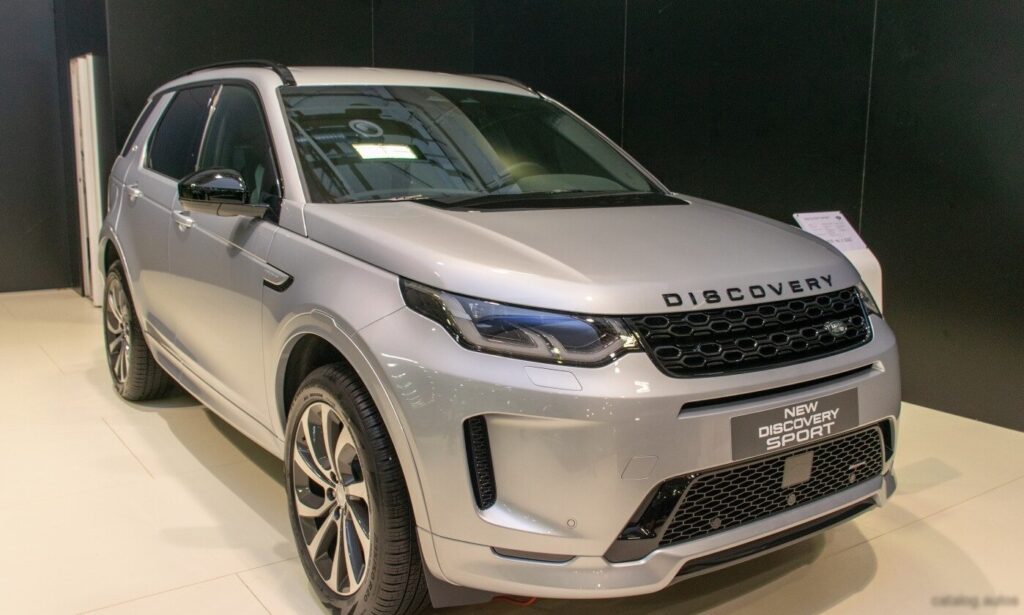
The Land Rover Discovery Sport 2.0 D180, introduced with the facelift in May 2019, represents a key variant within the second-generation Discovery Sport lineup (L550). Positioned as a mid-range offering, this model combined a 2.0-liter turbocharged diesel engine with a mild-hybrid system, an automatic transmission, and all-wheel drive. Notably, it was one of the few configurations offered with optional seven-seat capability, expanding its appeal to families. The facelift brought updated styling, improved technology, and refinements to the Ingenium engine family, solidifying the Discovery Sport’s position as a premium compact SUV.
Technical Specifications
| Brand | Land Rover |
| Model | Discovery Sport |
| Generation | Discovery Sport (facelift 2019) |
| Type | 2.0 D180 (180 Hp) Mild Hybrid AWD Automatic 5+2 Seating |
| Start of production | May, 2019 |
| Powertrain Architecture | MHEV (Mild Hybrid Electric Vehicle) |
| Body type | SUV |
| Seats | 7 |
| Doors | 5 |
| Fuel consumption at Low speed (WLTP) | 9.9-10.2 l/100 km (23.8 – 23.1 US mpg) |
| Fuel consumption at Medium speed (WLTP) | 7.8-8.3 l/100 km (30.2 – 28.3 US mpg) |
| Fuel consumption at high speed (WLTP) | 5.4-6.0 l/100 km (43.6 – 39.2 US mpg) |
| Fuel consumption at very high speed (WLTP) | 7.1-7.6 l/100 km (33.1 – 30.9 US mpg) |
| Combined fuel consumption (WLTP) | 7.1-7.6 l/100 km (33.1 – 30.9 US mpg) |
| CO2 emissions (WLTP) | 187-199 g/km |
| Fuel consumption (urban – NEDC) | 6.7-6.9 l/100 km (35.1 – 34.1 US mpg) |
| Fuel consumption (extra urban – NEDC) | 5.2-5.3 l/100 km (45.2 – 44.4 US mpg) |
| Fuel consumption (combined – NEDC) | 5.7-5.9 l/100 km (41.3 – 39.9 US mpg) |
| CO2 emissions (NEDC) | 150-155 g/km |
| Fuel Type | Diesel |
| Acceleration 0 – 100 km/h | 10.1 sec |
| Acceleration 0 – 62 mph | 10.1 sec |
| Acceleration 0 – 60 mph | 9.4 sec |
| Maximum speed | 201 km/h (124.9 mph) |
| Emission standard | Euro 6d-TEMP-EVAP-ISC |
| Weight-to-power ratio | 10.9 kg/Hp |
| Weight-to-torque ratio | 4.5 kg/Nm |
| Power | 180 Hp @ 4000 rpm |
| Torque | 430 Nm @ 1500-3000 rpm (317.15 lb.-ft.) |
| Engine layout | Front, Transverse |
| Engine Model/Code | Ingenium / 204DTD |
| Engine displacement | 1999 cm3 (121.99 cu. in.) |
| Number of cylinders | 4 |
| Engine configuration | Inline |
| Cylinder Bore | 83 mm (3.27 in.) |
| Piston Stroke | 92.35 mm (3.64 in.) |
| Compression ratio | 15.5:1 |
| Number of valves per cylinder | 4 |
| Fuel injection system | Diesel Commonrail |
| Engine aspiration | Turbocharger, Intercooler |
| Valvetrain | DOHC |
| Engine oil capacity | 6.5 l (6.87 US qt | 5.72 UK qt) |
| Kerb Weight | 1953 kg (4305.63 lbs.) |
| Max. weight | 2750 kg (6062.71 lbs.) |
| Max load | 797 kg (1757.08 lbs.) |
| Trunk (boot) space – minimum | 157 l (5.54 cu. ft.) |
| Trunk (boot) space – maximum | 1651 l (58.3 cu. ft.) |
| Fuel tank capacity | 65 l (17.17 US gal | 14.3 UK gal) |
| AdBlue tank | 17 l (4.49 US gal | 3.74 UK gal) |
| Max. roof load | 75 kg (165.35 lbs.) |
| Permitted trailer load with brakes (12%) | 2200 kg (4850.17 lbs.) |
| Permitted trailer load without brakes | 750 kg (1653.47 lbs.) |
| Permitted towbar download | 100 kg (220.46 lbs.) |
| Length | 4597 mm (180.98 in.) |
| Width with mirrors folded | 2069 mm (81.46 in.) |
| Width including mirrors | 2173 mm (85.55 in.) |
| Height | 1727 mm (67.99 in.) |
| Wheelbase | 2741 mm (107.91 in.) |
| Front track | 1625-1636 mm (63.98 – 64.41 in.) |
| Rear track | 1623-1643 mm (63.9 – 64.69 in.) |
| Front overhang | 901 mm (35.47 in.) |
| Rear overhang | 955 mm (37.6 in.) |
| Ride height (ground clearance) | 212 mm (8.35 in.) |
| Drag coefficient (Cd) | 0.33 |
| Minimum turning circle | 12.14 m (39.83 ft.) |
| Approach angle | 22.8-25.0° |
| Departure angle | 28.2-30.2° |
| Ramp-over angle | 20.6° |
| Wading depth | 600 mm (23.62 in.) |
| Drivetrain Architecture | ICE and electric motor drive front wheels, rear drive via clutch |
| Drive wheel | All wheel drive (4×4) |
| Number of gears | 9 |
| Gearbox type | Automatic transmission |
| Front suspension | Independent McPherson |
| Rear suspension | Independent multi-link |
| Front brakes | Ventilated discs, 325-349 mm |
| Rear brakes | Disc, 325 mm |
| Steering type | Steering rack and pinion |
| Power steering | Electric |
| Tires size | 225/65 R17; 235/65 R17; 235/60 R18; 235/55 R19; 235/50 R20; 245/45 R21 |
| Wheel rims size | 7.0J x 17; 8.0J x 18; 8.0J x 19; 8.0J x 20; 8.0J x 21 |
INTRODUCTION
The 2019 facelift of the Land Rover Discovery Sport brought significant updates to the popular compact SUV, and the 2.0 D180 Mild Hybrid AWD Automatic variant occupied an important position in the range. Built on the Land Rover L550 platform, which is shared with the Range Rover Evoque, this version aimed to balance fuel efficiency, performance, and practicality. The addition of mild-hybrid technology was a key feature, enhancing the vehicle’s efficiency without the full commitment of a plug-in hybrid system. The availability of a 5+2 seating configuration (optional third-row seating) further broadened its appeal, making it a viable option for larger families.
Powertrain & Engine Architecture
At the heart of the Discovery Sport D180 lies Land Rover’s Ingenium engine family. Specifically, the 204DTD engine is a 2.0-liter inline-four cylinder diesel engine. This engine utilizes a sophisticated common-rail direct fuel injection system, delivering fuel at extremely high pressures for optimized combustion. A single turbocharger with an intercooler provides forced induction, boosting power output. The DOHC (Double Overhead Camshaft) valvetrain ensures efficient valve control. The mild-hybrid system incorporates a 48V belt-integrated starter generator (BiSG), which assists the engine during acceleration and enables smoother start-stop functionality. This system recovers energy during braking, storing it in a small battery to reduce engine load. The engine produces 180 horsepower at 4000 rpm and 430 Nm (317.15 lb.-ft.) of torque between 1500 and 3000 rpm. The engine is paired with a ZF-sourced 9-speed automatic transmission, known for its smooth shifts and wide gear ratio spread.
Driving Characteristics
The 2.0 D180 Automatic delivers a comfortable and refined driving experience. While not overtly sporty, the engine provides adequate power for everyday driving and highway cruising. The 9-speed automatic transmission is well-tuned, offering smooth gear changes and contributing to fuel efficiency. The mild-hybrid system provides a noticeable boost during initial acceleration, mitigating some of the turbo lag often associated with diesel engines. Compared to the higher-output 240hp diesel variant, the D180 feels less urgent, but it offers a more relaxed and economical driving experience. The automatic transmission’s gear ratios are optimized for both fuel economy and usability, with close ratios in the lower gears for responsive acceleration and taller ratios for efficient highway cruising. The all-wheel-drive system provides excellent traction in various conditions, enhancing stability and confidence.
Equipment & Trim Levels
The Discovery Sport D180 typically came well-equipped, even in base trim. Standard features included leather upholstery, a touchscreen infotainment system with Apple CarPlay and Android Auto compatibility, automatic climate control, and a suite of safety features such as autonomous emergency braking and lane departure warning. Higher trim levels added features like premium audio systems, panoramic sunroofs, heated and cooled seats, and advanced driver-assistance systems. Optional extras included the aforementioned seven-seat configuration, adaptive cruise control, and a head-up display. Interior trim options varied, with choices ranging from brushed aluminum to wood veneers.
Chassis & Braking
The Discovery Sport utilizes an independent McPherson strut suspension at the front and an independent multi-link suspension at the rear, providing a comfortable ride and good handling characteristics. The suspension is tuned to prioritize comfort over outright sportiness, but it still offers a reasonable level of body control. Braking duties are handled by ventilated discs at the front and solid discs at the rear. Anti-lock Braking System (ABS) and Electronic Stability Control (ESC) are standard features. Stabilizer bars are fitted front and rear to reduce body roll during cornering. The vehicle’s weight, around 1953 kg (4305.63 lbs), is relatively high for its class, which impacts handling agility to some extent.
Market Reception & Comparison
The Discovery Sport D180 was generally well-received by automotive critics. It was praised for its comfortable ride, spacious interior (especially with the optional seven seats), and fuel efficiency. However, some reviewers noted that the engine could feel strained when fully loaded or during aggressive acceleration. Compared to the more powerful diesel variants, the D180 offered a more affordable entry point into the Discovery Sport range, appealing to buyers who prioritized economy and practicality over outright performance. Fuel economy figures of 7.1-7.6 l/100 km (33.1 – 30.9 US mpg) were competitive within its segment. Reliability reports have been generally positive, although some owners have reported minor issues with the infotainment system.
Legacy
The Land Rover Discovery Sport 2.0 D180 Mild Hybrid AWD Automatic has proven to be a reliable and popular choice in the used car market. The Ingenium engine has demonstrated good durability, and the mild-hybrid system has not been prone to major failures. The vehicle’s combination of practicality, comfort, and fuel efficiency continues to appeal to buyers seeking a premium compact SUV. While newer models offer more advanced technology and features, the 2019 facelifted Discovery Sport D180 remains a compelling option for those seeking a well-rounded and capable vehicle at a reasonable price point.