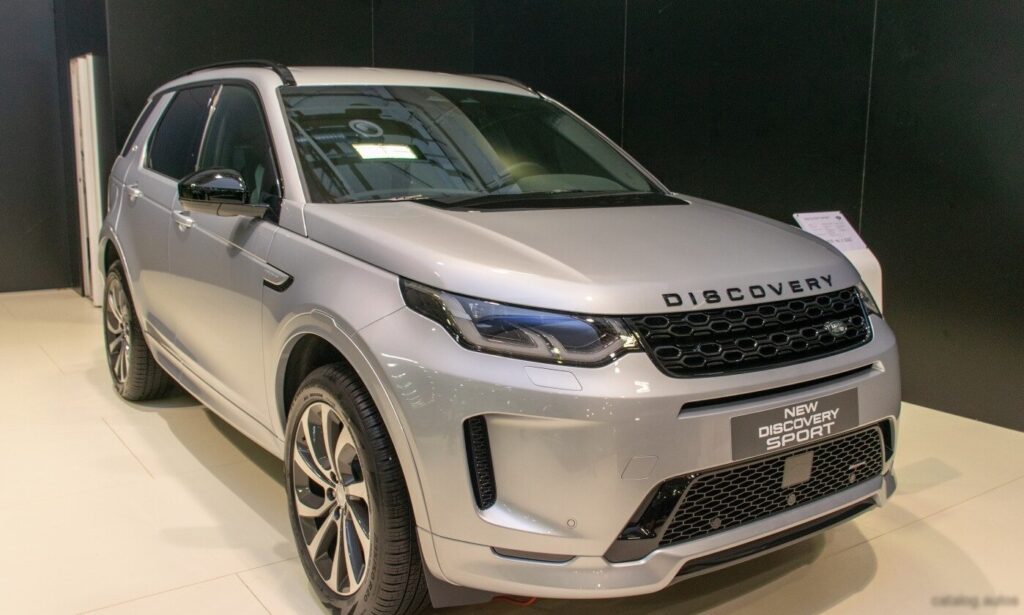
The Land Rover Discovery Sport 2.0 D240 Mild Hybrid AWD Automatic, introduced with the facelift in May 2019, represents a significant evolution of Land Rover’s compact SUV offering. Positioned as a mid-range to upper-mid-range trim within the Discovery Sport lineup, it aimed to balance performance, efficiency, and refinement. This variant is built upon the LF-XA platform, also known as the 1HX0/A3 platform, shared with other Jaguar Land Rover products. The introduction of mild hybrid technology marked a step towards electrification for the Discovery Sport, enhancing fuel economy and reducing emissions while maintaining a familiar driving experience. This model year brought styling updates, interior enhancements, and the integration of new technologies, solidifying the Discovery Sport’s position in the premium compact SUV segment.
Technical Specifications
| Brand | Land Rover |
| Model | Discovery Sport |
| Generation | Discovery Sport (facelift 2019) |
| Type (Engine) | 2.0 D240 (240 Hp) Mild Hybrid AWD Automatic |
| Start of production | May, 2019 |
| Powertrain Architecture | MHEV (Mild Hybrid Electric Vehicle) |
| Body type | SUV |
| Seats | 5 |
| Doors | 5 |
| Fuel consumption (combined) | 6.2-6.4 l/100 km (37.9 – 36.8 US mpg, 45.6 – 44.1 UK mpg, 16.1 – 15.6 km/l) |
| CO2 emissions | 163-168 g/km |
| Fuel Type | Diesel |
| Acceleration 0 – 100 km/h | 7.7-7.9 sec |
| Acceleration 0 – 62 mph | 7.7-7.9 sec |
| Acceleration 0 – 60 mph | 7.3 sec |
| Maximum speed | 220 km/h (136.7 mph) |
| Emission standard | Euro 6d-TEMP-EVAP-ISC |
| Weight-to-power ratio | 8.1 kg/Hp, 124.1 Hp/tonne |
| Weight-to-torque ratio | 3.9 kg/Nm, 258.5 Nm/tonne |
| Power | 240 Hp @ 4000 rpm |
| Power per litre | 120.1 Hp/l |
| Torque | 500 Nm @ 1500-3000 rpm (368.78 lb.-ft. @ 1500-3000 rpm) |
| Engine layout | Front, Transverse |
| Engine Model/Code | Ingenium / 204DTA |
| Engine displacement | 1999 cm3 (121.99 cu. in.) |
| Number of cylinders | 4 |
| Engine configuration | Inline |
| Cylinder Bore | 83 mm (3.27 in.) |
| Piston Stroke | 92.35 mm (3.64 in.) |
| Compression ratio | 15.5:1 |
| Number of valves per cylinder | 4 |
| Fuel injection system | Diesel Commonrail |
| Engine aspiration | Turbocharger, Intercooler |
| Valvetrain | DOHC |
| Engine oil capacity | 6.5 l (6.87 US qt | 5.72 UK qt) |
| Kerb Weight | 1934 kg (4263.74 lbs.) |
| Max. weight | 2620 kg (5776.11 lbs.) |
| Max load | 686 kg (1512.37 lbs.) |
| Trunk (boot) space – minimum | 1179 l (41.64 cu. ft.) |
| Trunk (boot) space – maximum | 1794 l (63.35 cu. ft.) |
| Fuel tank capacity | 65 l (17.17 US gal | 14.3 UK gal) |
| AdBlue tank | 17 l (4.49 US gal | 3.74 UK gal) |
| Max. roof load | 75 kg (165.35 lbs.) |
| Permitted trailer load with brakes (12%) | 2500 kg (5511.56 lbs.) |
| Permitted trailer load without brakes | 750 kg (1653.47 lbs.) |
| Permitted towbar download | 100 kg (220.46 lbs.) |
| Length | 4597 mm (180.98 in.) |
| Width with mirrors folded | 2069 mm (81.46 in.) |
| Width including mirrors | 2173 mm (85.55 in.) |
| Height | 1727 mm (67.99 in.) |
| Wheelbase | 2741 mm (107.91 in.) |
| Front track | 1626-1636 mm (64.02 – 64.41 in.) |
| Rear track | 1623-1643 mm (63.9 – 64.69 in.) |
| Front overhang | 901 mm (35.47 in.) |
| Rear overhang | 955 mm (37.6 in.) |
| Ride height (ground clearance) | 212 mm (8.35 in.) |
| Drag coefficient (Cd) | 0.34 |
| Minimum turning circle | 12.14 m (39.83 ft.) |
| Approach angle | 22.8-25.0° |
| Departure angle | 28.2-30.2° |
| Ramp-over angle | 20.6° |
| Wading depth | 600 mm (23.62 in.) |
| Drivetrain Architecture | ICE and electric motor drive front wheels, rear drive via clutch |
| Drive wheel | All wheel drive (4×4) |
| Number of gears | 9 |
| Gearbox type | Automatic transmission |
| Front suspension | Independent type McPherson |
| Rear suspension | Independent multi-link suspension |
| Front brakes | Ventilated discs, 349 mm |
| Rear brakes | Disc, 325 mm |
| Steering type | Steering rack and pinion |
| Power steering | Electric Steering |
| Tires size | 235/60 R18; 235/55 R19; 235/50 R20; 245/45 R21 |
| Wheel rims size | 8.0J x 18; 8.0J x 19; 8.0J x 20; 8.0J x 21 |
Powertrain & Engine Architecture
The heart of the Discovery Sport D240 is Land Rover’s Ingenium engine family, specifically the 204DTA 2.0-liter four-cylinder diesel. This engine benefits from a sophisticated turbocharging system and direct fuel injection, delivering a robust 240 horsepower at 4000 rpm and a substantial 500 Nm (368.78 lb.-ft.) of torque between 1500 and 3000 rpm. The mild hybrid system, utilizing a 48V electrical architecture, incorporates a Belt-integrated Starter Generator (BiSG) that assists the engine during acceleration and enables smoother start-stop functionality. This system contributes to improved fuel efficiency and reduced emissions. The engine features a DOHC valvetrain and a high compression ratio of 15.5:1, optimizing combustion efficiency. Paired with the engine is a ZF-sourced nine-speed automatic transmission, known for its smooth shifts and wide gear ratio spread. This transmission is crucial for balancing performance and fuel economy, allowing the engine to operate within its optimal torque band.
Driving Characteristics
The 2.0 D240 Automatic offers a refined and capable driving experience. While not as overtly sporty as some competitors, the combination of 240 hp and 500 Nm provides ample power for everyday driving and confident overtaking. The nine-speed automatic transmission contributes to smooth acceleration, although some drivers may notice a slight hesitation during kickdown. The mild hybrid system provides a subtle boost during acceleration, enhancing responsiveness. Compared to lower-powered versions of the Discovery Sport, the D240 feels noticeably more effortless, particularly when fully loaded or tackling inclines. The all-wheel-drive system provides excellent traction in various conditions, making it a capable vehicle for both on-road and light off-road use. The gear ratios are tuned for a balance between fuel efficiency and performance, with taller gears for highway cruising and shorter gears for quicker acceleration.
Equipment & Trim Levels
The D240 trim typically included a generous level of standard equipment. Interior features generally included leather upholstery, power-adjustable front seats, a touchscreen infotainment system with navigation, and a premium sound system. Standard safety features included autonomous emergency braking, lane departure warning, and front and rear parking sensors. Optional extras included a panoramic sunroof, adaptive cruise control, a head-up display, and upgraded interior trim materials. The D240 often served as a stepping stone to the higher R-Dynamic trims, offering a balance of luxury and performance without the full cost of the top-spec models.
Chassis & Braking
The Discovery Sport’s chassis is designed to provide a comfortable ride and confident handling. It utilizes an independent McPherson strut suspension at the front and a multi-link suspension at the rear. The D240 variant typically featured larger brakes than the entry-level models, with ventilated discs at the front (349mm) and solid discs at the rear (325mm). Anti-lock braking system (ABS) and electronic stability control (ESC) are standard features. The suspension tuning is geared towards comfort, but the vehicle remains relatively stable and predictable in corners. The all-wheel-drive system contributes to enhanced stability and traction, particularly on slippery surfaces.
Market Reception & Comparison
The Discovery Sport 2.0 D240 Mild Hybrid AWD Automatic was generally well-received by automotive critics. It was praised for its refined engine, comfortable ride, and spacious interior. The mild hybrid system was seen as a positive step towards improving fuel efficiency and reducing emissions. Compared to the lower-powered diesel variants, the D240 offered a noticeable performance upgrade, making it a more appealing option for drivers who frequently travel long distances or carry heavy loads. However, some critics noted that the infotainment system could be slow to respond at times. Fuel economy figures of 6.2-6.4 l/100 km (37.9-36.8 US mpg) were competitive within its class.
Legacy
The Ingenium engine family, including the 204DTA, has proven to be relatively reliable, although regular maintenance is crucial. The mild hybrid system has also demonstrated good durability. In the used car market, the Discovery Sport 2.0 D240 Mild Hybrid AWD Automatic remains a popular choice, offering a good balance of practicality, comfort, and performance. Potential buyers should look for vehicles with a full service history and ensure that the mild hybrid system is functioning correctly. The combination of a capable engine, refined transmission, and all-wheel-drive system makes this variant a compelling option for those seeking a premium compact SUV.