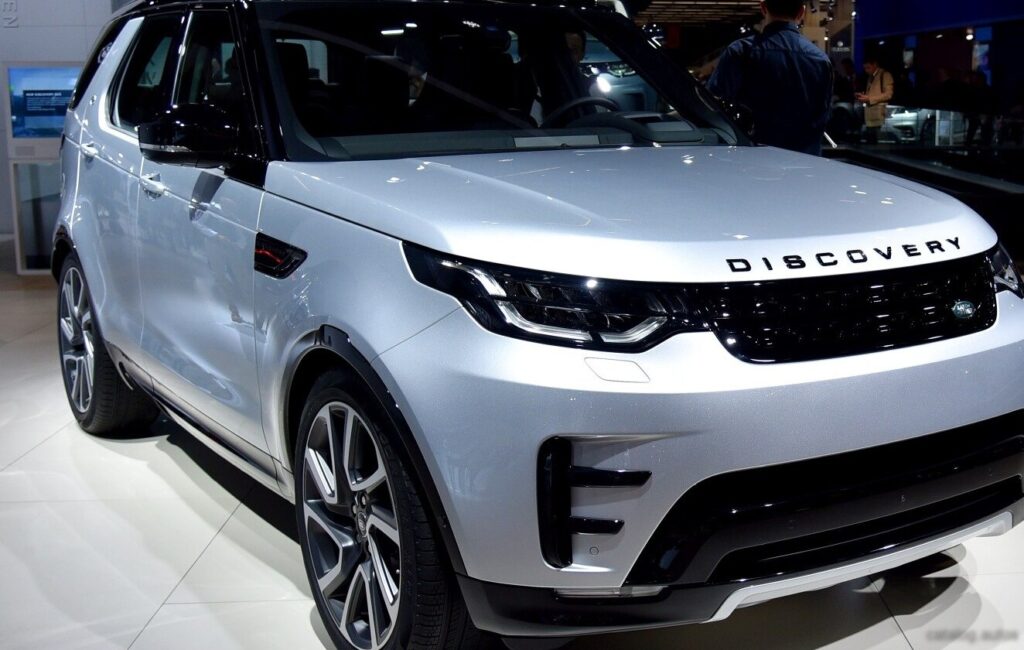
The Land Rover Discovery V 2.0 Si4, produced from 2017 to 2018, represents a significant shift in the Discovery lineage. This fifth-generation model, designated as the L550, moved away from the rugged, body-on-frame construction of its predecessors to a more contemporary monocoque chassis. The 2.0 Si4 variant, powered by the Ingenium engine family, was positioned as a mainstream offering within the Discovery V range, balancing performance, fuel efficiency, and luxury. It aimed to appeal to buyers seeking a versatile SUV with a premium badge and capable all-terrain abilities, while remaining relatively accessible in price compared to the higher-powered six-cylinder options.
Technical Specifications
| Brand | Land Rover |
| Model | Discovery |
| Generation | Discovery V |
| Type (Engine) | 2.0 Si4 (300 Hp) 4WD Automatic |
| Start of production | 2017 |
| End of production | 2018 |
| Powertrain Architecture | Internal Combustion engine |
| Body type | SUV |
| Seats | 5 |
| Doors | 5 |
| Fuel consumption (urban) | 11.6 l/100 km (20.3 US mpg, 24.4 UK mpg, 8.6 km/l) |
| Fuel consumption (extra urban) | 8.4 l/100 km (28 US mpg, 33.6 UK mpg, 11.9 km/l) |
| Fuel consumption (combined) | 9.6 l/100 km (24.5 US mpg, 29.4 UK mpg, 10.4 km/l) |
| CO2 emissions | 222 g/km |
| Fuel Type | Petrol (Gasoline) |
| Acceleration 0 – 100 km/h | 7.7 sec |
| Acceleration 0 – 62 mph | 7.7 sec |
| Acceleration 0 – 60 mph | 7.3 sec |
| Maximum speed | 201 km/h (124.9 mph) |
| Emission standard | Euro 6 |
| Weight-to-power ratio | 7 kg/Hp, 143.8 Hp/tonne |
| Weight-to-torque ratio | 5.2 kg/Nm, 191.8 Nm/tonne |
| Power | 300 Hp @ 5500 rpm |
| Power per litre | 150.2 Hp/l |
| Torque | 400 Nm @ 1500-4000 rpm (295.02 lb.-ft. @ 1500-4000 rpm) |
| Engine layout | Front, Transverse |
| Engine Model/Code | Ingenium / PT204 |
| Engine displacement | 1997 cm3 (121.86 cu. in.) |
| Number of cylinders | 4 |
| Engine configuration | Inline |
| Cylinder Bore | 83 mm (3.27 in.) |
| Piston Stroke | 92.3 mm (3.63 in.) |
| Compression ratio | 9.5:1 |
| Number of valves per cylinder | 4 |
| Fuel injection system | Direct injection |
| Engine aspiration | Turbocharger, Intercooler |
| Engine oil capacity | 7 l (7.4 US qt | 6.16 UK qt) |
| Coolant | 11.2 l (11.83 US qt | 9.85 UK qt) |
| Kerb Weight | 2086 kg (4598.84 lbs.) |
| Max. weight | 2900 kg (6393.41 lbs.) |
| Max load | 814 kg (1794.56 lbs.) |
| Trunk (boot) space – minimum | 1231 l (43.47 cu. ft.) |
| Trunk (boot) space – maximum | 2500 l (88.29 cu. ft.) |
| Fuel tank capacity | 90 l (23.78 US gal | 19.8 UK gal) |
| Max. roof load | 80 kg (176.37 lbs.) |
| Permitted trailer load with brakes (12%) | 3000 kg (6613.87 lbs.) |
| Permitted trailer load without brakes | 750 kg (1653.47 lbs.) |
| Permitted towbar download | 150 kg (330.69 lbs.) |
| Length | 4970 mm (195.67 in.) |
| Width with mirrors folded | 2073 mm (81.61 in.) |
| Width including mirrors | 2220 mm (87.4 in.) |
| Height | 1888 mm (74.33 in.) |
| Wheelbase | 2923 mm (115.08 in.) |
| Front track | 1692 mm (66.61 in.) |
| Rear (Back) track | 1687 mm (66.42 in.) |
| Ride height (ground clearance) | 220-283 mm (8.66 – 11.14 in.) |
| Drag coefficient (Cd) | 0.33 |
| Minimum turning circle (turning diameter) | 12.7 m (41.67 ft.) |
| Approach angle | 29.0-34.0° |
| Departure angle | 27.0-30.0° |
| Ramp-over (brakeover) angle | 22.2-27.5° |
| Climb angle | 45° |
| Wading depth | 900 mm (35.43 in.) |
| Drivetrain Architecture | The Internal combustion engine (ICE) drives permanently the four wheels of the vehicle. |
| Drive wheel | All wheel drive (4×4) |
| Number of gears and type of gearbox | 8 gears, automatic transmission |
| Front suspension | Double wishbone, Independent coil spring |
| Rear suspension | Independent multi-link suspension |
| Front brakes | Ventilated discs, 360 mm |
| Rear brakes | Ventilated discs, 350 mm |
| Assisting systems | ABS (Anti-lock braking system) |
| Steering type | Steering rack and pinion |
| Power steering | Electric Steering |
| Tires size | 235/65 R19; 255/60 R19; 255/55 R20; 275/45 R21; 285/40 R22 |
| Wheel rims size | 7.5J x 19; 8.5J x 20; 9.5J x 21; 9.5J x 22 |
INTRODUCTION
The Land Rover Discovery V 2.0 Si4, launched in 2017, marked a departure from the previous generations of the Discovery. Built on the Premium Lightweight Architecture (PLA), also known as the iLQ platform, it prioritized on-road comfort and refinement while retaining Land Rover’s renowned off-road capability. The 2.0 Si4 variant, utilizing the Ingenium engine, served as a key entry point into the Discovery V range, offering a balance between performance and economy. This model year represented the initial introduction of the fifth generation, with minor revisions occurring in subsequent years.
Powertrain & Engine Architecture
At the heart of the 2.0 Si4 lies the Ingenium engine family, specifically the PT204 code. This 1997cc inline-four cylinder engine utilizes direct injection and is turbocharged, producing 300 horsepower at 5500 rpm and 400 Nm (295 lb-ft) of torque between 1500 and 4000 rpm. The engine features a twin-scroll turbocharger for improved responsiveness and a variable valve timing system for optimized efficiency. The 8-speed automatic transmission, developed by ZF, is a crucial component of the powertrain. This transmission offers smooth shifts and contributes to the vehicle’s fuel efficiency. The transmission is programmed for both on-road comfort and off-road capability, with features like Sport mode for more aggressive shifting and a low-range gear selector for challenging terrain.
Driving Characteristics
The 2.0 Si4 Discovery V delivers a comfortable and refined driving experience. While not as overtly powerful as the higher-spec six-cylinder models, the 300 hp engine provides adequate performance for everyday driving and highway cruising. Acceleration from 0-60 mph takes approximately 7.3 seconds. The eight-speed automatic transmission is well-matched to the engine, providing smooth and timely gear changes. The gear ratios are tuned for a balance of acceleration and fuel economy. Compared to the more powerful variants, the 2.0 Si4 feels less urgent in its acceleration, but the difference is often negligible in typical driving scenarios. The Discovery V’s air suspension, even in standard form, contributes to a comfortable ride quality, absorbing bumps and imperfections in the road effectively.
Equipment & Trim Levels
The Discovery V 2.0 Si4 typically came equipped with a generous level of standard features. These included leather upholstery, a touchscreen infotainment system with navigation, automatic climate control, parking sensors, and a rearview camera. Higher trim levels, such as HSE and HSE Luxury, added features like premium leather, upgraded audio systems, panoramic sunroofs, and advanced driver-assistance systems. Optional extras included adaptive cruise control, blind-spot monitoring, and a terrain response system with multiple driving modes optimized for different surfaces. Interior trim options varied, with choices in wood veneers, aluminum accents, and different leather color combinations.
Chassis & Braking
The Discovery V’s monocoque chassis provides a strong and rigid foundation for the vehicle. The suspension system consists of a double-wishbone setup at the front and an independent multi-link setup at the rear, both utilizing coil springs and adaptive dampers. The braking system features ventilated discs on all four wheels, with 360mm discs at the front and 350mm discs at the rear. Anti-lock braking system (ABS) and electronic stability control (ESC) are standard features. The Discovery V’s all-wheel-drive system provides excellent traction in a variety of conditions, and the vehicle’s adjustable air suspension allows for increased ground clearance when tackling off-road obstacles.
Market Reception & Comparison
The Land Rover Discovery V 2.0 Si4 was generally well-received by automotive critics. It was praised for its comfortable ride, spacious interior, and capable all-terrain performance. However, some reviewers noted that the four-cylinder engine felt somewhat underpowered for a vehicle of its size and weight, especially when fully loaded. Compared to the 3.0-liter V6 variants, the 2.0 Si4 offered better fuel economy but less outright performance. The 2.0 Si4 was positioned as a more affordable alternative to the higher-spec models, appealing to buyers who prioritized efficiency and value over maximum power. Fuel economy figures averaged around 24.5 US mpg in combined driving, which was competitive for a luxury SUV of its class.
Legacy
The Land Rover Discovery V 2.0 Si4 has proven to be a relatively reliable vehicle, although, like all Land Rovers, it requires regular maintenance. The Ingenium engine has generally been well-regarded for its durability, but owners should be mindful of oil changes and cooling system maintenance. The ZF 8-speed automatic transmission is known for its robustness. In the used car market, the 2.0 Si4 Discovery V represents a good value proposition, offering a blend of luxury, capability, and affordability. However, potential buyers should carefully inspect the vehicle for any signs of off-road abuse or neglected maintenance. The fifth-generation Discovery, including the 2.0 Si4 variant, represents a significant evolution in the Discovery lineage, moving it towards a more refined and technologically advanced SUV.