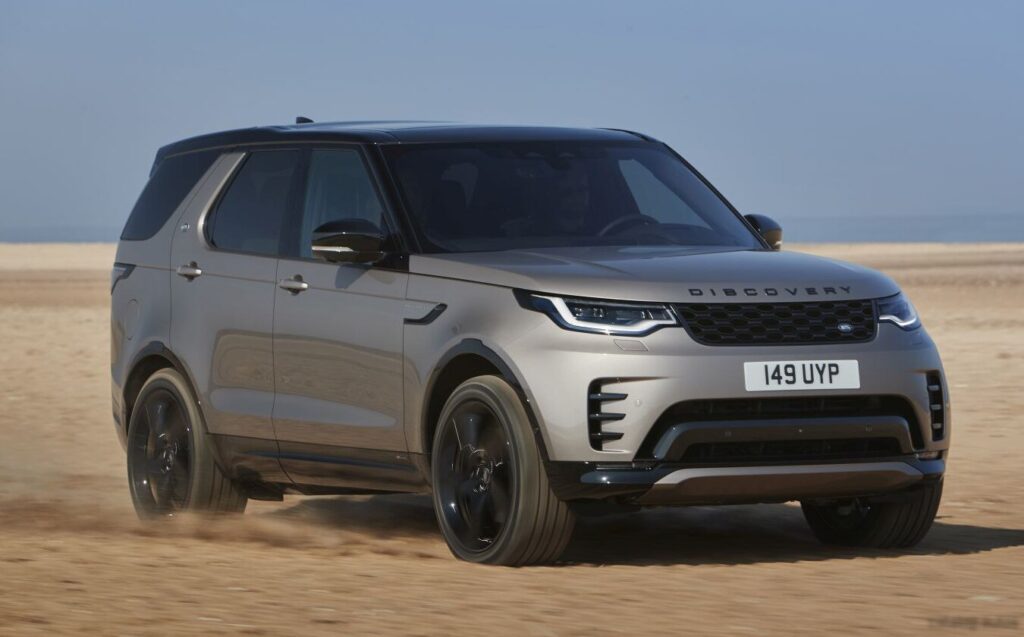
The Land Rover Discovery V, specifically the 2.0 P300 AWD Automatic variant introduced with the 2020 facelift, represents a significant shift in the model line’s powertrain strategy. Launched in November 2020, this version aimed to broaden the Discovery’s appeal by offering a more accessible entry point into the luxury SUV segment while still retaining the brand’s renowned off-road capability. Positioned as a mid-range offering, it slotted below the more powerful Ingenium six-cylinder options and the hybrid variants. The 2.0 P300 is built on the Premium Lightweight Architecture (PLA) platform, shared with other Jaguar Land Rover vehicles, and is primarily targeted towards buyers prioritizing fuel efficiency and a comfortable driving experience over outright performance.
Technical Specifications
| Brand | Land Rover |
| Model | Discovery |
| Generation | Discovery V (facelift 2020) |
| Type (Engine) | 2.0 P300 (300 Hp) AWD Automatic |
| Start of production | November, 2020 |
| Powertrain Architecture | Internal Combustion engine |
| Body type | SUV |
| Seats | 5 |
| Doors | 5 |
| Combined fuel consumption (WLTP) | 11.0-12.1 l/100 km (21.4 – 19.4 US mpg, 25.7 – 23.3 UK mpg, 9.1 – 8.3 km/l) |
| CO2 emissions (WLTP) | 248-273 g/km |
| Fuel consumption (NEDC, WLTP equivalent) | 9.1 l/100 km (25.8 US mpg, 31 UK mpg, 11 km/l) |
| CO2 emissions (NEDC, WLTP equivalent) | 207 g/km |
| Fuel Type | Petrol (Gasoline) |
| Acceleration 0 – 100 km/h | 7.3 sec |
| Acceleration 0 – 62 mph | 7.3 sec |
| Acceleration 0 – 60 mph | 6.9 sec |
| Maximum speed | 201 km/h (124.9 mph) |
| Emission standard | Euro 6d-F |
| Weight-to-power ratio | 7.2 kg/Hp, 139.1 Hp/tonne |
| Weight-to-torque ratio | 5.4 kg/Nm, 185.4 Nm/tonne |
| Power | 300 Hp @ 5500 rpm |
| Power per litre | 150.2 Hp/l |
| Torque | 400 Nm @ 1500-4500 rpm (295.02 lb.-ft. @ 1500-4500 rpm) |
| Engine layout | Front, Longitudinal |
| Engine Model/Code | Ingenium / PT204 |
| Engine displacement | 1997 cm3 (121.86 cu. in.) |
| Number of cylinders | 4 |
| Engine configuration | Inline |
| Cylinder Bore | 83 mm (3.27 in.) |
| Piston Stroke | 92.29 mm (3.63 in.) |
| Compression ratio | 9.5:1 |
| Number of valves per cylinder | 4 |
| Fuel injection system | Direct injection |
| Engine aspiration | Turbocharger, Intercooler |
| Engine oil capacity | 7 l (7.4 US qt | 6.16 UK qt) |
| Coolant | 14.7 l (15.53 US qt | 12.93 UK qt) |
| Kerb Weight | 2157 kg (4755.37 lbs.) |
| Trunk (boot) space – minimum | 1231 l (43.47 cu. ft.) |
| Trunk (boot) space – maximum | 2485 l (87.76 cu. ft.) |
| Fuel tank capacity | 90 l (23.78 US gal | 19.8 UK gal) |
| Permitted trailer load with brakes (12%) | 3000 kg (6613.87 lbs.) |
| Permitted trailer load without brakes | 750 kg (1653.47 lbs.) |
| Length | 4956 mm (195.12 in.) |
| Width | 2000 mm (78.74 in.) |
| Width with mirrors folded | 2073 mm (81.61 in.) |
| Width including mirrors | 2220 mm (87.4 in.) |
| Height | 1888 mm (74.33 in.) |
| Wheelbase | 2923 mm (115.08 in.) |
| Front track | 1692 mm (66.61 in.) |
| Rear (Back) track | 1687 mm (66.42 in.) |
| Front overhang | 858 mm (33.78 in.) |
| Rear overhang | 1175 mm (46.26 in.) |
| Ride height (ground clearance) | 283 mm (11.14 in.) |
| Drag coefficient (Cd) | 0.33 |
| Minimum turning circle (turning diameter) | 12.84 m (42.13 ft.) |
| Approach angle | 26-34° |
| Departure angle | 24.8-30° |
| Ramp-over (brakeover) angle | 21.2-27.5° |
| Climb angle | 45° |
| Wading depth | 900 mm (35.43 in.) |
| Drivetrain Architecture | The Internal combustion engine (ICE) drives permanently the four wheels of the vehicle. |
| Drive wheel | All wheel drive (4×4) |
| Number of gears and type of gearbox | 8 gears, automatic transmission |
| Front suspension | Double wishbone |
| Rear suspension | Independent multi-link suspension |
| Assisting systems | ABS (Anti-lock braking system) |
| Steering type | Steering rack and pinion |
| Power steering | Electric Steering |
| Tires size | 222/60 R19; 255/55 R20; 275/45 R21; 285/40 R22 |
| Wheel rims size | 7.5J x 19; 8.5J x 20; 9.5J x 21; 9.5J x 22 |
Powertrain & Engine Architecture
At the heart of the Discovery P300 lies the Ingenium engine family’s 2.0-liter turbocharged inline-four cylinder petrol engine, designated PT204. This engine utilizes direct fuel injection and a single twin-scroll turbocharger to deliver 300 horsepower at 5500 rpm and 400 Nm (295 lb-ft) of torque between 1500 and 4500 rpm. The engine features a relatively high compression ratio of 9.5:1, contributing to its efficiency. The engine is longitudinally mounted in the engine bay. The powertrain is paired with an eight-speed automatic transmission, a ZF 8HP45 unit known for its smooth shifts and efficiency. This transmission is standard across most Discovery variants, offering a balance between performance and fuel economy. The all-wheel-drive system is a full-time setup, providing enhanced traction in various conditions.
Driving Characteristics
The 2.0 P300 offers a comfortable and refined driving experience, prioritizing ease of use over sporty performance. Acceleration from 0-60 mph takes around 6.9 seconds, which is adequate for everyday driving but noticeably slower than the six-cylinder models. The eight-speed automatic transmission is well-tuned, providing smooth gear changes and contributing to a relaxed cruising experience. The gear ratios are optimized for fuel efficiency, meaning the engine can feel slightly strained during hard acceleration. Compared to the more powerful variants, the P300 requires more planning when overtaking or merging onto highways. However, the ample low-end torque from the turbocharger ensures responsive performance in most situations.
Equipment & Trim Levels
The 2.0 P300 typically came equipped with a generous amount of standard features, including leather upholstery, a touchscreen infotainment system with Apple CarPlay and Android Auto compatibility, automatic climate control, and a suite of safety features like autonomous emergency braking and lane departure warning. Higher trim levels offered upgrades such as premium leather, heated and ventilated seats, a panoramic sunroof, and a more advanced sound system. Optional extras included adaptive cruise control, a head-up display, and various off-road packages designed to enhance the vehicle’s all-terrain capabilities.
Chassis & Braking
The Discovery P300 utilizes a double-wishbone front suspension and an independent multi-link rear suspension, providing a comfortable ride quality both on and off-road. The suspension is tuned to prioritize comfort, but it also offers good body control in corners. Braking duties are handled by ventilated disc brakes on all four wheels, providing ample stopping power. ABS (Anti-lock Braking System) is standard, along with electronic brake-force distribution and brake assist. The vehicle’s weight, around 2157 kg (4755 lbs), is relatively high, which impacts handling and braking performance to some extent.
Market Reception & Comparison
The 2.0 P300 was generally well-received by critics as a sensible and practical option for buyers who didn’t require the outright performance of the higher-end models. Fuel economy, averaging around 21.4-19.4 US mpg, was a key selling point, making it more attractive to those concerned about running costs. Compared to the 3.0-liter six-cylinder variants, the P300 offered a lower price point but sacrificed performance. The 2.0-liter engine was also considered more reliable than some of the earlier Land Rover engines, although long-term reliability data is still being gathered. Against competitors like the BMW X5 and Audi Q7, the Discovery P300 offered a unique blend of luxury, off-road capability, and practicality.
Legacy
The 2.0 P300 variant of the Discovery V represents Land Rover’s attempt to broaden the appeal of its flagship SUV. While not as iconic as some of the earlier Discovery models, it has become a popular choice in the used car market due to its relatively affordable price and good fuel economy. The Ingenium engine has proven to be a reliable unit, and the eight-speed automatic transmission is known for its durability. As with any Land Rover, regular maintenance is crucial to ensure long-term reliability, but the P300 offers a compelling package for buyers seeking a luxurious and capable SUV.