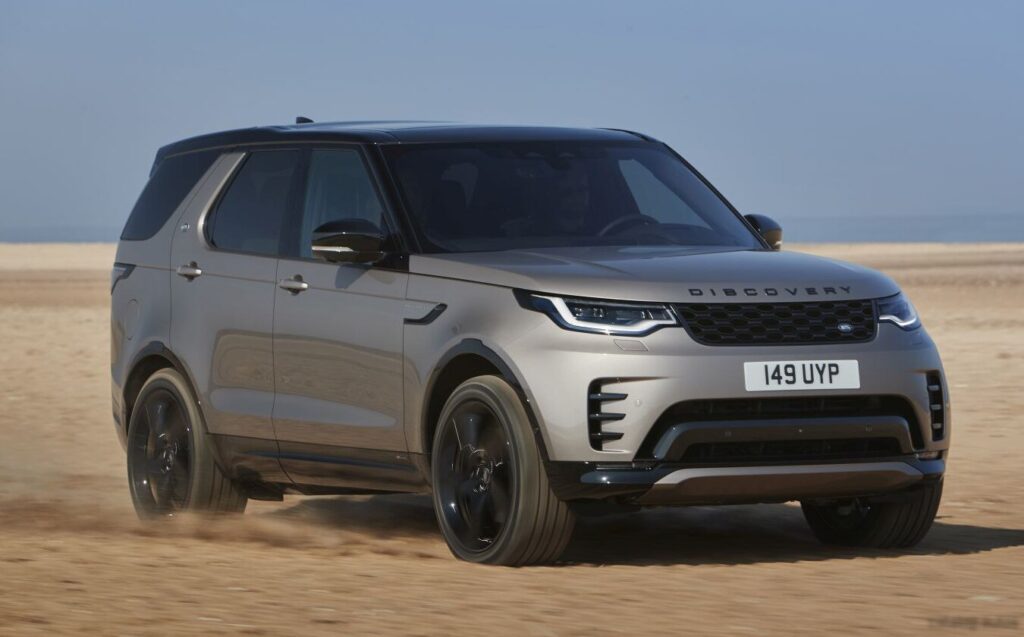
The Land Rover Discovery V, specifically the 3.0 D300 variant introduced with the 2020 facelift, represents a significant evolution of the fifth-generation Discovery (L550). Production ran from November 2020 through 2024. This model blends luxury, off-road capability, and now, mild-hybrid technology, positioning itself as a versatile premium SUV. The D300 trim sits towards the higher end of the Discovery V lineup, offering a substantial power upgrade over the base Ingenium engines while remaining below the more performance-focused models. It’s designed to appeal to buyers seeking a balance of refinement, towing capacity, and fuel efficiency.
Technical Specifications
| Brand | Land Rover |
| Model | Discovery |
| Generation | Discovery V (facelift 2020) |
| Type | 3.0 D300 (300 Hp) Mild Hybrid AWD Automatic |
| Start of production | November, 2020 |
| End of production | 2024 |
| Powertrain Architecture | MHEV (Mild Hybrid Electric Vehicle) |
| Body type | SUV |
| Seats | 5 |
| Doors | 5 |
| Combined fuel consumption (WLTP) | 8.3-8.8 l/100 km (28.3 – 26.7 US mpg) |
| CO2 emissions (WLTP) | 216-230 g/km |
| Fuel consumption (NEDC, WLTP equivalent) | 7.3 l/100 km (32.2 US mpg) |
| CO2 emissions (NEDC, WLTP equivalent) | 194 g/km |
| Fuel Type | Diesel |
| Acceleration 0 – 100 km/h | 6.8 sec |
| Acceleration 0 – 62 mph | 6.8 sec |
| Acceleration 0 – 60 mph | 6.5 sec |
| Maximum speed | 209 km/h (129.87 mph) |
| Emission standard | Euro 6d-F |
| Weight-to-power ratio | 7.7 kg/Hp |
| Weight-to-torque ratio | 3.6 kg/Nm |
| Power | 300 Hp @ 4000 rpm |
| Torque | 650 Nm @ 1500-2500 rpm (479.42 lb.-ft. @ 1500-2500 rpm) |
| Engine layout | Front, Longitudinal |
| Engine Model/Code | Ingenium / DT306 |
| Engine displacement | 2996 cm3 (182.83 cu. in.) |
| Number of cylinders | 6 |
| Engine configuration | Inline |
| Cylinder Bore | 83 mm (3.27 in.) |
| Piston Stroke | 92.31 mm (3.63 in.) |
| Compression ratio | 15.5:1 |
| Number of valves per cylinder | 4 |
| Fuel injection system | Diesel Commonrail |
| Engine aspiration | Turbocharger, Intercooler |
| Engine oil capacity | 9.8 l (10.36 US qt | 8.62 UK qt) |
| Kerb Weight | 2311 kg (5094.88 lbs.) |
| Trunk (boot) space – minimum | 1231 l (43.47 cu. ft.) |
| Trunk (boot) space – maximum | 2485 l (87.76 cu. ft.) |
| Fuel tank capacity | 89 l (23.51 US gal | 19.58 UK gal) |
| AdBlue tank | 18 l (4.76 US gal | 3.96 UK gal) |
| Permitted trailer load with brakes (12%) | 3500 kg (7716.18 lbs.) |
| Permitted trailer load without brakes | 750 kg (1653.47 lbs.) |
| Length | 4956 mm (195.12 in.) |
| Width | 2000 mm (78.74 in.) |
| Width with mirrors folded | 2073 mm (81.61 in.) |
| Width including mirrors | 2220 mm (87.4 in.) |
| Height | 1888 mm (74.33 in.) |
| Wheelbase | 2923 mm (115.08 in.) |
| Front track | 1692 mm (66.61 in.) |
| Rear (Back) track | 1687 mm (66.42 in.) |
| Front overhang | 858 mm (33.78 in.) |
| Rear overhang | 1175 mm (46.26 in.) |
| Ride height (ground clearance) | 283 mm (11.14 in.) |
| Drag coefficient (Cd) | 0.35 |
| Minimum turning circle (turning diameter) | 12.84 m (42.13 ft.) |
| Approach angle | 26-34° |
| Departure angle | 24.8-30° |
| Ramp-over (brakeover) angle | 21.2-27.5° |
| Climb angle | 45° |
| Wading depth | 900 mm (35.43 in.) |
| Drivetrain Architecture | ICE and electric motor permanently drive all four wheels. |
| Drive wheel | All wheel drive (4×4) |
| Number of gears and type of gearbox | 8 gears, automatic transmission |
| Front suspension | Double wishbone |
| Rear suspension | Independent multi-link suspension |
| Assisting systems | ABS (Anti-lock braking system) |
| Steering type | Steering rack and pinion |
| Power steering | Electric Steering |
| Tires size | 222/60 R19; 255/55 R20; 275/45 R21; 285/40 R22 |
| Wheel rims size | 7.5J x 19; 8.5J x 20; 9.5J x 21; 9.5J x 22 |
INTRODUCTION
The Land Rover Discovery V facelift, launched in November 2020, brought a refreshed design and updated technology to the popular SUV. The 3.0 D300 variant, powered by the Ingenium engine, is a key component of this update. It builds upon the foundation of the L550 platform (shared with the Range Rover Velar and Jaguar F-Pace) and aims to deliver a more refined and efficient driving experience. This trim level is positioned as a sweet spot in the range, offering significant performance without the premium price tag of the higher-spec models. The introduction of mild-hybrid technology further enhances fuel economy and reduces emissions.
Powertrain & Engine Architecture
At the heart of the D300 is Land Rover’s 3.0-liter inline-six cylinder Ingenium diesel engine, designated DT306. This engine utilizes a sophisticated diesel commonrail fuel injection system and a single turbocharger with an intercooler. The key feature of this engine is its mild-hybrid (MHEV) system. A 48-volt electrical system powers an integrated starter generator (ISG) which assists the engine during acceleration, allowing for smoother starts and improved fuel efficiency. The ISG also enables regenerative braking, capturing energy during deceleration to recharge the battery. The engine produces 300 horsepower at 4000 rpm and a substantial 650 Nm (479.42 lb.-ft.) of torque between 1500 and 2500 rpm. The engine features a high compression ratio of 15.5:1. The engine is longitudinally mounted, driving all four wheels through an eight-speed automatic transmission developed by ZF. This transmission is known for its smooth shifting and wide gear ratios, optimized for both on-road comfort and off-road capability.
Driving Characteristics
The 3.0 D300 offers a compelling blend of performance and refinement. The mild-hybrid system provides a noticeable boost in responsiveness, particularly during initial acceleration. The eight-speed automatic transmission is well-tuned, providing smooth and timely gear changes. While not as overtly sporty as some competitors, the Discovery D300 delivers ample power for confident overtaking and effortless cruising. Compared to the lower-powered Ingenium engines (like the D200 or D240), the D300 feels significantly more capable, especially when fully loaded or towing. The gear ratios are optimized for both fuel efficiency and towing capacity. The automatic transmission, while smooth, isn’t as quick to downshift as some performance-oriented gearboxes, but it’s perfectly adequate for most driving situations. The all-wheel-drive system provides excellent traction in various conditions, making it a capable off-roader as well.
Equipment & Trim Levels
The D300 trim typically includes a generous level of standard equipment. This generally includes leather upholstery, heated front seats, a touchscreen infotainment system with Apple CarPlay and Android Auto compatibility, a panoramic sunroof, and a suite of advanced driver-assistance systems (ADAS) such as adaptive cruise control, lane keep assist, and automatic emergency braking. Optional extras could include premium audio systems, upgraded leather trim, rear seat entertainment, and advanced off-road packages. The interior design is modern and luxurious, with a focus on practicality and comfort. The dashboard layout is clean and intuitive, with a central touchscreen controlling most vehicle functions.
Chassis & Braking
The Discovery V utilizes a robust chassis designed for both on-road comfort and off-road durability. The front suspension features a double wishbone setup, while the rear employs an independent multi-link suspension. This configuration provides a comfortable ride and good handling characteristics. The D300 variant typically features larger brakes than the lower-spec models, providing ample stopping power. Disc brakes are fitted on all four wheels. The electronic stability control (ESC) system is integrated with the all-wheel-drive system to enhance stability and control in challenging conditions. Stabilizer bars are fitted front and rear to reduce body roll during cornering.
Market Reception & Comparison
The Land Rover Discovery V D300 was generally well-received by automotive critics. It was praised for its refined engine, comfortable ride, and spacious interior. The mild-hybrid system was also noted as a positive addition, improving fuel economy without compromising performance. Compared to the lower-powered Discovery variants, the D300 offered a significant performance upgrade, making it a more appealing option for buyers who frequently tow or carry heavy loads. However, some critics noted that the Discovery’s fuel economy, even with the mild-hybrid system, wasn’t class-leading. Compared to competitors like the BMW X5 or Audi Q7, the Discovery offered a more rugged and off-road-focused experience, but potentially at the expense of on-road agility.
Legacy
The Ingenium engine family, including the DT306, has proven to be relatively reliable, although some owners have reported issues with the diesel particulate filter (DPF) and the AdBlue system, particularly on vehicles used primarily for short journeys. The mild-hybrid system has also generally proven durable. On the used car market, the Discovery V D300 holds its value reasonably well, reflecting its desirable combination of luxury, performance, and capability. Regular maintenance, including oil changes and filter replacements, is crucial for ensuring the long-term reliability of this powertrain. The D300 represents a significant step forward in Land Rover’s efforts to improve fuel efficiency and reduce emissions while maintaining the brand’s reputation for off-road prowess.