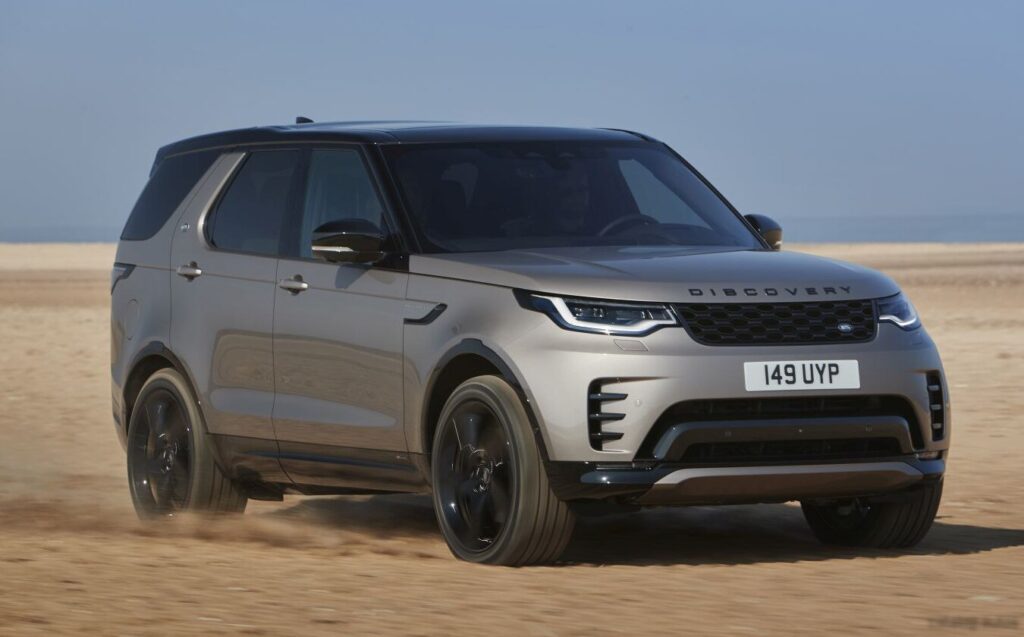
The Land Rover Discovery V, specifically the 3.0 D300 variant introduced with the 2020 facelift, represents a significant evolution of the fifth-generation Discovery (L550) series. Production ran from November 2020 through 2024. This model combines a potent diesel engine with mild-hybrid technology, all-wheel drive, and an eight-speed automatic transmission, offering a blend of performance, efficiency, and practicality within the luxury SUV segment. Positioned as a mid-to-high range trim, the D300 caters to buyers seeking substantial power and towing capacity without sacrificing the refinement expected of the Discovery nameplate. It sits above the lower-powered diesel options (like the D200 and D250) and below potential future high-performance variants.
Technical Specifications
| Brand | Land Rover |
| Model | Discovery |
| Generation | Discovery V (facelift 2020) |
| Type | 3.0 D300 (300 Hp) Mild Hybrid AWD Automatic 7 Seat |
| Start of production | November, 2020 |
| End of production | 2024 |
| Powertrain Architecture | MHEV (Mild Hybrid Electric Vehicle) |
| Body type | SUV |
| Seats | 7 |
| Doors | 5 |
| Combined fuel consumption (WLTP) | 8.3-8.9 l/100 km (28.3 – 26.4 US mpg) |
| CO2 emissions (WLTP) | 218-232 g/km |
| Fuel consumption (NEDC) | 7.4 l/100 km (31.8 US mpg) |
| CO2 emissions (NEDC) | 194 g/km |
| Fuel Type | Diesel |
| Acceleration 0 – 100 km/h | 6.8 sec |
| Acceleration 0 – 62 mph | 6.8 sec |
| Acceleration 0 – 60 mph | 6.5 sec |
| Maximum speed | 209 km/h (129.87 mph) |
| Emission standard | Euro 6d-F |
| Weight-to-power ratio | 7.9 kg/Hp |
| Weight-to-torque ratio | 3.6 kg/Nm |
| Power | 300 Hp @ 4000 rpm |
| Torque | 650 Nm @ 1500-2500 rpm (479.42 lb.-ft.) |
| Engine layout | Front, Longitudinal |
| Engine Model/Code | Ingenium / DT306 |
| Engine displacement | 2996 cm3 (182.83 cu. in.) |
| Number of cylinders | 6 |
| Engine configuration | Inline |
| Cylinder Bore | 83 mm (3.27 in.) |
| Piston Stroke | 92.31 mm (3.63 in.) |
| Compression ratio | 15.5:1 |
| Number of valves per cylinder | 4 |
| Fuel injection system | Diesel Commonrail |
| Engine aspiration | Turbocharger, Intercooler |
| Engine oil capacity | 9.8 l (10.36 US qt | 8.62 UK qt) |
| Kerb Weight | 2362 kg (5207.32 lbs.) |
| Trunk (boot) space – minimum | 258 l (9.11 cu. ft.) |
| Trunk (boot) space – maximum | 2391 l (84.44 cu. ft.) |
| Fuel tank capacity | 89 l (23.51 US gal | 19.58 UK gal) |
| AdBlue tank | 18 l (4.76 US gal | 3.96 UK gal) |
| Permitted trailer load with brakes (12%) | 3500 kg (7716.18 lbs.) |
| Permitted trailer load without brakes | 750 kg (1653.47 lbs.) |
| Length | 4956 mm (195.12 in.) |
| Width | 2000 mm (78.74 in.) |
| Width with mirrors folded | 2073 mm (81.61 in.) |
| Width including mirrors | 2220 mm (87.4 in.) |
| Height | 1888 mm (74.33 in.) |
| Wheelbase | 2923 mm (115.08 in.) |
| Front track | 1692 mm (66.61 in.) |
| Rear track | 1687 mm (66.42 in.) |
| Ride height (ground clearance) | 283 mm (11.14 in.) |
| Drag coefficient (Cd) | 0.35 |
| Minimum turning circle | 12.84 m (42.13 ft.) |
| Front suspension | Double wishbone |
| Rear suspension | Independent multi-link suspension |
| Tires size | 222/60 R19; 255/55 R20; 275/45 R21; 285/40 R22 |
| Wheel rims size | 7.5J x 19; 8.5J x 20; 9.5J x 21; 9.5J x 22 |
Powertrain & Engine Architecture
The heart of the Discovery D300 is Land Rover’s Ingenium engine family, specifically the DT306, a 3.0-liter inline-six cylinder diesel. This engine benefits from a sophisticated turbocharging system and direct injection, delivering a substantial 300 horsepower at 4000 rpm and a robust 650 Nm (479.42 lb.-ft.) of torque between 1500 and 2500 rpm. The ‘MHEV’ designation indicates a 48-volt mild-hybrid system. This system utilizes a Belt-integrated Starter Generator (BSG) to provide power assistance during acceleration, enabling smoother starts and improved fuel economy. The BSG also facilitates extended stop/start functionality. The engine employs a diesel commonrail fuel injection system, optimized for efficient combustion and reduced emissions. The eight-speed automatic transmission, sourced from ZF, is a crucial component, providing smooth and responsive gear changes. It’s calibrated to work seamlessly with the engine’s torque curve, offering both comfortable cruising and capable off-road performance.
Driving Characteristics
The D300 offers a compelling driving experience, balancing power and refinement. The readily available torque from the Ingenium engine provides strong acceleration, with a 0-60 mph time of around 6.5 seconds. While not a sports SUV, the D300 feels confident and composed on the road. The eight-speed automatic transmission contributes to relaxed highway cruising, while also providing quick downshifts when needed. Compared to the lower-powered diesel variants, the D300 offers a noticeable performance advantage, particularly when fully loaded or towing. The mild-hybrid system enhances responsiveness, minimizing turbo lag and providing a more linear power delivery. Compared to a potential petrol variant, the D300 prioritizes torque and fuel efficiency over outright horsepower.
Equipment & Trim Levels
The D300 trim typically includes a high level of standard equipment. This generally encompasses leather upholstery, heated front seats, a touchscreen infotainment system with navigation, Apple CarPlay and Android Auto compatibility, a premium sound system, and a suite of advanced driver-assistance systems (ADAS) such as adaptive cruise control, lane keep assist, and automatic emergency braking. Optional extras could include a panoramic sunroof, upgraded leather trim, rear-seat entertainment, and advanced off-road packages. The interior design emphasizes luxury and practicality, with ample space for passengers and cargo. The seven-seat configuration provides versatility for families.
Chassis & Braking
The Discovery V utilizes a robust chassis designed for both on-road comfort and off-road capability. It features double-wishbone front suspension and an independent multi-link rear suspension, providing a smooth and controlled ride. Air suspension is often standard on D300 models, allowing for adjustable ride height and improved off-road articulation. The braking system typically consists of ventilated disc brakes on all four wheels, coupled with ABS, electronic brakeforce distribution (EBD), and brake assist. The D300’s weight (2362 kg / 5207.32 lbs) necessitates a capable braking system to ensure safe and confident stopping power.
Market Reception & Comparison
The Land Rover Discovery D300 was generally well-received by automotive critics. Praise was directed towards its powerful engine, refined ride quality, and spacious interior. Fuel economy, while respectable for a vehicle of its size and capability (8.3-8.9 l/100 km), was a common point of discussion, with some reviewers noting that it could be improved. Compared to the D200 and D250 variants, the D300 offered a significant performance upgrade, justifying its higher price point for buyers prioritizing power and towing capacity. It competed with other luxury SUVs such as the BMW X5, Audi Q7, and Volvo XC90.
Legacy
The Ingenium engine family, including the DT306, has proven to be relatively reliable, although preventative maintenance is crucial, particularly regarding the diesel particulate filter (DPF) and AdBlue system. The mild-hybrid system adds a layer of complexity, but has generally demonstrated good durability. On the used car market, the Discovery D300 holds its value reasonably well, appealing to buyers seeking a capable and luxurious SUV with a proven powertrain. Its combination of performance, practicality, and refinement ensures its continued desirability in the years to come.