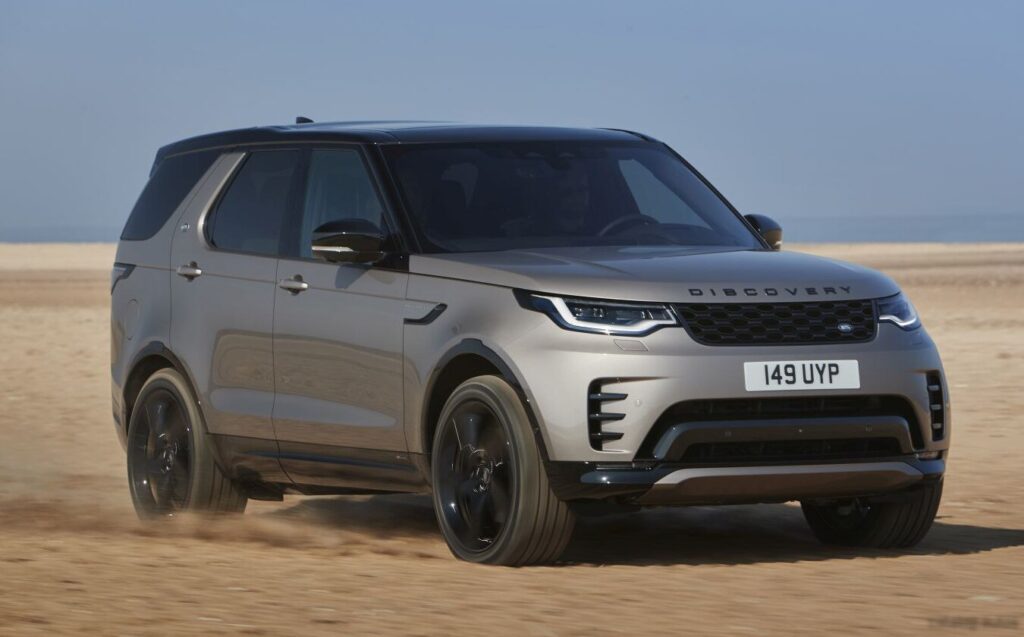
The Land Rover Discovery V, specifically the 3.0 D350 variant introduced with the 2020 facelift, represents a significant evolution in the Discovery lineage. Production began in May 2024, building upon the fifth-generation Discovery (L462) launched in 2017. This model year brought substantial updates to technology, styling, and powertrain options, with the D350 positioned as a high-performance diesel offering within the range. It slots in above the D250 and D300 models, offering increased power and torque for those prioritizing towing capacity and effortless performance. The D350 utilizes a mild-hybrid system, enhancing fuel efficiency and refinement while maintaining the robust off-road capability expected of a Land Rover.
Technical Specifications
| Brand | Land Rover |
| Model | Discovery |
| Generation | Discovery V (facelift 2020) |
| Type (Engine) | 3.0 D350 (350 Hp) Mild Hybrid AWD Automatic |
| Start of production | May, 2024 |
| Powertrain Architecture | MHEV (Mild Hybrid Electric Vehicle) |
| Body type | SUV |
| Seats | 5 |
| Doors | 5 |
| Combined fuel consumption (WLTP) | 8-8.5 l/100 km (29.4 – 27.7 US mpg, 35.3 – 33.2 UK mpg, 12.5 – 11.8 km/l) |
| CO2 emissions (WLTP) | 209-223 g/km |
| Fuel Type | Diesel |
| Acceleration 0 – 100 km/h | 6.3 sec |
| Acceleration 0 – 62 mph | 6.3 sec |
| Acceleration 0 – 60 mph | 5.9 sec |
| Maximum speed | 209 km/h (129.87 mph) |
| Emission standard | Euro 6e |
| Weight-to-power ratio | 6.6 kg/Hp, 151.1 Hp/tonne |
| Weight-to-torque ratio | 3.3 kg/Nm, 302.2 Nm/tonne |
| Battery voltage | 48 V |
| Battery technology | Lithium-ion (Li-Ion) |
| Power | 350 Hp @ 4000 rpm |
| Power per litre | 116.8 Hp/l |
| Torque | 700 Nm @ 1500-3000 rpm (516.29 lb.-ft. @ 1500-3000 rpm) |
| Engine layout | Front, Longitudinal |
| Engine Model/Code | Ingenium |
| Engine displacement | 2997 cm3 (182.89 cu. in.) |
| Number of cylinders | 6 |
| Engine configuration | Inline |
| Cylinder Bore | 83 mm (3.27 in.) |
| Piston Stroke | 92.3 mm (3.63 in.) |
| Compression ratio | 15.5:1 |
| Number of valves per cylinder | 4 |
| Fuel injection system | Diesel Commonrail |
| Engine aspiration | BiTurbo, Intercooler |
| Valvetrain | DOHC |
| Kerb Weight | 2316 kg (5105.91 lbs.) |
| Max. weight | 3080 kg (6790.24 lbs.) |
| Max load | 764 kg (1684.33 lbs.) |
| Trunk (boot) space – minimum | 986 l (34.82 cu. ft.) |
| Trunk (boot) space – maximum | 2061 l (72.78 cu. ft.) |
| Fuel tank capacity | 89 l (23.51 US gal | 19.58 UK gal) |
| AdBlue tank | 18 l (4.76 US gal | 3.96 UK gal) |
| Max. roof load | 80 kg (176.37 lbs.) |
| Permitted trailer load with brakes (12%) | 3500 kg (7716.18 lbs.) |
| Permitted trailer load without brakes | 750 kg (1653.47 lbs.) |
| Permitted towbar download | 150 kg (330.69 lbs.) |
| Length | 4956 mm (195.12 in.) |
| Width with mirrors folded | 2073 mm (81.61 in.) |
| Width including mirrors | 2220 mm (87.4 in.) |
| Height | 1888 mm (74.33 in.) |
| Wheelbase | 2923 mm (115.08 in.) |
| Front track | 1692 mm (66.61 in.) |
| Rear (Back) track | 1687 mm (66.42 in.) |
| Ride height (ground clearance) | 207-285 mm (8.15 – 11.22 in.) |
| Minimum turning circle (turning diameter) | 12.84 m (42.13 ft.) |
| Approach angle | 26-33.6° |
| Departure angle | 24.8-30° |
| Ramp-over (brakeover) angle | 21.2-27.5° |
| Wading depth | 900 mm (35.43 in.) |
| Drivetrain Architecture | ICE and electric motor permanently drive all four wheels. |
| Drive wheel | All wheel drive (4×4) |
| Number of gears and type of gearbox | 8 gears, automatic transmission |
| Front suspension | Double wishbone, Transverse stabilizer, Air suspension |
| Rear suspension | Independent multi-link suspension, Air suspension, Transverse stabilizer |
| Front brakes | Ventilated discs, 380 mm |
| Rear brakes | Ventilated discs, 365 mm |
| Steering type | Steering rack and pinion |
| Power steering | Electric Steering |
| Tires size | 255/55 R20; 275/45 R21; 285/40 R22 |
| Wheel rims size | 8.5J x 20; 9.5J x 21; 9.5J x 22 |
Powertrain & Engine Architecture
The heart of the D350 is Land Rover’s Ingenium 3.0-liter inline-six diesel engine. This engine, designated as part of the Ingenium family, is characterized by its modular design and advanced technologies. The engine utilizes a sophisticated twin-turbocharger setup, along with a diesel commonrail fuel injection system, delivering a broad torque curve and responsive power delivery. The 48V mild-hybrid system incorporates a Belt-integrated Starter Generator (BiSG) which assists the engine during acceleration, captures energy during deceleration, and enables smoother start-stop operation. This system contributes to improved fuel economy and reduced emissions. The engine boasts a high compression ratio of 15.5:1 and a DOHC valvetrain, optimizing combustion efficiency. The engine is longitudinally mounted in the chassis, driving all four wheels through an eight-speed automatic transmission.
Driving Characteristics
The 350 horsepower and 700 Nm (516 lb-ft) of torque provide the Discovery D350 with strong acceleration and effortless cruising ability. The eight-speed automatic transmission is well-tuned, offering smooth and timely gear changes. While not as overtly sporty as some competitors, the D350 delivers a composed and refined driving experience. The mild-hybrid system provides a noticeable boost during initial acceleration, enhancing responsiveness. Compared to the lower-powered D250 and D300 variants, the D350 offers significantly more performance, particularly when fully loaded or towing. The gear ratios are optimized for both on-road comfort and off-road capability, providing ample torque in low ranges for challenging terrain.
Equipment & Trim Levels
The D350 trim typically includes a high level of standard equipment. This includes leather upholstery, heated front seats, a touchscreen infotainment system with navigation, a premium sound system, and a suite of advanced driver-assistance systems (ADAS) such as adaptive cruise control, lane keep assist, and automatic emergency braking. Optional extras often include a panoramic sunroof, upgraded leather trim, rear seat entertainment, and advanced off-road packages. The interior design emphasizes luxury and practicality, with ample space for passengers and cargo.
Chassis & Braking
The Discovery V utilizes a robust aluminum-intensive monocoque chassis, contributing to its strength and relatively low weight. The suspension system features double wishbones at the front and an independent multi-link setup at the rear, both incorporating air suspension. This allows for adjustable ride height and improved off-road capability. The D350 is equipped with ventilated disc brakes on all four wheels, providing ample stopping power. Front brake discs measure 380mm, while rear discs are 365mm. The electronic stability control (ESC) system and anti-lock braking system (ABS) work in conjunction to enhance safety and control.
Market Reception & Comparison
The Land Rover Discovery D350 was generally well-received by automotive critics. Praise was given for its powerful engine, refined ride quality, and luxurious interior. However, some reviewers noted the relatively high price point compared to competitors. Compared to the D250, the D350 offered a substantial performance upgrade, justifying the price premium for those needing extra power. Fuel economy, while improved by the mild-hybrid system, remained a consideration for some buyers. Reliability reports have been mixed, with some owners reporting issues with the infotainment system and air suspension.
Legacy
The Ingenium engine family, including the 3.0-liter diesel used in the D350, has become a mainstay of the Land Rover and Jaguar lineups. The mild-hybrid technology introduced with this model represents a step towards electrification and improved fuel efficiency. On the used car market, the D350 commands a premium over lower-powered variants, reflecting its performance and equipment levels. Proper maintenance, particularly regarding the air suspension and diesel particulate filter, is crucial for long-term reliability. The D350 remains a desirable option for those seeking a capable, comfortable, and well-equipped luxury SUV.