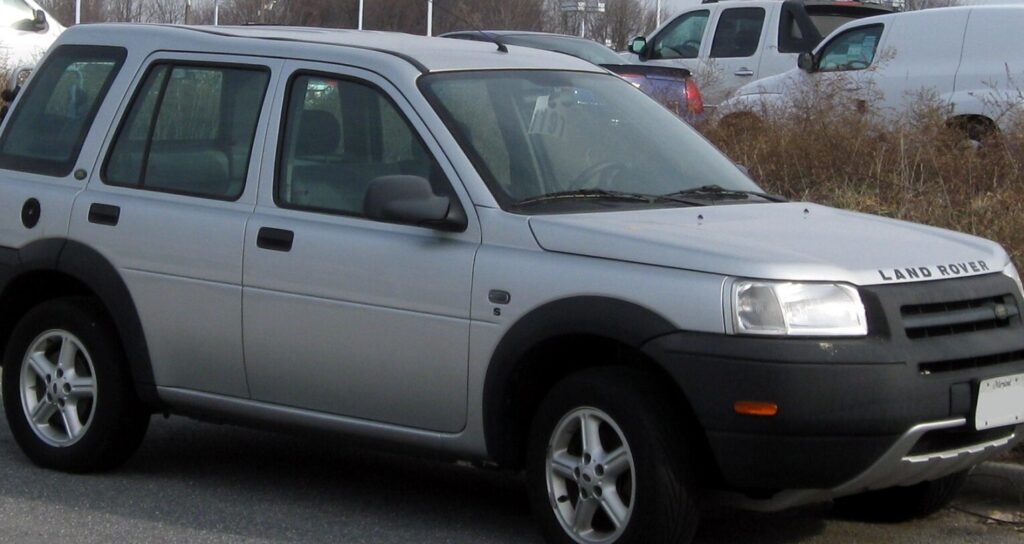
The Land Rover Freelander I, launched in 1998, represented a significant step for the British marque, being their first foray into the compact SUV segment. The 1.8 i 16V variant, produced from 1998 to 2001, served as the entry point into the Freelander range, offering a more affordable option compared to the more powerful V6 models. Positioned as a practical and capable vehicle for both on-road and light off-road use, the 1.8L model aimed to broaden the Freelander’s appeal to a wider customer base, particularly in Europe where smaller displacement engines were favored. It was built on the 1HX0/A3 platform, shared with other Rover Group products.
Technical Specifications
| Brand | Land Rover |
| Model | Freelander |
| Generation | Freelander I (LN) |
| Type (Engine) | 1.8 i 16V (120 Hp) |
| Start of production | 1998 |
| End of production | 2001 |
| Powertrain Architecture | Internal Combustion engine |
| Body type | SUV |
| Seats | 5 |
| Doors | 5 |
| Fuel consumption (urban) | 13 l/100 km (18.1 US mpg, 21.7 UK mpg, 7.7 km/l) |
| Fuel consumption (extra urban) | 8.6 l/100 km (27.4 US mpg, 32.8 UK mpg, 11.6 km/l) |
| Fuel consumption (combined) | 9.8 l/100 km (24 US mpg, 28.8 UK mpg, 10.2 km/l) |
| Fuel Type | Petrol (Gasoline) |
| Acceleration 0 – 100 km/h | 11.9 sec |
| Acceleration 0 – 62 mph | 11.9 sec |
| Acceleration 0 – 60 mph | 11.3 sec |
| Maximum speed | 165 km/h (102.53 mph) |
| Weight-to-power ratio | 11.5 kg/Hp, 87 Hp/tonne |
| Weight-to-torque ratio | 8.4 kg/Nm, 119.6 Nm/tonne |
| Power | 120 Hp @ 5550 rpm |
| Power per litre | 66.8 Hp/l |
| Torque | 165 Nm @ 2750 rpm (121.7 lb.-ft. @ 2750 rpm) |
| Engine layout | Front, Transverse |
| Engine Model/Code | 18K4F |
| Engine displacement | 1796 cm3 (109.6 cu. in.) |
| Number of cylinders | 4 |
| Engine configuration | Inline |
| Cylinder Bore | 80 mm (3.15 in.) |
| Piston Stroke | 89.3 mm (3.52 in.) |
| Compression ratio | 10.5:1 |
| Number of valves per cylinder | 4 |
| Fuel injection system | Multi-port manifold injection |
| Engine aspiration | Naturally aspirated engine |
| Valvetrain | DOHC |
| Engine oil capacity | 4.5 l (4.76 US qt | 3.96 UK qt) |
| Coolant capacity | 5.5 l (5.81 US qt | 4.84 UK qt) |
| Kerb Weight | 1380 kg (3042.38 lbs.) |
| Max. weight | 1960 kg (4321.06 lbs.) |
| Max load | 580 kg (1278.68 lbs.) |
| Trunk (boot) space – minimum | 370 l (13.07 cu. ft.) |
| Trunk (boot) space – maximum | 1315 l (46.44 cu. ft.) |
| Fuel tank capacity | 59 l (15.59 US gal | 12.98 UK gal) |
| Length | 4382 mm (172.52 in.) |
| Width | 1805 mm (71.06 in.) |
| Height | 1760 mm (69.29 in.) |
| Wheelbase | 2560 mm (100.79 in.) |
| Front track | 1535 mm (60.43 in.) |
| Rear (Back) track | 1545 mm (60.83 in.) |
| Drive wheel | All wheel drive (4×4) |
| Number of gears and type of gearbox | 5 gears, manual transmission |
| Front suspension | Coil spring |
| Rear suspension | Coil spring |
| Front brakes | Ventilated discs |
| Rear brakes | Drum |
| Assisting systems | ABS (Anti-lock braking system) |
| Steering type | Steering rack and pinion |
| Power steering | Hydraulic Steering |
| Tires size | 195/80 R15 |
Powertrain & Engine Architecture
The Freelander 1.8 i 16V utilized the 18K4F engine, a 1.8-liter inline-four cylinder petrol engine. This engine was part of the Rover K-series family, known for its compact size and relatively lightweight construction. The 18K4F featured a multi-port fuel injection system and a double overhead camshaft (DOHC) valvetrain, operating with four valves per cylinder. This configuration helped to deliver a reasonable amount of power for its displacement. The engine produced 120 horsepower at 5550 rpm and 165 Nm (121.7 lb-ft) of torque at 2750 rpm. The engine’s relatively low compression ratio of 10.5:1 was a design choice aimed at accommodating lower octane fuels commonly available in many markets. The 1.8L Freelander was typically paired with a five-speed manual transmission, although an optional automatic transmission was also available. The automatic transmission, while offering convenience, did impact acceleration and fuel economy.
Driving Characteristics
The 1.8L Freelander, particularly with the manual transmission, offered a reasonably engaging driving experience for its class. However, with 120 hp propelling a vehicle weighing around 1380 kg (3042 lbs), acceleration was not its strong suit. The 0-60 mph time was around 11.3 seconds, and top speed was limited to 165 km/h (102.53 mph). The automatic transmission further dulled performance, increasing the 0-60 mph time to around 11.9 seconds. The engine felt somewhat strained when accelerating hard, requiring frequent downshifts to maintain momentum. The Freelander’s permanent four-wheel drive system provided good traction on slippery surfaces, making it a capable vehicle in inclement weather. However, it wasn’t designed for serious off-roading. The suspension provided a comfortable ride on paved roads, but could feel somewhat bouncy when encountering larger bumps.
Equipment & Trim Levels
The 1.8 i 16V Freelander typically came with a fairly basic level of equipment, reflecting its position as the entry-level model. Standard features included power steering, central locking, electric front windows, and an AM/FM radio. Interior upholstery was typically cloth, and the dashboard featured a relatively simple design. Optional extras included air conditioning, alloy wheels, a sunroof, and upgraded audio systems. Higher trim levels, such as the ‘X’ or ‘SE’ variants, added more features as standard, such as leather upholstery, climate control, and more sophisticated audio systems. The 1.8L models were often seen as a practical choice for buyers who prioritized affordability and fuel economy over luxury features.
Chassis & Braking
The Freelander I featured an independent suspension system all around, utilizing coil springs and MacPherson struts at the front and a multi-link setup at the rear. This suspension design provided a good balance between ride comfort and handling. Braking duties were handled by ventilated discs at the front and drum brakes at the rear. Anti-lock Braking System (ABS) was standard, enhancing safety by preventing wheel lockup during hard braking. The steering system was a rack and pinion type with hydraulic power assistance, providing precise and responsive steering feel. The 1.8L models typically used 195/80 R15 tires, which offered a good compromise between comfort and grip.
Market Reception & Comparison
The 1.8L Freelander received mixed reviews from automotive critics. While praised for its practicality, spacious interior, and capable four-wheel drive system, it was often criticized for its lack of outright performance. Compared to the V6 models, the 1.8L felt noticeably slower and less refined. However, it offered significantly better fuel economy, with combined fuel consumption figures around 9.8 l/100 km (24 US mpg). The 1.8L also proved to be more reliable than the V6, as the K-series engine was less prone to head gasket failures, a common issue with the Rover V6. It was a popular choice for buyers who needed a versatile and affordable SUV for everyday use.
Legacy
The 1.8L Freelander I, while not the most powerful or prestigious version of the model, remains a relatively affordable and practical used car option today. The K-series engine, while requiring regular maintenance, is generally considered to be reliable if properly cared for. Common issues include oil leaks and occasional cooling system problems. The Freelander’s permanent four-wheel drive system continues to be a valuable asset, making it a capable vehicle in all weather conditions. The 1.8L variant represents a good entry point into Freelander ownership, offering a balance of affordability, practicality, and capability. Its enduring appeal lies in its ability to provide a comfortable and versatile driving experience at a reasonable price.