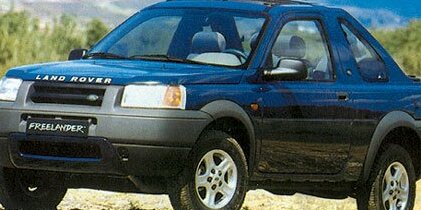
The Land Rover Freelander I Soft Top 1.8 i 16V, produced from 1998 to 2006, represented a unique offering within the first generation Freelander lineup. Positioned as an entry-level variant, it combined the practicality of a compact SUV with the open-air experience of a soft-top convertible. This model was primarily aimed at the European market, where smaller SUVs and convertibles enjoyed significant popularity. It was a key part of Land Rover’s attempt to broaden its appeal beyond traditional, larger off-road vehicles, offering a more accessible and lifestyle-oriented option.
Technical Specifications
| Brand | Land Rover |
| Model | Freelander |
| Generation | Freelander I Soft Top |
| Type (Engine) | 1.8 i 16V (117 Hp) |
| Start of production | 1998 |
| End of production | 2006 |
| Powertrain Architecture | Internal Combustion engine |
| Body type | SUV |
| Seats | 4 |
| Doors | 3 |
| Fuel consumption (urban) | 12.9 l/100 km (18.2 US mpg, 21.9 UK mpg) |
| Fuel consumption (extra urban) | 8.1 l/100 km (29 US mpg, 34.9 UK mpg) |
| Fuel consumption (combined) | 9.8 l/100 km (24 US mpg, 28.8 UK mpg) |
| Fuel Type | Petrol (Gasoline) |
| Acceleration 0 – 100 km/h | 11.8 sec |
| Acceleration 0 – 62 mph | 11.8 sec |
| Acceleration 0 – 60 mph | 11.2 sec |
| Maximum speed | 160 km/h (99.42 mph) |
| Weight-to-power ratio | 12.6 kg/Hp |
| Weight-to-torque ratio | 9.3 kg/Nm |
| Power | 117 Hp @ 5500 rpm |
| Torque | 160 Nm @ 2750 rpm (118.01 lb.-ft. @ 2750 rpm) |
| Engine layout | Front, Transverse |
| Engine Model/Code | 18K4F |
| Engine displacement | 1796 cm3 (109.6 cu. in.) |
| Number of cylinders | 4 |
| Engine configuration | Inline |
| Cylinder Bore | 80 mm (3.15 in.) |
| Piston Stroke | 89.3 mm (3.52 in.) |
| Compression ratio | 10.5:1 |
| Number of valves per cylinder | 4 |
| Fuel injection system | Multi-port manifold injection |
| Engine aspiration | Naturally aspirated engine |
| Valvetrain | DOHC |
| Engine oil capacity | 4.5 l (4.76 US qt | 3.96 UK qt) |
| Coolant capacity | 4.8 l (5.07 US qt | 4.22 UK qt) |
| Kerb Weight | 1480 kg (3262.84 lbs.) |
| Max. weight | 2040 kg (4497.43 lbs.) |
| Max load | 560 kg (1234.59 lbs.) |
| Trunk (boot) space – minimum | 311 l (10.98 cu. ft.) |
| Trunk (boot) space – maximum | 1194 l (42.17 cu. ft.) |
| Fuel tank capacity | 60 l (15.85 US gal | 13.2 UK gal) |
| Length | 4368 mm (171.97 in.) |
| Width | 1809 mm (71.22 in.) |
| Height | 1708 mm (67.24 in.) |
| Wheelbase | 2557 mm (100.67 in.) |
| Front track | 1534 mm (60.39 in.) |
| Rear (Back) track | 1545 mm (60.83 in.) |
| Drive wheel | All wheel drive (4×4) |
| Number of gears and type of gearbox | 5 gears, manual transmission |
| Front suspension | Coil spring |
| Rear suspension | Coil spring |
| Front brakes | Ventilated discs |
| Rear brakes | Drum |
| Assisting systems | ABS (Anti-lock braking system) |
| Steering type | Steering rack and pinion |
| Power steering | Hydraulic Steering |
| Tires size | 195/80 R15 S |
INTRODUCTION
The Land Rover Freelander I Soft Top 1.8 i 16V, launched in 1998, was a significant departure for the brand. Built on the 1HX0/A3 platform, it aimed to attract a younger, more lifestyle-focused demographic. The soft-top configuration, while adding a unique aesthetic, also presented engineering challenges in maintaining structural rigidity and weather protection. This variant occupied the entry-level position in the Freelander range, offering a more affordable and accessible route into Land Rover ownership. Production continued until 2006, with the model undergoing minor revisions throughout its lifespan.
Powertrain & Engine Architecture
At the heart of the Freelander 1.8 i 16V lay the 18K4F engine, a 1.8-liter inline-four cylinder petrol engine. This engine, derived from the Rover K-series family, featured a multi-port fuel injection system and a double overhead camshaft (DOHC) valvetrain. The engine produced 117 horsepower at 5500 rpm and 160 Nm (118 lb-ft) of torque at 2750 rpm. The engine’s design prioritized refinement and fuel efficiency over outright performance. The 5-speed manual transmission was standard, designed to work with the engine’s torque curve. The transmission was a conventional setup, offering smooth shifts but lacking the sophistication of more modern automatic gearboxes.
Driving Characteristics
The 1.8L engine, paired with the manual transmission, provided adequate, but not exhilarating, performance. Acceleration from 0-60 mph took around 11.2 seconds, and the top speed was limited to 99.42 mph. The gear ratios were tuned for everyday drivability, with a focus on maximizing fuel economy. Compared to the more powerful 2.5-liter V6 versions, the 1.8L felt noticeably slower, particularly when fully loaded or tackling steep inclines. However, the lighter weight of the 1.8L engine contributed to improved handling and a more nimble feel. The soft-top design did introduce some body flex, especially on uneven surfaces, but the overall driving experience was comfortable and enjoyable for casual use.
Equipment & Trim Levels
The Freelander 1.8 i 16V Soft Top typically came with a reasonable level of standard equipment. This included power steering, ABS brakes, and a basic audio system. Interior upholstery was typically cloth, with a functional and durable design. Optional extras included air conditioning, alloy wheels, and upgraded audio systems. The soft-top itself was available in a range of colors and could be fully retracted for an open-air driving experience. The dashboard layout was straightforward and easy to use, with clearly labeled controls. The interior space was adequate for four adults, although rear legroom was somewhat limited.
Chassis & Braking
The Freelander I featured an independent suspension system with coil springs all around. The front suspension utilized MacPherson struts, while the rear employed a multi-link setup. This provided a comfortable ride and decent handling characteristics. The braking system consisted of ventilated discs on the front wheels and drum brakes on the rear. ABS was standard, enhancing braking performance and stability. The chassis was reinforced to compensate for the lack of a fixed roof, but some body flex was still noticeable. The tires were typically 195/80 R15, providing a good balance of comfort and grip.
Market Reception & Comparison
The Freelander 1.8 i 16V Soft Top received mixed reviews from automotive critics. While the soft-top design was praised for its unique appeal, the engine’s performance was often criticized as being underpowered, especially when compared to the V6 models. Fuel economy was considered reasonable for its class, but not exceptional. Reliability was also a concern, with some reports of issues with the engine and transmission. Compared to the 2.5-liter V6, the 1.8L offered a lower purchase price and better fuel economy, but at the expense of performance. The 1.9 TDI diesel version provided a more economical and torquey alternative, but lacked the refinement of the petrol engine.
Legacy
The Land Rover Freelander I Soft Top 1.8 i 16V remains a relatively rare and sought-after vehicle in the used car market. While not known for its blistering performance, it offers a unique combination of practicality, style, and open-air enjoyment. The 18K4F engine, while generally reliable, requires regular maintenance to prevent issues. Common problems include oil leaks and timing chain wear. The soft-top mechanism also requires periodic attention to ensure proper operation. Despite these potential issues, the Freelander I Soft Top 1.8 i 16V has developed a loyal following among enthusiasts who appreciate its quirky charm and distinctive character.