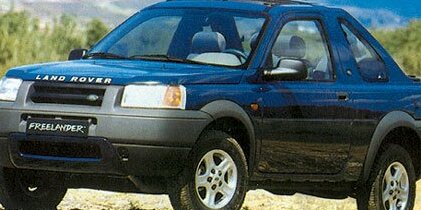
The Land Rover Freelander I Soft Top 2.0 DI, produced between 1998 and 2001, represented a unique offering within the first generation Freelander range. Positioned as an entry-level variant, it combined the practicality of a compact SUV with the open-air experience of a soft-top convertible. This model was primarily aimed at the European market, where smaller, more versatile vehicles were highly sought after. It was a key part of Land Rover’s attempt to broaden its appeal beyond traditional, larger 4×4 vehicles. The Freelander I series (designated 1HX0) was a significant departure for Land Rover, utilizing a monocoque chassis – a first for the brand – and offering a more road-focused driving experience than its predecessors.
Technical Specifications
| Brand | Land Rover |
| Model | Freelander |
| Generation | Freelander I Soft Top |
| Type (Engine) | 2.0 DI (98 Hp) |
| Start of production | 1998 |
| End of production | 2001 |
| Powertrain Architecture | Internal Combustion engine |
| Body type | SUV |
| Seats | 4 |
| Doors | 3 |
| Fuel consumption (urban) | 9.6 l/100 km (24.5 US mpg) |
| Fuel consumption (extra urban) | 6.7 l/100 km (35.1 US mpg) |
| Fuel Type | Diesel |
| Acceleration 0 – 100 km/h | 15.2 sec |
| Acceleration 0 – 62 mph | 15.2 sec |
| Acceleration 0 – 60 mph | 14.4 sec |
| Maximum speed | 155 km/h (96.31 mph) |
| Weight-to-power ratio | 15.1 kg/Hp |
| Weight-to-torque ratio | 7 kg/Nm |
| Power | 98 Hp @ 4200 rpm |
| Power per litre | 49.1 Hp/l |
| Torque | 210 Nm @ 2000 rpm (154.89 lb.-ft. @ 2000 rpm) |
| Engine layout | Front, Transverse |
| Engine Model/Code | L / 20T2N |
| Engine displacement | 1994 cm3 (121.68 cu. in.) |
| Number of cylinders | 4 |
| Engine configuration | Inline |
| Cylinder Bore | 84.5 mm (3.33 in.) |
| Piston Stroke | 88.9 mm (3.5 in.) |
| Compression ratio | 19.5:1 |
| Number of valves per cylinder | 2 |
| Fuel injection system | Direct injection |
| Engine aspiration | Turbocharger |
| Valvetrain | OHC |
| Engine oil capacity | 4.9 l (5.18 US qt | 4.31 UK qt) |
| Coolant | 7.2 l (7.61 US qt | 6.34 UK qt) |
| Kerb Weight | 1480 kg (3262.84 lbs.) |
| Max. weight | 2050 kg (4519.48 lbs.) |
| Max load | 570 kg (1256.63 lbs.) |
| Trunk (boot) space – minimum | 370 l (13.07 cu. ft.) |
| Trunk (boot) space – maximum | 1315 l (46.44 cu. ft.) |
| Fuel tank capacity | 59 l (15.59 US gal | 12.98 UK gal) |
| Length | 4380 mm (172.44 in.) |
| Width | 1805 mm (71.06 in.) |
| Height | 1760 mm (69.29 in.) |
| Wheelbase | 2560 mm (100.79 in.) |
| Front track | 1535 mm (60.43 in.) |
| Rear (Back) track | 1545 mm (60.83 in.) |
| Drive wheel | All wheel drive (4×4) |
| Number of gears | 5 |
| Gearbox type | Manual transmission |
| Front suspension | Coil spring |
| Rear suspension | Coil spring |
| Front brakes | Disc |
| Rear brakes | Drum |
| Assisting systems | ABS (Anti-lock braking system) |
| Steering type | Steering rack and pinion |
| Power steering | Hydraulic Steering |
| Tires size | 195/80 R15 |
Powertrain & Engine Architecture
The 2.0 DI engine, identified by the engine code L/20T2N, is a four-cylinder, inline diesel engine. It features direct injection and a turbocharger, allowing it to produce 98 horsepower at 4200 rpm and 210 Nm (154.89 lb-ft) of torque at 2000 rpm. The direct injection system, a relatively advanced feature for its time, contributed to improved fuel efficiency and reduced emissions. The engine utilizes a single overhead camshaft (OHC) valvetrain with two valves per cylinder. The five-speed manual transmission was the only gearbox option available with this engine. This transmission was chosen for its durability and suitability for the engine’s torque characteristics. The engine’s transverse mounting within the front-wheel-drive based chassis helped optimize space utilization.
Driving Characteristics
The 2.0 DI engine, paired with the five-speed manual transmission, provided adequate, but not exhilarating, performance. Acceleration from 0 to 60 mph took approximately 14.4 seconds, and the top speed was around 96.31 mph. The turbocharger helped to mitigate some of the inherent lag associated with diesel engines, but the power delivery was still relatively linear. Compared to the more powerful V6 petrol versions of the Freelander, the 2.0 DI felt noticeably slower, particularly when fully loaded or tackling steep inclines. However, the lower engine weight and the manual transmission did contribute to a more engaging driving experience than the automatic options available with other Freelander engines. The gear ratios were well-suited for everyday driving, prioritizing fuel economy over outright performance.
Equipment & Trim Levels
The 2.0 DI Soft Top typically came with a relatively basic level of equipment, reflecting its position as the entry-level model. Standard features included power steering, ABS brakes, and a basic audio system. The soft-top roof was manually operated. Interior upholstery was typically cloth, and the dashboard featured a functional, but not luxurious, design. Optional extras included air conditioning, alloy wheels, and upgraded audio systems. The interior space was comparable to other compact SUVs, offering comfortable seating for four adults. The soft-top mechanism did slightly reduce luggage space compared to the hard-top versions.
Chassis & Braking
The Freelander I utilized a monocoque chassis, a departure from Land Rover’s traditional body-on-frame construction. This resulted in a lighter and more rigid structure, improving handling and fuel efficiency. The suspension consisted of coil springs all around, providing a comfortable ride on most road surfaces. The front brakes were discs, while the rear brakes were drums – a cost-saving measure common in this segment. The steering was a rack and pinion system with hydraulic power assistance. The all-wheel-drive system, a key feature of the Freelander, provided enhanced traction in slippery conditions, although it was primarily road-focused rather than designed for serious off-road use.
Market Reception & Comparison
The Freelander I Soft Top 2.0 DI received mixed reviews from automotive critics. While the soft-top design was praised for its unique appeal, the engine was often criticized for its lack of power. Fuel economy was generally considered good for a vehicle of its size and capability. Compared to other Freelander trims, such as the 1.8 petrol or the 2.0 TD4, the 2.0 DI offered a balance between affordability and practicality. The 1.8 petrol was generally considered underpowered, while the 2.0 TD4 offered better performance but at a higher price point. Reliability was generally acceptable, although some owners reported issues with the turbocharger and fuel injection system.
Legacy
The Land Rover Freelander I Soft Top 2.0 DI, while not a high-performance vehicle, holds a unique place in Land Rover’s history. It represented a bold attempt to broaden the brand’s appeal and offer a more accessible entry point into the world of Land Rover ownership. Today, these vehicles are relatively rare and are sought after by enthusiasts who appreciate their quirky charm and open-air driving experience. The 2.0 DI engine, while not known for its longevity, is generally reliable if properly maintained. Parts availability can be a challenge, but a dedicated community of Freelander owners provides support and resources. The Freelander I paved the way for future generations of Land Rover SUVs, demonstrating the brand’s ability to innovate and adapt to changing market demands.