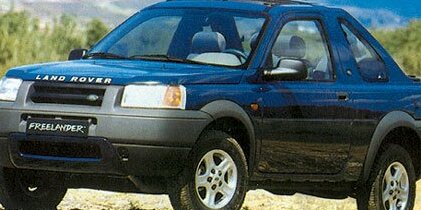
The Land Rover Freelander I Soft Top 2.0 TD4 Automatic, produced between 2001 and 2006, represented a unique offering within the first generation Freelander lineup. Positioned as a more accessible entry point into Land Rover ownership, this variant combined a diesel engine with an automatic transmission and the distinctive appeal of a convertible soft top. It was primarily marketed in Europe, where smaller SUVs and convertibles enjoyed significant popularity. The Freelander I, internally designated as the LX platform, aimed to bridge the gap between traditional off-road vehicles and more comfortable, road-focused SUVs. This particular configuration offered a blend of practicality, affordability, and open-air driving enjoyment, though it came with compromises in performance compared to higher-spec Freelander models.
Technical Specifications
| Brand | Land Rover |
| Model | Freelander |
| Generation | Freelander I Soft Top |
| Type (Engine) | 2.0 TD4 (112 Hp) Automatic |
| Start of production | 2001 |
| End of production | 2006 |
| Powertrain Architecture | Internal Combustion engine |
| Body type | SUV |
| Seats | 5 |
| Doors | 5 |
| Fuel consumption (urban) | 11.2 l/100 km (21 US mpg, 25.2 UK mpg, 8.9 km/l) |
| Fuel consumption (extra urban) | 7.1 l/100 km (33.1 US mpg, 39.8 UK mpg, 14.1 km/l) |
| Fuel consumption (combined) | 8.6 l/100 km (27.4 US mpg, 32.8 UK mpg, 11.6 km/l) |
| Fuel Type | Diesel |
| Acceleration 0 – 100 km/h | 14.4 sec |
| Acceleration 0 – 62 mph | 14.4 sec |
| Acceleration 0 – 60 mph | 13.7 sec |
| Maximum speed | 159 km/h (98.8 mph) |
| Weight-to-power ratio | 14.4 kg/Hp, 69.3 Hp/tonne |
| Weight-to-torque ratio | 6.2 kg/Nm, 161 Nm/tonne |
| Power | 112 Hp @ 4000 rpm |
| Power per litre | 57.4 Hp/l |
| Torque | 260 Nm @ 1750 rpm (191.77 lb.-ft. @ 1750 rpm) |
| Engine layout | Front, Transverse |
| Engine Model/Code | 204D3 |
| Engine displacement | 1951 cm3 (119.06 cu. in.) |
| Number of cylinders | 4 |
| Engine configuration | Inline |
| Cylinder Bore | 84 mm (3.31 in.) |
| Piston Stroke | 88 mm (3.46 in.) |
| Compression ratio | 18:1 |
| Number of valves per cylinder | 4 |
| Fuel injection system | Diesel Commonrail |
| Engine aspiration | Turbocharger, Intercooler |
| Valvetrain | DOHC |
| Engine oil capacity | 6.8 l (7.19 US qt | 5.98 UK qt) |
| Coolant | 7.25 l (7.66 US qt | 6.38 UK qt) |
| Kerb Weight | 1615 kg (3560.47 lbs.) |
| Max. weight | 2080 kg (4585.62 lbs.) |
| Max load | 465 kg (1025.15 lbs.) |
| Trunk (boot) space – minimum | 311 l (10.98 cu. ft.) |
| Trunk (boot) space – maximum | 1194 l (42.17 cu. ft.) |
| Fuel tank capacity | 60 l (15.85 US gal | 13.2 UK gal) |
| Length | 4368 mm (171.97 in.) |
| Width | 1809 mm (71.22 in.) |
| Height | 1708 mm (67.24 in.) |
| Wheelbase | 2557 mm (100.67 in.) |
| Front track | 1534 mm (60.39 in.) |
| Rear (Back) track | 1545 mm (60.83 in.) |
| Drive wheel | All wheel drive (4×4) |
| Number of gears and type of gearbox | 5 gears, automatic transmission |
| Front suspension | Coil spring |
| Rear suspension | Coil spring |
| Front brakes | Ventilated discs |
| Rear brakes | Drum |
| Assisting systems | ABS (Anti-lock braking system) |
| Steering type | Steering rack and pinion |
| Power steering | Hydraulic Steering |
| Tires size | 195/80 R15 S |
| Wheel rims size | 15 |
Powertrain & Engine Architecture
The heart of the Freelander I Soft Top 2.0 TD4 Automatic is the 204D3 engine, a 1.951-liter inline-four cylinder diesel. This engine was part of the Rover/Land Rover MDi series of diesel engines, developed in collaboration with BMW. The ‘TD4’ designation signifies ‘Turbo Diesel 4-cylinder’. It utilizes a common rail direct injection system, delivering fuel at high pressure for improved combustion efficiency and reduced emissions. A turbocharger with an intercooler further enhances power output. The engine produces 112 horsepower at 4000 rpm and 260 Nm (192 lb-ft) of torque at 1750 rpm. The automatic transmission is a Jatco unit, a five-speed torque converter automatic, chosen for its relative smoothness and ease of use. This transmission was not known for its sportiness, prioritizing comfort over rapid gear changes.
Driving Characteristics
The 2.0 TD4 Automatic, while capable, wasn’t a performance standout. Acceleration from 0-60 mph took around 13.7-14.4 seconds, and top speed was limited to approximately 99 mph. The automatic transmission, while convenient, contributed to a noticeable delay in response compared to the available manual gearbox. Gear ratios were optimized for fuel economy and relaxed cruising rather than spirited driving. The engine’s torque, however, provided adequate pulling power for everyday driving and moderate off-road conditions. The soft top added a slight weight penalty and reduced structural rigidity compared to the fixed-roof Freelander, which could be felt in cornering.
Equipment & Trim Levels
The 2.0 TD4 Automatic Soft Top typically came with a reasonable level of standard equipment. This included air conditioning, power steering, central locking, electric windows, and an AM/FM radio. Interior upholstery was generally cloth, with options for leather upgrades. Dashboard trim was typically plastic, reflecting the vehicle’s price point. Optional extras included alloy wheels, a sunroof (in addition to the soft top), upgraded audio systems, and parking sensors. The soft top itself was a multi-layered construction designed for weather resistance and security, though it wasn’t as refined as a hardtop in terms of noise insulation.
Chassis & Braking
The Freelander I utilized a monocoque chassis construction, providing a good balance of strength and weight. Suspension consisted of coil springs all around, with independent suspension at the front and a multi-link setup at the rear. Front brakes were ventilated discs, providing adequate stopping power, while rear brakes were drums, a cost-saving measure. Anti-lock Braking System (ABS) was standard. The soft top variant shared the same chassis and braking components as other Freelander I models, but the reduced rigidity of the body required careful tuning of the suspension to maintain acceptable handling characteristics.
Market Reception & Comparison
The Freelander I Soft Top 2.0 TD4 Automatic received mixed reviews. Critics praised its affordability, practicality, and the novelty of the soft top, but often criticized its performance and build quality. Compared to the more powerful 2.5-liter V6 models, the 2.0 TD4 felt underpowered. Against the 2.0 TD4 manual, the automatic version offered less driver engagement and slightly worse fuel economy. However, the automatic was favored by buyers seeking a more relaxed driving experience. Reliability was a concern for some owners, with reports of issues related to the engine’s fuel injection system and the automatic transmission.
Legacy
The Freelander I Soft Top 2.0 TD4 Automatic, while not a sales leader, holds a unique place in Land Rover’s history. It represented an attempt to broaden the brand’s appeal to a wider audience. Today, these vehicles are relatively rare and sought after by enthusiasts who appreciate their quirky charm and affordability. The 204D3 engine, while prone to certain issues, is generally considered robust if properly maintained. Finding parts can be challenging, but a dedicated community of Freelander owners provides support and resources. The soft top mechanism requires regular maintenance to prevent leaks and ensure smooth operation. Overall, the Freelander I Soft Top 2.0 TD4 Automatic remains a distinctive and enjoyable vehicle for those willing to embrace its quirks.