
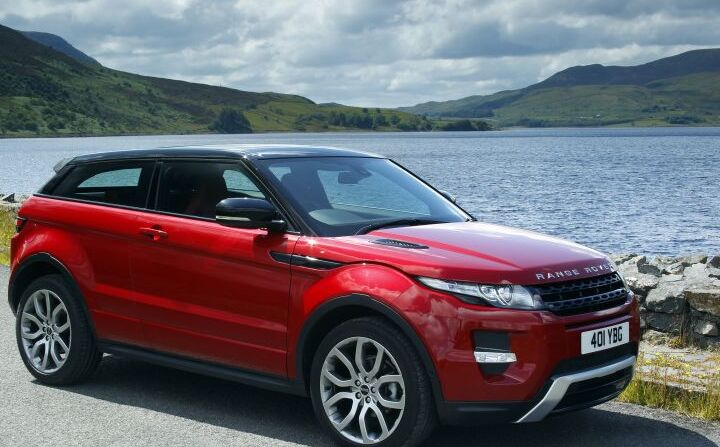
The Land Rover Range Rover Evoque I coupe 2.0 Si4, produced from 2012 to 2014, represented a significant step for the British marque, blending luxury and capability into a more compact and stylish package. This variant, powered by a 2.0-liter turbocharged four-cylinder engine producing 240 horsepower, occupied a mid-to-upper position within the Evoque lineup, appealing to buyers seeking a balance of performance and refinement. It was a key model in establishing the Evoque as a successful entry point into the Range Rover brand, particularly in markets like North America and Europe. The Evoque I coupe, built on the Land Rover-Ford developed 2HX platform (shared with the Ford Kuga/Escape), aimed to attract a younger demographic while maintaining the core Range Rover values of all-terrain ability and premium features.
Technical Specifications
| Brand | Land Rover |
| Model | Range Rover Evoque |
| Generation | Range Rover Evoque I coupe |
| Type (Engine) | 2.0 Si4 (240 Hp) AWD Automatic |
| Start of production | 2012 |
| End of production | 2014 |
| Powertrain Architecture | Internal Combustion engine |
| Body type | Coupe, SUV |
| Seats | 5 |
| Doors | 3 |
| Fuel consumption (urban) | 11.9 l/100 km (19.8 US mpg) |
| Fuel consumption (extra urban) | 6.9 l/100 km (34.1 US mpg) |
| Fuel consumption (combined) | 8.7 l/100 km (27 US mpg) |
| CO2 emissions | 199 g/km |
| Fuel Type | Petrol (Gasoline) |
| Acceleration 0 – 100 km/h | 7.6 sec |
| Acceleration 0 – 62 mph | 7.6 sec |
| Acceleration 0 – 60 mph | 7.2 sec |
| Maximum speed | 217 km/h (134.84 mph) |
| Emission standard | Euro 5 |
| Weight-to-power ratio | 6.8 kg/Hp |
| Weight-to-torque ratio | 4.8 kg/Nm |
| Power | 240 Hp |
| Torque | 340 Nm (250.77 lb.-ft.) |
| Engine layout | Front, Transverse |
| Engine Model/Code | EcoBoost / 204PT |
| Engine displacement | 1999 cm3 (121.99 cu. in.) |
| Number of cylinders | 4 |
| Engine configuration | Inline |
| Cylinder Bore | 87.5 mm (3.44 in.) |
| Piston Stroke | 83.1 mm (3.27 in.) |
| Compression ratio | 10:1 |
| Number of valves per cylinder | 4 |
| Fuel injection system | Direct injection |
| Engine aspiration | Turbocharger, Intercooler |
| Engine oil capacity | 5.6 l (5.92 US qt | 4.93 UK qt) |
| Coolant | 8.4 l (8.88 US qt | 7.39 UK qt) |
| Kerb Weight | 1640 kg (3615.58 lbs.) |
| Fuel tank capacity | 70 l (18.49 US gal | 15.4 UK gal) |
| Length | 4355 mm (171.46 in.) |
| Width | 1965 mm (77.36 in.) |
| Height | 1605 mm (63.19 in.) |
| Wheelbase | 2660 mm (104.72 in.) |
| Drag coefficient (Cd) | 0.36 |
| Minimum turning circle | 11.3 m (37.07 ft.) |
| Drive wheel | All wheel drive (4×4) |
| Number of gears | 6 |
| Gearbox type | automatic transmission |
| Front suspension | Independent, type McPherson with coil spring and anti-roll bar |
| Rear suspension | Independent multi-link suspension |
| Front brakes | Ventilated discs |
| Rear brakes | Disc |
| Assisting systems | ABS (Anti-lock braking system) |
| Steering type | Steering rack and pinion |
| Power steering | Electric Steering |
Powertrain & Engine Architecture
The heart of the Evoque 2.0 Si4 is the Ford EcoBoost 204PT engine, a 1.999-liter inline-four cylinder powerplant. This engine, part of Ford’s EcoBoost family, utilizes direct fuel injection and a single turbocharger with an intercooler to deliver a respectable 240 horsepower and 250 lb-ft of torque. The engine’s aluminum block and cylinder head contribute to its relatively lightweight construction. The 204PT engine features a timing chain for durability and a variable valve timing system to optimize performance and efficiency across the rev range. The six-speed automatic transmission, sourced from Aisin, was specifically tuned for the Evoque to provide smooth shifts and responsive acceleration. While not known for being the fastest shifting transmission, it prioritized comfort and refinement, aligning with the Range Rover brand image.
Driving Characteristics
The 2.0 Si4 automatic offered a comfortable and capable driving experience. Acceleration from 0-60 mph took around 7.2 seconds, making it adequately quick for everyday driving and highway merging. The automatic transmission, while smooth, could feel slightly hesitant during quick downshifts. The all-wheel-drive system, a key Range Rover feature, provided excellent traction in various conditions. The Evoque’s Terrain Response system, offering selectable driving modes (General, Grass/Gravel/Snow, Mud/Ruts, Sand), further enhanced its off-road capability. Compared to the more powerful 2.0 Si4 models (available with 285 hp), this variant prioritized fuel economy and a more relaxed driving experience. It also offered a noticeable improvement in fuel efficiency over the range-topping versions, though still not exceptional by modern standards.
Equipment & Trim Levels
The 2.0 Si4 Automatic typically came well-equipped, reflecting its position in the Evoque lineup. Standard features included leather upholstery, dual-zone climate control, a touchscreen infotainment system, and parking sensors. Optional extras included a panoramic sunroof, premium audio system (Meridian), heated seats, and various driver assistance features like blind-spot monitoring. Trim levels varied by market, but generally offered increasing levels of luxury and technology. The coupe body style itself was considered a more stylish and sporty option compared to the five-door model, appealing to buyers prioritizing aesthetics.
Chassis & Braking
The Evoque I coupe featured a McPherson strut front suspension and a multi-link rear suspension, providing a comfortable ride and good handling characteristics. Stabilizer bars were fitted front and rear to reduce body roll during cornering. Braking duties were handled by ventilated discs at the front and solid discs at the rear. Anti-lock brakes (ABS) and electronic stability control (ESC) were standard safety features. The Evoque’s chassis was designed to balance on-road comfort with off-road capability, offering a surprisingly composed ride even on rough surfaces.
Market Reception & Comparison
The Range Rover Evoque, and the 2.0 Si4 variant in particular, was well-received by critics and consumers alike. It was praised for its stylish design, luxurious interior, and capable all-wheel-drive system. The 2.0 Si4 automatic offered a good balance of performance and fuel economy, making it a popular choice for buyers who didn’t require the extra power of the higher-output models. Compared to competitors like the BMW X3 and Audi Q5, the Evoque offered a more distinctive design and a stronger focus on off-road capability. However, some critics noted that the automatic transmission could be slow to respond and that the rear seat space in the coupe model was limited.
Legacy
The Land Rover Range Rover Evoque I, particularly the 2.0 Si4 Automatic, proved to be a successful model for the brand, attracting a new generation of buyers to the Range Rover family. The EcoBoost engine, while not without its occasional issues (such as timing chain wear in some cases), generally proved to be reliable with proper maintenance. Today, well-maintained examples of the Evoque I coupe 2.0 Si4 hold their value reasonably well in the used car market, appealing to buyers seeking a stylish and capable luxury SUV. Its impact lies in redefining the Range Rover brand for a more modern audience, proving that luxury and capability could be packaged in a smaller, more accessible form.


