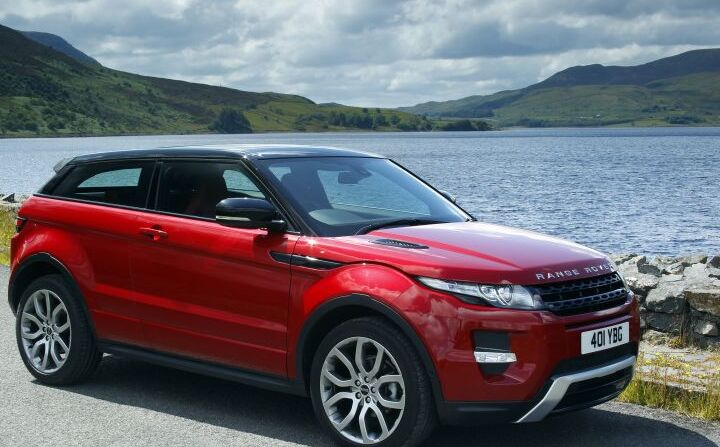
The Land Rover Range Rover Evoque I coupe 2.2 SD4 AWD Automatic represents a compelling blend of luxury, performance, and capability within the first generation Evoque lineup, produced primarily for the 2015 model year. Positioned as a mid-range offering, it catered to buyers seeking a more potent engine than the base models, coupled with the convenience of an automatic transmission and the security of all-wheel drive. This variant played a significant role in establishing the Evoque as a desirable and fashionable compact SUV, particularly in European and North American markets. It was built on the Land Rover 2HX platform, shared with the Freelander 2.
Technical Specifications
| Brand | Land Rover |
| Model | Range Rover Evoque |
| Generation | Range Rover Evoque I coupe |
| Type (Engine) | 2.2 SD4 (190 Hp) AWD Automatic |
| Start of production | 2015 |
| End of production | 2015 |
| Powertrain Architecture | Internal Combustion engine |
| Body type | Coupe, SUV |
| Seats | 5 |
| Doors | 3 |
| Fuel consumption (urban) | 6.9 l/100 km (34.1 US mpg) |
| Fuel consumption (extra urban) | 5.2 l/100 km (45.2 US mpg) |
| Fuel consumption (combined) | 5.8 l/100 km (40.6 US mpg) |
| CO2 emissions | 153 g/km |
| Fuel Type | Diesel |
| Acceleration 0 – 100 km/h | 8.5 sec |
| Acceleration 0 – 62 mph | 8.5 sec |
| Acceleration 0 – 60 mph | 8.1 sec |
| Maximum speed | 195 km/h (121.17 mph) |
| Emission standard | Euro 5 |
| Weight-to-power ratio | 8.9 kg/Hp |
| Weight-to-torque ratio | 4 kg/Nm |
| Power | 190 Hp |
| Torque | 420 Nm (309.78 lb.-ft.) |
| Engine layout | Front, Transverse |
| Engine Model/Code | 224DT |
| Engine displacement | 2179 cm3 (132.97 cu. in.) |
| Number of cylinders | 4 |
| Engine configuration | Inline |
| Cylinder Bore | 85 mm (3.35 in.) |
| Piston Stroke | 96 mm (3.78 in.) |
| Compression ratio | 15.8:1 |
| Number of valves per cylinder | 4 |
| Fuel injection system | Diesel Commonrail |
| Engine aspiration | Turbocharger, Intercooler |
| Engine oil capacity | 5.9 l (6.23 US qt | 5.19 UK qt) |
| Coolant capacity | 8.2 l (8.66 US qt | 7.21 UK qt) |
| Kerb Weight | 1685 kg (3714.79 lbs.) |
| Fuel tank capacity | 60 l (15.85 US gal | 13.2 UK gal) |
| Length | 4355 mm (171.46 in.) |
| Width | 1900 mm (74.8 in.) |
| Width with mirrors folded | 2085 mm (82.09 in.) |
| Height | 1605 mm (63.19 in.) |
| Wheelbase | 2660 mm (104.72 in.) |
| Minimum turning circle | 11.3 m (37.07 ft.) |
| Drive wheel | All wheel drive (4×4) |
| Number of gears | 9 |
| Gearbox type | automatic transmission |
Powertrain & Engine Architecture
At the heart of the Evoque 2.2 SD4 lies Land Rover’s 224DT engine, a 2.2-liter inline-four cylinder diesel. This engine, part of the AJ-diesel family developed in collaboration with PSA Peugeot Citroën, utilizes a common-rail direct injection system and a variable geometry turbocharger with intercooling. The 224DT engine code specifically denotes a 190 horsepower output, achieved through optimized engine mapping and turbocharger settings. The engine features a cast iron block and aluminum cylinder head, contributing to its durability. The nine-speed automatic transmission, sourced from ZF, was a key feature, offering a wide range of gear ratios for improved fuel efficiency and performance. This transmission was known for its smooth shifts and ability to keep the engine in its optimal power band.
Driving Characteristics
The 190 hp output and nine-speed automatic transmission provided a balanced driving experience. While not overtly sporty, the Evoque 2.2 SD4 delivered ample torque (420 Nm or 309.78 lb.-ft.) for confident acceleration and effortless cruising. The automatic transmission, while generally smooth, could occasionally exhibit slight hesitation during downshifts. Compared to the lower-powered 150 hp diesel variant, the SD4 offered noticeably improved performance, particularly when overtaking or climbing hills. It wasn’t as quick as the 240 hp petrol Si4 models, but it provided a more economical and refined driving experience. The all-wheel-drive system provided excellent traction in various conditions, making it a capable vehicle for both on-road and light off-road use.
Equipment & Trim Levels
The 2.2 SD4 Automatic typically came well-equipped, reflecting the Evoque’s premium positioning. Standard features included leather upholstery, dual-zone climate control, a touchscreen infotainment system, and alloy wheels. Optional extras included features like a panoramic sunroof, premium audio systems (Meridian), parking assist, and various driver assistance technologies. Trim levels varied by market, but generally offered increasing levels of luxury and technology. The SD4 trim often served as a stepping stone between the entry-level models and the higher-specification HSE trims.
Chassis & Braking
The Evoque’s chassis featured independent suspension all around – McPherson struts at the front and a multi-link setup at the rear. This configuration provided a comfortable ride quality, although it could feel slightly firm on rough surfaces. The steering was electrically assisted, offering a reasonable level of feedback. Braking duties were handled by ventilated discs at the front and solid discs at the rear. Anti-lock braking system (ABS) and electronic stability control were standard safety features. The suspension was tuned to balance on-road comfort with off-road capability, providing a reasonable compromise for both environments.
Market Reception & Comparison
The Range Rover Evoque, including the 2.2 SD4 Automatic variant, was generally well-received by automotive critics. It was praised for its stylish design, luxurious interior, and capable performance. The 2.2 SD4 offered a good balance between fuel economy and power, making it a popular choice for buyers who wanted a refined and efficient SUV. Compared to the petrol Si4 models, the SD4 offered superior fuel economy, while the lower-powered diesel variants lacked the same level of performance. Reliability was generally good, although some owners reported issues with the nine-speed automatic transmission, particularly in early production models.
Legacy
The Range Rover Evoque I, and specifically the 2.2 SD4 Automatic, established a strong foundation for the Evoque nameplate. The 224DT engine proved to be a reliable unit when properly maintained, and the nine-speed automatic transmission, despite some early issues, became a common feature in Land Rover and other vehicles. On the used car market, these Evoques are sought after for their style and relative affordability. However, potential buyers should be aware of the potential for transmission issues and ensure that the vehicle has been regularly serviced. The Evoque’s success demonstrated Land Rover’s ability to create a desirable and modern SUV that appealed to a wider audience.