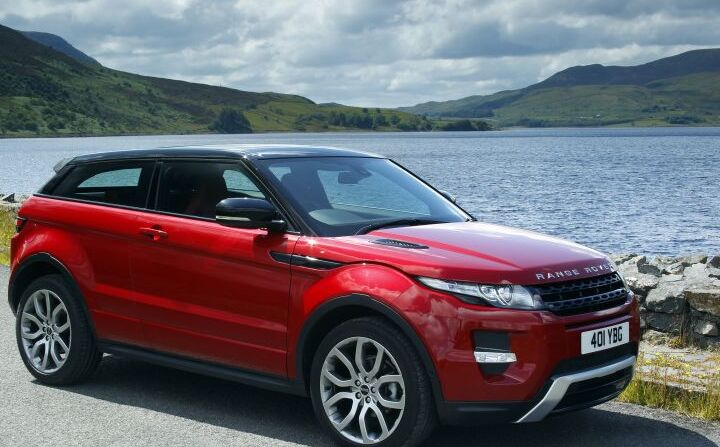
The Land Rover Range Rover Evoque I coupe 2.2 TD4, producing 150 horsepower, was a significant variant within the first generation Evoque lineup, produced from 2012 to 2015. Positioned as a more accessible entry point into the Evoque range, it offered a blend of style, capability, and relatively improved fuel economy compared to the higher-powered petrol and diesel options. This model played a crucial role in broadening the Evoque’s appeal, attracting buyers who prioritized efficiency and refinement over outright performance. It was built on the Land Rover LX platform, shared with the Freelander 2, and represented a key step in Land Rover’s strategy to offer a more compact and fuel-efficient SUV.
Technical Specifications
| Brand | Land Rover |
| Model | Range Rover Evoque |
| Generation | Range Rover Evoque I coupe |
| Type (Engine) | 2.2 TD4 (150 Hp) 4WD Automatic |
| Start of production | 2012 |
| End of production | 2015 |
| Powertrain Architecture | Internal Combustion engine |
| Body type | Coupe, SUV |
| Seats | 5 |
| Doors | 3 |
| Fuel consumption (urban) | 7.8 l/100 km (30.2 US mpg) |
| Fuel consumption (extra urban) | 5.7 l/100 km (41.3 US mpg) |
| Fuel consumption (combined) | 6.4 l/100 km (36.8 US mpg) |
| CO2 emissions | 169 g/km |
| Fuel Type | Diesel |
| Acceleration 0 – 100 km/h | 9.6 sec |
| Acceleration 0 – 62 mph | 9.6 sec |
| Acceleration 0 – 60 mph | 9.1 sec |
| Maximum speed | 182 km/h (113.09 mph) |
| Emission standard | Euro 5 |
| Weight-to-power ratio | 11.2 kg/Hp |
| Weight-to-torque ratio | 4.2 kg/Nm |
| Power | 150 Hp |
| Torque | 400 Nm (295.02 lb.-ft.) |
| Engine layout | Front, Transverse |
| Engine Model/Code | 224DT |
| Engine displacement | 2179 cm3 (132.97 cu. in.) |
| Number of cylinders | 4 |
| Engine configuration | Inline |
| Cylinder Bore | 85 mm (3.35 in.) |
| Piston Stroke | 96 mm (3.78 in.) |
| Compression ratio | 15.8:1 |
| Number of valves per cylinder | 4 |
| Fuel injection system | Diesel Commonrail |
| Engine aspiration | Turbocharger, Intercooler |
| Engine oil capacity | 5.9 l (6.23 US qt | 5.19 UK qt) |
| Coolant | 8.2 l (8.66 US qt | 7.21 UK qt) |
| Kerb Weight | 1685 kg (3714.79 lbs.) |
| Fuel tank capacity | 60 l (15.85 US gal | 13.2 UK gal) |
| Length | 4355 mm (171.46 in.) |
| Width | 1965 mm (77.36 in.) |
| Height | 1605 mm (63.19 in.) |
| Wheelbase | 2660 mm (104.72 in.) |
| Drag coefficient (Cd) | 0.36 |
| Minimum turning circle | 11.3 m (37.07 ft.) |
| Drive wheel | All wheel drive (4×4) |
| Number of gears | 6 |
| Gearbox type | automatic transmission |
| Front suspension | Independent, type McPherson with coil spring and anti-roll bar |
| Rear suspension | Independent multi-link suspension |
| Front brakes | Ventilated discs |
| Rear brakes | Disc |
| Steering type | Steering rack and pinion |
| Power steering | Electric Steering |
Powertrain & Engine Architecture
The heart of the Evoque 2.2 TD4 was the 224DT engine, a 2.2-liter inline-four cylinder diesel. This engine was part of Land Rover’s family of diesel engines developed in collaboration with PSA Peugeot Citroën. It featured a common rail direct injection system, delivering fuel at extremely high pressure for improved combustion efficiency and reduced emissions. The engine utilized a variable geometry turbocharger (VGT) and an intercooler to enhance power output and torque across a wider rev range. The 150 horsepower variant was specifically tuned for fuel economy and driveability, prioritizing torque delivery over peak power. The six-speed automatic transmission, sourced from Aisin, was a key component of this package. It was chosen for its smooth shifting characteristics and ability to provide comfortable cruising. While not a performance-oriented transmission, it was well-suited to the engine’s torque curve and the Evoque’s intended role as a stylish, all-weather vehicle.
Driving Characteristics
The 150 hp TD4 automatic Evoque offered a relaxed and refined driving experience. Acceleration was adequate for everyday driving, with the 0-60 mph sprint taking around 9.1 seconds. However, it wasn’t particularly quick, especially when fully loaded or tackling steep inclines. The automatic transmission contributed to a smooth and effortless driving style, but it could sometimes feel hesitant during quick overtaking maneuvers. The gear ratios were optimized for fuel efficiency, meaning the engine didn’t rev as freely as some of its competitors. Compared to the 240 hp petrol version, the TD4 felt noticeably slower, but it offered significantly better fuel economy. The all-wheel-drive system provided excellent traction in various conditions, making it a capable vehicle for both on-road and light off-road use.
Equipment & Trim Levels
The 2.2 TD4 automatic typically came with a respectable level of standard equipment. This included features like climate control, a touchscreen infotainment system, alloy wheels, and parking sensors. Interior upholstery was generally cloth, although leather options were available as upgrades. Higher trim levels, such as Dynamic and Prestige, added features like heated seats, a panoramic sunroof, and upgraded audio systems. Optional extras included navigation, adaptive cruise control, and a rear-view camera. The Evoque’s interior design was a standout feature, offering a premium feel and a modern aesthetic.
Chassis & Braking
The Evoque’s chassis was tuned to provide a balance between comfort and handling. The front suspension utilized McPherson struts, while the rear featured a multi-link setup. This configuration delivered a relatively compliant ride, absorbing bumps and imperfections in the road surface effectively. The steering was precise and well-weighted, providing good feedback to the driver. Braking performance was adequate, with ventilated discs at the front and solid discs at the rear. Anti-lock brakes (ABS) and electronic stability control (ESC) were standard features, enhancing safety and control.
Market Reception & Comparison
The Range Rover Evoque, including the 2.2 TD4 automatic variant, was generally well-received by critics. It was praised for its stylish design, luxurious interior, and capable all-wheel-drive system. The 150 hp diesel engine was considered a good compromise between performance and fuel economy, making it an attractive option for buyers who prioritized efficiency. Compared to other compact SUVs of the time, such as the BMW X3 and Audi Q5, the Evoque offered a more distinctive design and a more luxurious interior. However, it was often criticized for its limited rear passenger space and its relatively high price tag.
Legacy
The Land Rover Range Rover Evoque I 2.2 TD4 (150 Hp) 4WD Automatic has proven to be a relatively reliable powertrain in the used car market. The 224DT engine is known for its durability, and the Aisin automatic transmission is generally considered robust. However, like all diesel engines, it’s important to ensure regular maintenance, including oil changes and filter replacements. Common issues include diesel particulate filter (DPF) clogging and potential problems with the turbocharger. Overall, this variant remains a popular choice for buyers seeking a stylish, capable, and relatively fuel-efficient SUV.