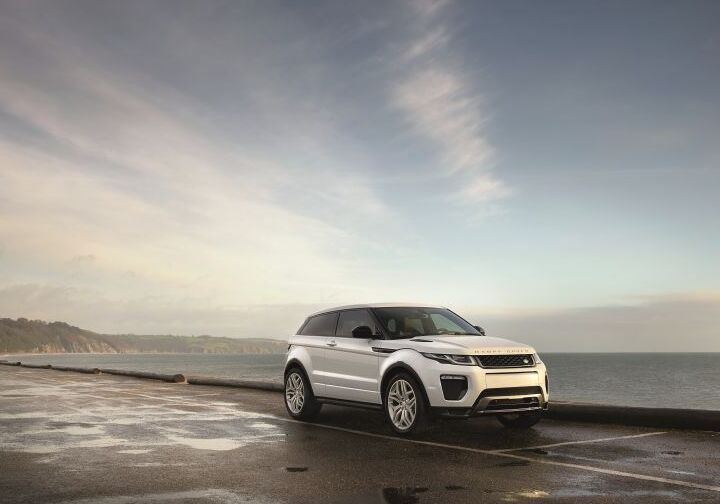
The Land Rover Range Rover Evoque I coupe (facelift 2015) 2.0 Si4, producing 240 horsepower, represents a significant iteration within the first generation of the Evoque line. Introduced in 2015 and continuing through 2018, this variant aimed to balance the Evoque’s signature style with a more potent engine option. Positioned as a mid-to-upper trim level, it offered a step up in performance from the base 2.0-liter engine while remaining more accessible than the higher-performance models. The facelift brought styling updates and technological enhancements to the already popular Evoque, solidifying its position as a premium compact SUV. This model is built on the Land Rover LX platform, shared with other Ford-era Land Rover and Ford vehicles.
Technical Specifications
| Brand | Land Rover |
| Model | Range Rover Evoque |
| Generation | Range Rover Evoque I coupe (facelift 2015) |
| Type (Engine) | 2.0 Si4 (240 Hp) AWD Automatic |
| Start of production | 2015 |
| End of production | 2018 |
| Powertrain Architecture | Internal Combustion engine |
| Body type | Coupe, SUV |
| Seats | 5 |
| Doors | 3 |
| Fuel consumption (combined) | 7.8 l/100 km (30.2 US mpg, 36.2 UK mpg, 12.8 km/l) |
| CO2 emissions | 181 g/km |
| Fuel Type | Petrol (Gasoline) |
| Acceleration 0 – 100 km/h | 7.6 sec |
| Acceleration 0 – 62 mph | 7.6 sec |
| Acceleration 0 – 60 mph | 7.2 sec |
| Maximum speed | 217 km/h (134.84 mph) |
| Emission standard | Euro 6 |
| Weight-to-power ratio | 6.9 kg/Hp, 144.8 Hp/tonne |
| Weight-to-torque ratio | 4.9 kg/Nm, 205.2 Nm/tonne |
| Power | 240 Hp @ 5800 rpm |
| Power per litre | 120.1 Hp/l |
| Torque | 340 Nm @ 1750 rpm (250.77 lb.-ft. @ 1750 rpm) |
| Engine layout | Front, Transverse |
| Engine Model/Code | EcoBoost / 204PT |
| Engine displacement | 1999 cm3 (121.99 cu. in.) |
| Number of cylinders | 4 |
| Engine configuration | Inline |
| Cylinder Bore | 87.5 mm (3.44 in.) |
| Piston Stroke | 83.1 mm (3.27 in.) |
| Compression ratio | 10:1 |
| Number of valves per cylinder | 4 |
| Fuel injection system | Direct injection |
| Engine aspiration | Turbocharger, Intercooler |
| Valvetrain | DOHC |
| Engine oil capacity | 5.4 l (5.71 US qt | 4.75 UK qt) |
| Coolant | 8.5 l (8.98 US qt | 7.48 UK qt) |
| Kerb Weight | 1657 kg (3653.06 lbs.) |
| Fuel tank capacity | 70 l (18.49 US gal | 15.4 UK gal) |
| Length | 4371 mm (172.09 in.) |
| Width including mirrors | 2085 mm (82.09 in.) |
| Height | 1625 mm (63.98 in.) |
| Wheelbase | 2660 mm (104.72 in.) |
| Drag coefficient (Cd) | 0.37 |
| Approach angle | 25° |
| Departure angle | 33° |
| Drivetrain Architecture | All wheel drive (4×4) |
| Number of gears and type of gearbox | 9 gears, automatic transmission |
| Front suspension | Independent, type McPherson with coil spring and anti-roll bar |
| Rear suspension | Independent multi-link suspension |
| Front brakes | Ventilated discs |
| Rear brakes | Disc |
| Tires size | 225/65 R17; 235/60 R18; 235/55 R19; 245/45 R20 |
Powertrain & Engine Architecture
At the heart of the 2.0 Si4 Evoque lies the Ford EcoBoost 2.0-liter turbocharged inline-four cylinder engine, designated with the engine code 204PT. This engine, part of Ford’s EcoBoost family, utilizes direct fuel injection and a twin-scroll turbocharger to deliver a balance of power and efficiency. The engine features a double overhead camshaft (DOHC) valvetrain with four valves per cylinder, optimizing airflow for improved performance. The 204PT engine benefits from variable valve timing on both intake and exhaust sides, further enhancing its responsiveness and fuel economy. The engine is transversely mounted in the front of the vehicle. Paired with this engine is a ZF 9-speed automatic transmission, a key component in maximizing fuel efficiency and providing smooth gear changes. This transmission offers a wide range of gear ratios, allowing the engine to operate within its optimal power band more frequently.
Driving Characteristics
The 240 horsepower and 340 Nm (250.77 lb-ft) of torque provided by the 2.0 Si4 engine translate to a noticeably more spirited driving experience compared to the lower-powered Evoque variants. Acceleration from 0-60 mph takes approximately 7.2 seconds, making it competitive within its class. The 9-speed automatic transmission contributes to a refined driving experience, offering quick and seamless shifts. While not a sports car, the Evoque 2.0 Si4 provides ample power for everyday driving and confident overtaking maneuvers. The all-wheel-drive system ensures excellent traction in various weather conditions, a hallmark of the Land Rover brand. Compared to the manual transmission options, the automatic prioritizes convenience and ease of use, though it may slightly diminish the driver’s sense of control. The gear ratios are tuned for a balance between acceleration and fuel economy, with taller gears for highway cruising.
Equipment & Trim Levels
The 2.0 Si4 typically came well-equipped, reflecting its position as a mid-range to upper-range trim. Standard features often included leather upholstery, automatic climate control, a touchscreen infotainment system with navigation, and parking sensors. Optional extras could include a panoramic sunroof, premium audio systems (often Meridian), adaptive cruise control, and various driver-assistance technologies. Interior trim options varied, with choices in wood veneers, aluminum accents, and different leather color combinations. The facelifted model introduced updated interior materials and a more modern infotainment system compared to the pre-2015 models.
Chassis & Braking
The Evoque’s chassis features an independent McPherson strut suspension at the front and an independent multi-link suspension at the rear, providing a comfortable ride and responsive handling. Stabilizer bars are fitted to both axles to reduce body roll during cornering. Braking duties are handled by ventilated discs at the front and solid discs at the rear. Anti-lock Braking System (ABS) is standard, along with Electronic Stability Control (ESC) and Traction Control. The steering system is an electric power-assisted rack and pinion setup, offering precise and weighted steering feel.
Market Reception & Comparison
The Range Rover Evoque, in general, was well-received by critics and consumers alike, praised for its stylish design and luxurious interior. The 2.0 Si4 variant offered a compelling alternative to the diesel options available in Europe and provided a more accessible entry point to the Evoque range for buyers seeking more performance than the base engine. Fuel economy was respectable for a vehicle of its class, averaging around 30.2 US mpg in combined driving. Reliability reports have been mixed, with some owners reporting issues with the infotainment system and occasional turbocharger concerns. Compared to the 2.0-liter base engine, the 2.0 Si4 offered a significant performance boost, while the diesel variants (like the 2.2 SD4) prioritized fuel economy and low-end torque.
Legacy
The Land Rover Range Rover Evoque I (2011-2018) established a new design language for Land Rover and broadened the brand’s appeal to a younger audience. The 2.0 Si4 variant, with its potent turbocharged engine and refined automatic transmission, remains a popular choice in the used car market. While the EcoBoost engine is generally considered reliable, regular maintenance, including oil changes and inspection of the turbocharger, is crucial for long-term durability. The 9-speed automatic transmission, while sophisticated, has been known to exhibit occasional software glitches, which can often be resolved with software updates. Overall, the 2.0 Si4 Evoque offers a blend of style, performance, and luxury that continues to attract buyers today.