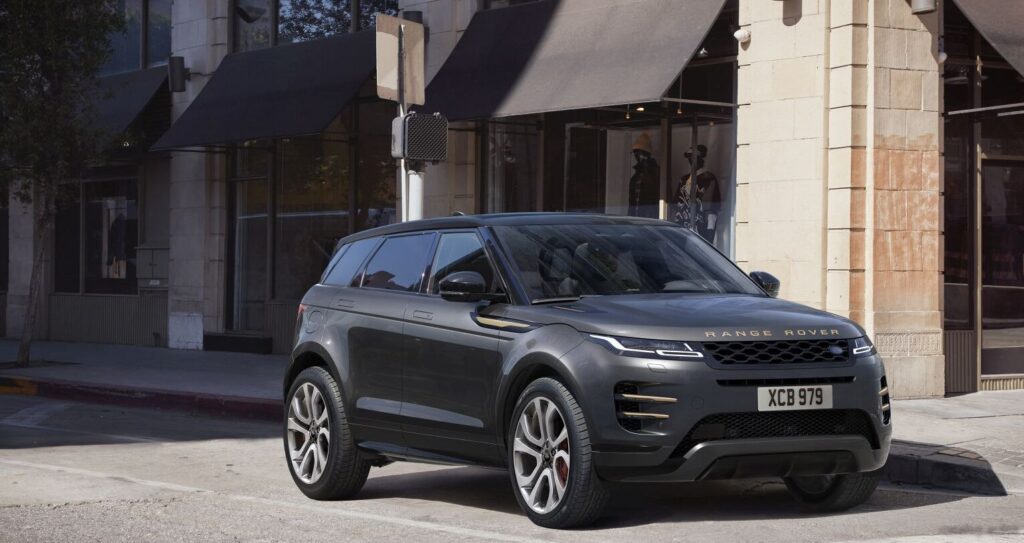
The Land Rover Range Rover Evoque II 2.0 Si4 (200 Hp) Mild Hybrid AWD Automatic represents a significant iteration within the second generation of the Evoque, produced from 2019 to 2023. Positioned as a mid-range offering in the Evoque lineup, this variant blended respectable performance with enhanced fuel efficiency thanks to its mild-hybrid technology. It aimed to appeal to buyers seeking a premium compact SUV experience with a balance between power and economy, fitting into the increasingly popular segment of luxury crossovers. The Evoque II, built on the Premium Transverse Architecture (PTA), represented a substantial upgrade over the original Evoque, offering increased refinement, technology, and interior space.
Technical Specifications
| Brand | Land Rover |
| Model | Range Rover Evoque |
| Generation | Range Rover Evoque II |
| Type (Engine) | 2.0 Si4 (200 Hp) Mild Hybrid AWD Automatic |
| Start of production | 2019 |
| End of production | 2023 |
| Powertrain Architecture | MHEV (Mild Hybrid Electric Vehicle) |
| Body type | SUV |
| Seats | 5 |
| Doors | 5 |
| Fuel consumption (combined) | 7.7 l/100 km (30.5 US mpg, 36.7 UK mpg, 13 km/l) |
| CO2 emissions | 176 g/km |
| Fuel Type | Petrol (Gasoline) |
| Acceleration 0 – 100 km/h | 8.5 sec |
| Acceleration 0 – 62 mph | 8.5 sec |
| Acceleration 0 – 60 mph | 8.1 sec |
| Maximum speed | 216 km/h (134.22 mph) |
| Emission standard | Euro 6 |
| Weight-to-power ratio | 9.2 kg/Hp, 108.4 Hp/tonne |
| Weight-to-torque ratio | 5.4 kg/Nm, 184.3 Nm/tonne |
| Power | 200 Hp @ 5500 rpm |
| Power per litre | 100.1 Hp/l |
| Torque | 340 Nm @ 1300-4500 rpm (250.77 lb.-ft. @ 1300-4500 rpm) |
| Engine layout | Front, Transverse |
| Engine Model/Code | Ingenium / PT204 |
| Engine displacement | 1998 cm3 (121.93 cu. in.) |
| Number of cylinders | 4 |
| Engine configuration | Inline |
| Cylinder Bore | 83 mm (3.27 in.) |
| Piston Stroke | 92.3 mm (3.63 in.) |
| Compression ratio | 10.5:1 |
| Number of valves per cylinder | 4 |
| Fuel injection system | Direct injection |
| Engine aspiration | Twin-Turbo, Intercooler |
| Valvetrain | DOHC |
| Engine oil capacity | 7 l (7.4 US qt | 6.16 UK qt) |
| Coolant | 11.2 l (11.83 US qt | 9.85 UK qt) |
| Kerb Weight | 1845 kg (4067.53 lbs.) |
| Trunk (boot) space – minimum | 591 l (20.87 cu. ft.) |
| Trunk (boot) space – maximum | 1383 l (48.84 cu. ft.) |
| Fuel tank capacity | 67 l (17.7 US gal | 14.74 UK gal) |
| Permitted trailer load with brakes (12%) | 1800 kg (3968.32 lbs.) |
| Permitted trailer load without brakes | 750 kg (1653.47 lbs.) |
| Length | 4371 mm (172.09 in.) |
| Width | 1904 mm (74.96 in.) |
| Width with mirrors folded | 1996 mm (78.58 in.) |
| Width including mirrors | 2100 mm (82.68 in.) |
| Height | 1649 mm (64.92 in.) |
| Wheelbase | 2681 mm (105.55 in.) |
| Front track | 1626 mm (64.02 in.) |
| Rear (Back) track | 1632 mm (64.25 in.) |
| Front overhang | 880 mm (34.65 in.) |
| Rear overhang | 810 mm (31.89 in.) |
| Ride height (ground clearance) | 212 mm (8.35 in.) |
| Drag coefficient (Cd) | 0.325 |
| Minimum turning circle | 11.6 m (38.06 ft.) |
| Approach angle | 25.0° |
| Departure angle | 30.6° |
| Ramp-over angle | 20.7° |
| Climb angle | 45.0° |
| Wading depth | 600 mm (23.62 in.) |
| Drive wheel | All wheel drive (4×4) |
| Number of gears and type of gearbox | 9 gears, automatic transmission |
| Front suspension | Independent type McPherson |
| Rear suspension | Independent multi-link suspension |
| Assisting systems | ABS (Anti-lock braking system) |
| Steering type | Steering rack and pinion |
| Power steering | Electric Steering |
| Tires size | 225/65 R17; 235/65 R17; 235/60 R18; 235/50 R20; 245/45 R21 |
| Wheel rims size | 7.0J x 17; 8.0J 18; 8.0J x 20; 8.0J x 21 |
INTRODUCTION
The Land Rover Range Rover Evoque II 2.0 Si4 (200 Hp) Mild Hybrid AWD Automatic, launched in 2019, represents a key variant within the second-generation Evoque (L551) model range. Building upon the success of the original Evoque, the II version offered a more refined and technologically advanced package. This particular trim level, powered by the Ingenium 2.0-liter four-cylinder engine with mild-hybrid assistance, aimed to provide a balance of performance, fuel efficiency, and luxury. It occupied a middle ground in the Evoque II lineup, positioned above the entry-level models and below the more powerful and feature-rich trims.
Powertrain & Engine Architecture
At the heart of the 2.0 Si4 is Land Rover’s Ingenium engine family, specifically the PT204 code. This 1998cc inline-four cylinder engine utilizes direct fuel injection and a twin-turbocharger setup to produce 200 horsepower at 5500 rpm and 340 Nm (250.77 lb-ft) of torque between 1300 and 4500 rpm. The mild-hybrid system, a 48-volt setup, incorporates a Belt-integrated Starter Generator (BiSG) that assists the engine during acceleration and enables smoother start-stop functionality, contributing to improved fuel economy. The engine features a DOHC valvetrain with four valves per cylinder. The engine is transversely mounted. The powertrain is paired with a ZF-sourced nine-speed automatic transmission, known for its smooth shifts and wide gear ratio spread. This transmission is crucial for optimizing both fuel efficiency and performance.
Driving Characteristics
The 200 hp output and 340 Nm of torque provide adequate, though not exhilarating, performance. Acceleration from 0-60 mph takes approximately 8.1 seconds, and the vehicle feels responsive in everyday driving situations. The nine-speed automatic transmission is well-tuned, offering smooth gear changes and keeping the engine within its optimal power band. Compared to the higher-output 246 hp version of the 2.0-liter Ingenium, this variant feels noticeably less potent, particularly during overtaking maneuvers. However, the mild-hybrid system helps to mitigate some of the turbo lag, providing a more immediate response from the engine. The automatic transmission, while generally smooth, can occasionally exhibit some hesitancy in downshifting. The all-wheel-drive system provides confident traction in various conditions, making it suitable for both on-road and light off-road use.
Equipment & Trim Levels
The 2.0 Si4 Automatic typically came standard with features such as leather upholstery, a touchscreen infotainment system with Apple CarPlay and Android Auto compatibility, automatic climate control, and a suite of driver-assistance systems including emergency braking and lane-keeping assist. Optional extras included a panoramic sunroof, premium audio system, adaptive cruise control, and upgraded interior trim materials. Trim levels varied by market, but generally, this engine/transmission combination was offered within the ‘S’ or ‘SE’ trims, representing a step up from the base models. Interior design focused on a modern aesthetic with a minimalist dashboard layout and high-quality materials.
Chassis & Braking
The Evoque II utilizes an independent McPherson strut suspension at the front and an independent multi-link suspension at the rear. This setup provides a comfortable ride quality while maintaining reasonable handling characteristics. The steering is electrically assisted, offering a light and precise feel. Braking duties are handled by ventilated disc brakes at the front and solid disc brakes at the rear. The ABS system ensures effective braking performance in various conditions. Stabilizer bars are fitted to both the front and rear axles to reduce body roll during cornering.
Market Reception & Comparison
The Range Rover Evoque II 2.0 Si4 (200 Hp) Mild Hybrid AWD Automatic was generally well-received by automotive critics. It was praised for its stylish design, comfortable interior, and refined driving experience. However, some reviewers noted that the 200 hp engine felt somewhat underpowered for a vehicle of its size and weight. Compared to the more powerful 246 hp version, the 200 hp model offered better fuel economy but at the expense of performance. Against competitors like the BMW X1, Audi Q3, and Mercedes-Benz GLA, the Evoque II stood out with its distinctive styling and brand cachet. Fuel economy figures of around 30.5 US mpg combined were competitive within its class.
Legacy
The Ingenium engine family has proven to be relatively reliable, although some owners have reported minor issues with the turbocharger and fuel injectors. The nine-speed automatic transmission has also been generally dependable, but requires regular fluid changes to maintain optimal performance. In the used car market, the Evoque II 2.0 Si4 (200 Hp) Mild Hybrid AWD Automatic represents a good value proposition for buyers seeking a stylish and comfortable compact SUV. Its mild-hybrid technology and relatively low running costs make it an attractive option for those looking for a balance between performance and efficiency. The Evoque II continues to hold its value well, reflecting the enduring appeal of the Range Rover brand.