
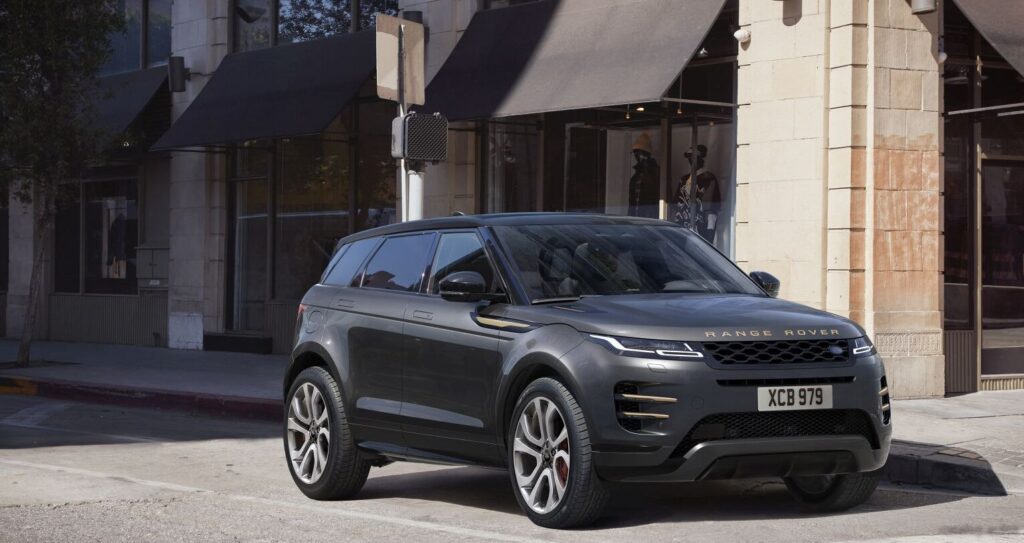
The Land Rover Range Rover Evoque II 2.0 Si4 (300 Hp) Mild Hybrid AWD Automatic represents a significant iteration within the second generation of the Evoque, produced from 2019 to 2023. Positioned as a mid-to-high-range trim level, this variant blended performance, luxury, and the increasing demand for mild hybrid technology within the compact luxury SUV segment. It built upon the success of the original Evoque, offering a more refined driving experience and updated technology while maintaining the model’s distinctive coupe-like styling. The Evoque II, based on the Premium Transverse Architecture (PTA), aimed to broaden the Range Rover appeal to a younger demographic seeking a stylish and capable vehicle.
Technical Specifications
| Brand | Land Rover |
| Model | Range Rover Evoque |
| Generation | Range Rover Evoque II |
| Type (Engine) | 2.0 Si4 (300 Hp) Mild Hybrid AWD Automatic |
| Start of production | 2019 |
| End of production | 2023 |
| Powertrain Architecture | MHEV (Mild Hybrid Electric Vehicle) |
| Body type | SUV |
| Seats | 5 |
| Doors | 5 |
| Fuel consumption (combined) | 8.1 l/100 km (29 US mpg, 34.9 UK mpg, 12.3 km/l) |
| CO2 emissions | 186 g/km |
| Fuel Type | Petrol (Gasoline) |
| Acceleration 0 – 100 km/h | 6.6 sec |
| Acceleration 0 – 62 mph | 6.6 sec |
| Acceleration 0 – 60 mph | 6.3 sec |
| Maximum speed | 242 km/h (150.37 mph) |
| Emission standard | Euro 6 |
| Weight-to-power ratio | 6.4 kg/Hp, 155.8 Hp/tonne |
| Weight-to-torque ratio | 4.8 kg/Nm, 207.8 Nm/tonne |
| Power | 300 Hp @ 5500 rpm |
| Power per litre | 150.2 Hp/l |
| Torque | 400 Nm @ 1500-4500 rpm (295.02 lb.-ft. @ 1500-4500 rpm) |
| Engine layout | Front, Transverse |
| Engine Model/Code | Ingenium / PT204 |
| Engine displacement | 1998 cm3 (121.93 cu. in.) |
| Number of cylinders | 4 |
| Engine configuration | Inline |
| Cylinder Bore | 83 mm (3.27 in.) |
| Piston Stroke | 92.3 mm (3.63 in.) |
| Compression ratio | 9.5:1 |
| Number of valves per cylinder | 4 |
| Fuel injection system | Direct injection |
| Engine aspiration | Twin-Turbo, Intercooler |
| Valvetrain | DOHC |
| Engine oil capacity | 7 l (7.4 US qt | 6.16 UK qt) |
| Coolant capacity | 11.2 l (11.83 US qt | 9.85 UK qt) |
| Kerb Weight | 1925 kg (4243.9 lbs.) |
| Trunk (boot) space – minimum | 591 l (20.87 cu. ft.) |
| Trunk (boot) space – maximum | 1383 l (48.84 cu. ft.) |
| Fuel tank capacity | 67 l (17.7 US gal | 14.74 UK gal) |
| Permitted trailer load with brakes (12%) | 1800 kg (3968.32 lbs.) |
| Permitted trailer load without brakes | 750 kg (1653.47 lbs.) |
| Length | 4371 mm (172.09 in.) |
| Width | 1904 mm (74.96 in.) |
| Width with mirrors folded | 1996 mm (78.58 in.) |
| Width including mirrors | 2100 mm (82.68 in.) |
| Height | 1649 mm (64.92 in.) |
| Wheelbase | 2681 mm (105.55 in.) |
| Front track | 1626 mm (64.02 in.) |
| Rear track | 1632 mm (64.25 in.) |
| Front overhang | 880 mm (34.65 in.) |
| Rear overhang | 810 mm (31.89 in.) |
| Ride height (ground clearance) | 212 mm (8.35 in.) |
| Drag coefficient (Cd) | 0.33 |
| Minimum turning circle | 11.6 m (38.06 ft.) |
| Approach angle | 25.0° |
| Departure angle | 30.6° |
| Ramp-over angle | 20.7° |
| Climb angle | 45.0° |
| Wading depth | 600 mm (23.62 in.) |
| Drive wheel | All wheel drive (4×4) |
| Number of gears | 9 |
| Gearbox type | Automatic transmission |
| Front suspension | Independent type McPherson |
| Rear suspension | Independent multi-link suspension |
| Assisting systems | ABS (Anti-lock braking system) |
| Steering type | Steering rack and pinion |
| Power steering | Electric Steering |
| Tires size | 225/65 R17; 235/65 R17; 235/60 R18; 235/50 R20; 245/45 R21 |
| Wheel rims size | 7.0J x 17; 8.0J 18; 8.0J x 20; 8.0J x 21 |
INTRODUCTION
The 2019-2023 Range Rover Evoque II 2.0 Si4 (300 Hp) Mild Hybrid AWD Automatic represents a sophisticated blend of performance and efficiency within the Evoque lineup. This variant, utilizing Land Rover’s Ingenium engine family, was designed to appeal to buyers seeking a premium SUV experience with a reduced environmental impact. The introduction of mild hybrid technology aimed to improve fuel economy and reduce emissions without sacrificing the driving dynamics expected of a Range Rover. It sat comfortably in the middle to upper range of the Evoque II trims, offering a significant step up in power and refinement compared to the base models.
Powertrain & Engine Architecture
At the heart of the 2.0 Si4 is Land Rover’s Ingenium engine, specifically the PT204 code. This 1998cc inline-four cylinder engine employs direct fuel injection and a twin-turbocharger setup, delivering 300 horsepower at 5500 rpm and 400 Nm (295 lb-ft) of torque between 1500 and 4500 rpm. The mild hybrid system incorporates a 48-volt electrical architecture and a belt-integrated starter generator (BiSG). This BiSG assists the engine during acceleration, allowing for smoother starts and improved responsiveness, while also enabling regenerative braking to recapture energy during deceleration. The engine utilizes a DOHC valvetrain with four valves per cylinder. The nine-speed automatic transmission, sourced from ZF, is a crucial component of the powertrain, providing smooth and efficient gear changes. The transmission is calibrated to work seamlessly with the mild hybrid system, optimizing gear selection for both performance and fuel economy.
Driving Characteristics
The 300 hp output and the assistance of the mild hybrid system translate to a noticeably more spirited driving experience compared to lower-powered Evoque variants. Acceleration from 0-60 mph is achieved in approximately 6.3 seconds, making it a competitive performer in its class. The nine-speed automatic transmission contributes to a comfortable ride, with well-spaced gear ratios that keep the engine within its optimal power band. While not a sports SUV, the 2.0 Si4 offers ample power for overtaking and highway cruising. The all-wheel-drive system provides excellent traction in various conditions, enhancing both on-road handling and off-road capability. Compared to the base 1.5L Ingenium engine, the 2.0 Si4 delivers a significantly more refined and powerful experience, while the mild hybrid system helps to mitigate some of the fuel economy penalties associated with the larger engine.
Equipment & Trim Levels
The 2.0 Si4 typically came equipped with a generous array of standard features, including leather upholstery, a touchscreen infotainment system with Apple CarPlay and Android Auto compatibility, navigation, and a suite of advanced driver-assistance systems (ADAS) such as lane departure warning, automatic emergency braking, and adaptive cruise control. Optional extras included a panoramic sunroof, premium audio systems (Meridian), heated and ventilated front seats, and a configurable digital instrument cluster. Trim levels within the 2.0 Si4 range often varied based on package selection, allowing buyers to customize their vehicle with specific features and aesthetics.
Chassis & Braking
The Evoque II utilizes an independent McPherson strut front suspension and an independent multi-link rear suspension, providing a comfortable and controlled ride. The suspension is tuned to balance on-road comfort with off-road capability. Braking systems typically consisted of ventilated front discs and solid rear discs, with ABS and electronic brake-force distribution as standard features. The chassis is designed to provide a stable and predictable handling experience, with a focus on minimizing body roll during cornering.
Market Reception & Comparison
The Range Rover Evoque II 2.0 Si4 (300 Hp) Mild Hybrid AWD Automatic was generally well-received by automotive critics. Reviewers praised its stylish design, refined interior, and improved performance compared to earlier Evoque models. The mild hybrid system was seen as a positive step towards greater fuel efficiency, although real-world fuel economy figures varied depending on driving conditions. Compared to other trims, the 2.0 Si4 offered a compelling balance of performance and luxury, making it a popular choice for buyers seeking a premium SUV experience. Competitors included the BMW X2, Audi Q3, and Mercedes-Benz GLA.
Legacy
The Ingenium engine family, including the PT204, has proven to be relatively reliable, although regular maintenance is crucial. The mild hybrid system, while adding complexity, has generally demonstrated good durability. On the used car market, the 2019-2023 Evoque II 2.0 Si4 holds its value well, reflecting its desirable combination of style, performance, and technology. Potential buyers should be aware of the importance of maintaining the mild hybrid system and ensuring that all software updates are installed to optimize performance and efficiency.


