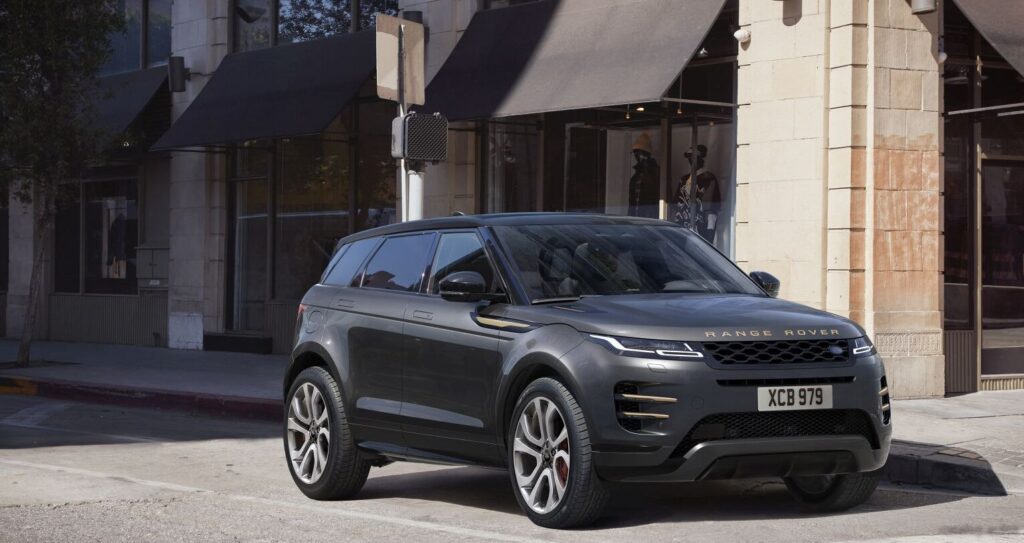
The Land Rover Range Rover Evoque II 2.0 Td4 (150 hp) was a diesel-powered variant of the second-generation Evoque, produced from 2019 to 2020. Positioned as an entry-level option within the Evoque II range, it offered a balance of fuel efficiency and respectable performance, aimed at buyers prioritizing economy and refinement over outright speed. This model played a significant role in the Evoque’s continued success in the premium compact SUV segment, particularly in European markets where diesel engines remained popular. It was built on the Land Rover PTA platform, sharing its underpinnings with other Jaguar Land Rover vehicles.
Technical Specifications
| Brand | Land Rover |
| Model | Range Rover Evoque |
| Generation | Range Rover Evoque II |
| Type (Engine) | 2.0 Td4 (150 Hp) |
| Start of production | 2019 |
| End of production | 2020 |
| Powertrain Architecture | Internal Combustion engine |
| Body type | SUV |
| Seats | 5 |
| Doors | 5 |
| Fuel consumption (combined) | 5.4 l/100 km (43.6 US mpg, 52.3 UK mpg, 18.5 km/l) |
| CO2 emissions | 143 g/km |
| Fuel Type | Diesel |
| Acceleration 0 – 100 km/h | 10.5 sec |
| Acceleration 0 – 62 mph | 10.5 sec |
| Acceleration 0 – 60 mph | 10 sec |
| Maximum speed | 201 km/h (124.9 mph) |
| Emission standard | Euro 6 |
| Weight-to-power ratio | 11.9 kg/Hp, 83.9 Hp/tonne |
| Weight-to-torque ratio | 4.7 kg/Nm, 212.6 Nm/tonne |
| Power | 150 Hp @ 2400 rpm |
| Power per litre | 75 Hp/l |
| Torque | 380 Nm @ 1750-2500 rpm (280.27 lb.-ft. @ 1750-2500 rpm) |
| Engine layout | Front, Transverse |
| Engine Model/Code | Ingenium / 204DTD |
| Engine displacement | 1999 cm3 (121.99 cu. in.) |
| Number of cylinders | 4 |
| Engine configuration | Inline |
| Cylinder Bore | 83 mm (3.27 in.) |
| Piston Stroke | 92.35 mm (3.64 in.) |
| Compression ratio | 15.5:1 |
| Number of valves per cylinder | 4 |
| Fuel injection system | Diesel Commonrail |
| Engine aspiration | Turbocharger, Intercooler |
| Valvetrain | DOHC |
| Engine oil capacity | 6.5 l (6.87 US qt | 5.72 UK qt) |
| Coolant | 11.2 l (11.83 US qt | 9.85 UK qt) |
| Kerb Weight | 1787 kg (3939.66 lbs.) |
| Trunk (boot) space – minimum | 591 l (20.87 cu. ft.) |
| Trunk (boot) space – maximum | 1383 l (48.84 cu. ft.) |
| Fuel tank capacity | 65 l (17.17 US gal | 14.3 UK gal) |
| AdBlue tank | 17.2 l (4.54 US gal | 3.78 UK gal) |
| Permitted trailer load with brakes (12%) | 1600 kg (3527.4 lbs.) |
| Permitted trailer load without brakes | 750 kg (1653.47 lbs.) |
| Length | 4371 mm (172.09 in.) |
| Width | 1904 mm (74.96 in.) |
| Width with mirrors folded | 1996 mm (78.58 in.) |
| Width including mirrors | 2100 mm (82.68 in.) |
| Height | 1649 mm (64.92 in.) |
| Wheelbase | 2681 mm (105.55 in.) |
| Front track | 1626 mm (64.02 in.) |
| Rear (Back) track | 1632 mm (64.25 in.) |
| Front overhang | 880 mm (34.65 in.) |
| Rear overhang | 810 mm (31.89 in.) |
| Ride height (ground clearance) | 212 mm (8.35 in.) |
| Drag coefficient (Cd) | 0.32 |
| Minimum turning circle (turning diameter) | 11.6 m (38.06 ft.) |
| Approach angle | 25.0° |
| Departure angle | 30.6° |
| Ramp-over (brakeover) angle | 20.7° |
| Climb angle | 45.0° |
| Wading depth | 600 mm (23.62 in.) |
| Drivetrain Architecture | The Internal combustion engine (ICE) drives the front wheels of the vehicle. |
| Drive wheel | Front wheel drive |
| Number of gears and type of gearbox | 6 gears, manual transmission |
| Front suspension | Independent type McPherson |
| Rear suspension | Independent multi-link suspension |
| Assisting systems | ABS (Anti-lock braking system) |
| Steering type | Steering rack and pinion |
| Power steering | Electric Steering |
| Tires size | 225/65 R17; 235/65 R17; 235/60 R18; 235/50 R20; 245/45 R21 |
| Wheel rims size | 7.0J x 17; 8.0J 18; 8.0J x 20; 8.0J x 21 |
INTRODUCTION
The Land Rover Range Rover Evoque II 2.0 Td4 (150 hp) represented a key offering in the refreshed Evoque lineup launched in 2019. Building upon the success of the original Evoque, the second generation brought enhanced technology, improved refinement, and a more sophisticated design. The 2.0 Td4 variant, powered by Land Rover’s Ingenium engine, was designed to appeal to buyers seeking a balance between fuel economy and usability. It occupied the lower end of the Evoque II range, serving as the entry point to the model, and was primarily sold in European and Asian markets.
Powertrain & Engine Architecture
At the heart of the 2.0 Td4 was Land Rover’s Ingenium engine family, specifically the 204DTD code. This 2.0-liter inline-four diesel engine featured advanced technologies such as a turbocharger with intercooler, direct injection, and a sophisticated valvetrain with dual overhead camshafts (DOHC). The engine produced 150 horsepower at 2400 rpm and 380 Nm (280.27 lb-ft) of torque between 1750 and 2500 rpm. The diesel commonrail fuel injection system delivered precise fuel metering for optimal combustion and efficiency. This particular variant was typically paired with a 6-speed manual transmission, although an 8-speed automatic was sometimes available as an option. The engine’s transverse mounting and front-wheel-drive configuration contributed to its compact footprint and efficient packaging.
Driving Characteristics
The 150 hp 2.0 Td4 Evoque II offered adequate, but not exhilarating, performance. Acceleration from 0 to 60 mph took around 10 seconds, and the top speed was approximately 125 mph. The engine’s torque delivery, peaking at 1750 rpm, provided reasonable responsiveness for everyday driving situations. Compared to higher-output Evoque variants (like the 2.0 Si4 petrol), the Td4 felt less urgent in its acceleration. The manual transmission, while offering greater driver engagement, had relatively long throws. The front-wheel-drive configuration, while contributing to fuel efficiency, limited traction in adverse weather conditions compared to all-wheel-drive models. The gear ratios were tuned for fuel economy, meaning the engine could feel strained when pushed hard.
Equipment & Trim Levels
The 2.0 Td4 typically came with a respectable level of standard equipment. Interior features included cloth upholstery, a leather-wrapped steering wheel, and an 8-inch touchscreen infotainment system with Apple CarPlay and Android Auto compatibility. Standard safety features included autonomous emergency braking, lane departure warning, and front and rear parking sensors. Optional extras included leather seats, a panoramic sunroof, upgraded audio systems, and various driver-assistance technologies. Trim levels varied by market, but generally offered progressive upgrades in terms of interior materials, exterior styling, and technology features. The base trim focused on value, while higher trims added luxury and convenience features.
Chassis & Braking
The Evoque II utilized an independent McPherson strut suspension at the front and an independent multi-link suspension at the rear. This setup provided a comfortable ride quality, absorbing bumps and imperfections in the road surface effectively. The front-wheel-drive configuration and relatively modest power output meant that the suspension didn’t require the robustness of the all-wheel-drive models. Braking duties were handled by disc brakes at the front and, in some markets, drum brakes at the rear. ABS (Anti-lock Braking System) was standard. The steering employed an electric power steering system, offering light and precise control.
Market Reception & Comparison
The Range Rover Evoque II 2.0 Td4 (150 hp) was generally well-received by automotive critics as a practical and efficient option within the Evoque range. It was praised for its stylish design, comfortable interior, and fuel economy. However, some reviewers noted that the engine lacked the punch of higher-output variants. Compared to the petrol-powered Evoque models, the Td4 offered significantly better fuel economy (around 43.6 US mpg combined) but slightly slower acceleration. Against competitors like the Audi Q3 and BMW X1, the Evoque II Td4 held its own in terms of style and interior quality, but its fuel economy was often slightly lower.
Legacy
The Ingenium engine family, including the 204DTD, has proven to be relatively reliable, although some owners have reported issues with the diesel particulate filter (DPF), particularly on vehicles used primarily for short journeys. The Evoque II 2.0 Td4 (150 hp) remains a popular choice on the used car market, offering a blend of style, practicality, and affordability. Its fuel efficiency and relatively low running costs make it an attractive option for buyers seeking a premium compact SUV. The model helped solidify the Evoque’s position as a key player in the luxury crossover segment, and its success paved the way for further development of Land Rover’s Ingenium engine technology.