Technical Specifications
| Brand | Land Rover |
| Model | Range Rover Evoque |
| Generation | Range Rover Evoque II (facelift 2023) |
| Type (Engine) | 1.5 P160 (160 Hp) Mild Hybrid Automatic |
| Start of production | June, 2023 |
| Powertrain Architecture | MHEV (Mild Hybrid Electric Vehicle) |
| Body type | SUV |
| Seats | 5 |
| Doors | 5 |
| Combined fuel consumption (WLTP) | 7.8-8.1 l/100 km (30.2 – 29 US mpg, 36.2 – 34.9 UK mpg, 12.8 – 12.3 km/l) |
| CO2 emissions (WLTP) | 177-184 g/km |
| Fuel Type | Petrol (Gasoline) |
| Acceleration 0 – 100 km/h | 10.3 sec |
| Acceleration 0 – 62 mph | 10.3 sec |
| Acceleration 0 – 60 mph | 9.7 sec |
| Maximum speed | 199 km/h (123.65 mph) |
| Emission standard | Euro 6d |
| Weight-to-power ratio | 10.7 kg/Hp, 93.2 Hp/tonne |
| Weight-to-torque ratio | 6.6 kg/Nm, 151.4 Nm/tonne |
| Gross battery capacity | 0.2 kWh |
| Battery voltage | 48 V |
| Battery technology | Lithium-ion (Li-Ion) |
| Battery location | Under the trunk |
| Electric motor | 1 |
| Electric motor location | Front, Transverse |
| Power | 160 Hp @ 5500 rpm |
| Power per litre | 106.8 Hp/l |
| Torque | 260 Nm @ 1600-4000 rpm (191.77 lb.-ft. @ 1600-4000 rpm) |
| Engine layout | Front, Transverse |
| Engine Model/Code | Ingenium |
| Engine displacement | 1498 cm3 (91.41 cu. in.) |
| Number of cylinders | 3 |
| Engine configuration | Inline |
| Cylinder Bore | 83 mm (3.27 in.) |
| Piston Stroke | 92.29 mm (3.63 in.) |
| Compression ratio | 10.5:1 |
| Number of valves per cylinder | 4 |
| Fuel injection system | Direct injection |
| Engine aspiration | Turbocharger, Intercooler |
| Valvetrain | DOHC |
| Engine systems | Start & Stop System, Particulate filter |
| Kerb Weight | 1717 kg (3785.34 lbs.) |
| Trunk (boot) space – minimum | 591 l (20.87 cu. ft.) |
| Trunk (boot) space – maximum | 1383 l (48.84 cu. ft.) |
| Fuel tank capacity | 67 l (17.7 US gal | 14.74 UK gal) |
| Length | 4371 mm (172.09 in.) |
| Width with mirrors folded | 1996 mm (78.58 in.) |
| Width including mirrors | 2100 mm (82.68 in.) |
| Height | 1649 mm (64.92 in.) |
| Wheelbase | 2681 mm (105.55 in.) |
| Front track | 1625 mm (63.98 in.) |
| Rear (Back) track | 1632 mm (64.25 in.) |
| Front overhang | 880 mm (34.65 in.) |
| Rear overhang | 810 mm (31.89 in.) |
| Ride height (ground clearance) | 212 mm (8.35 in.) |
| Drag coefficient (Cd) | 0.33 |
| Minimum turning circle (turning diameter) | 11.6 m (38.06 ft.) |
| Approach angle | 22.2° |
| Departure angle | 30.6° |
| Ramp-over (brakeover) angle | 20.7° |
| Wading depth | 530 mm (20.87 in.) |
| Drivetrain Architecture | ICE and electric motor drive the front wheels, mixed mode only |
| Drive wheel | Front wheel drive |
| Number of gears and type of gearbox | 8 gears, automatic transmission |
| Front suspension | Independent, McPherson with coil spring and anti-roll bar |
| Rear suspension | Independent multi-link spring suspension with stabilizer |
| Front brakes | Ventilated discs, 349 mm |
| Rear brakes | Disc, 300 mm |
| Assisting systems | ABS (Anti-lock braking system) |
| Steering type | Steering rack and pinion |
| Power steering | Electric Steering |
| Wheel rims size | 18; 19; 20 |
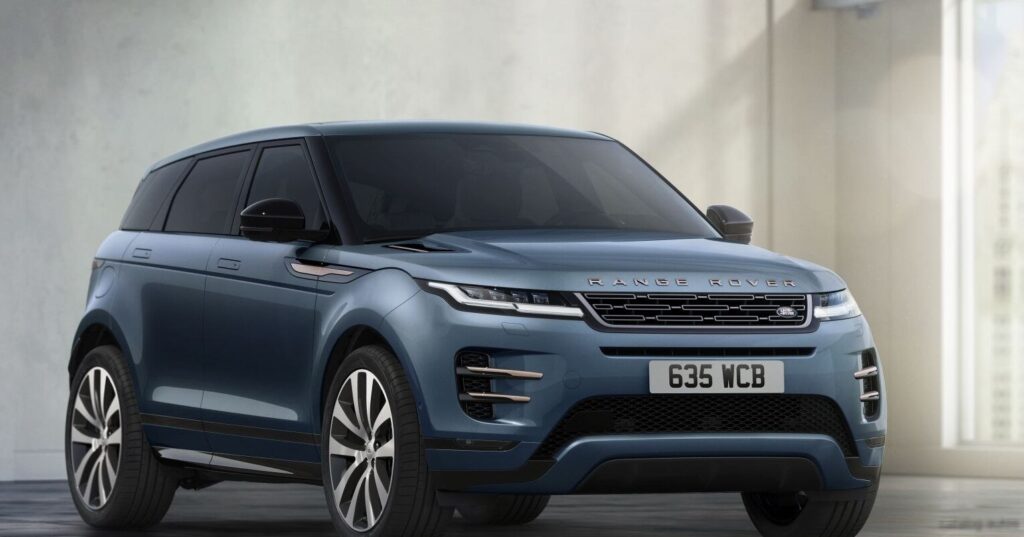
The 2023 Land Rover Range Rover Evoque II 1.5 P160 Mild Hybrid Automatic is a five-door compact SUV that forms part of the second generation Evoque lineup, which debuted in 2019 and received a significant facelift in 2023. This variant utilizes Land Rover’s Ingenium engine family, specifically a 1.5-liter three-cylinder gasoline engine coupled with a 48-volt mild hybrid system. The Evoque, since its original launch, has been a key model for Land Rover, appealing to a younger demographic seeking a stylish and capable SUV. The P160 trim aims to broaden the Evoque’s appeal by offering a more economical option without sacrificing the brand’s core values of luxury and off-road capability. It sits at the lower end of the Evoque range, below the more powerful P200 and P250 models.
Powertrain & Engine Architecture
At the heart of the 1.5 P160 is Land Rover’s Ingenium engine, a modular engine family designed for efficiency and scalability. This particular engine is a 1.5-liter turbocharged inline-three cylinder, designated as the J310. It produces 160 horsepower at 5500 rpm and 260 Nm (191.77 lb.-ft.) of torque between 1600 and 4000 rpm. The engine features direct fuel injection and a single twin-scroll turbocharger, enhancing responsiveness and reducing turbo lag. The mild hybrid system, utilizing a 48V electric motor, provides a small power boost during acceleration and enables smoother start-stop operation, improving fuel economy. The engine is paired with an eight-speed automatic transmission, providing smooth gear changes and contributing to overall efficiency. The transmission is calibrated to prioritize comfort and fuel economy over sporty performance in this specific configuration.
Driving Characteristics
The 1.5 P160 Evoque delivers a comfortable and refined driving experience, prioritizing ease of use over outright performance. Acceleration from 0-60 mph takes approximately 9.7 seconds, which is slower than the more powerful Evoque variants. The eight-speed automatic transmission is well-tuned for everyday driving, offering smooth shifts and adequate responsiveness. The mild hybrid system provides a subtle boost during acceleration, but it’s not particularly noticeable. The gear ratios are optimized for fuel efficiency, meaning the engine can feel slightly strained when climbing hills or during rapid acceleration. Compared to the four-cylinder P200, the P160 feels less powerful, but it offers a more relaxed and economical driving experience. The front-wheel-drive configuration contributes to improved fuel economy but limits off-road capability compared to all-wheel-drive models.
Equipment & Trim Levels
The 1.5 P160 typically comes with a generous level of standard equipment. Interior features generally include leather upholstery (or a high-quality fabric alternative), a touchscreen infotainment system with Apple CarPlay and Android Auto compatibility, and a suite of driver-assistance features such as lane departure warning, emergency braking, and front and rear parking sensors. Optional extras often include a panoramic sunroof, upgraded sound system, adaptive cruise control, and premium interior trim options. The dashboard layout is modern and minimalist, with a focus on intuitive controls. Trim levels can vary by market, but generally, the P160 serves as a well-equipped base model, with options available to personalize the vehicle.
Chassis & Braking
The Evoque II utilizes a sophisticated chassis design, featuring independent suspension all around. The front suspension employs McPherson struts with a coil spring and anti-roll bar, while the rear utilizes a multi-link setup with a stabilizer bar. This configuration provides a comfortable ride and good handling characteristics. The P160 variant typically features ventilated discs on the front wheels and solid discs on the rear, providing adequate stopping power for its weight class. ABS (Anti-lock Braking System) is standard, enhancing safety and control during emergency braking situations. The steering is electrically assisted, providing a light and precise feel.
Market Reception & Comparison
The 1.5 P160 Evoque has been generally well-received by critics as a sensible and economical entry point into the Range Rover Evoque range. Reviewers have praised its comfortable ride, refined interior, and fuel efficiency. However, some have noted its relatively modest performance compared to the more powerful variants. Compared to the P200, the P160 offers better fuel economy (around 7.8-8.1 l/100km) but sacrifices some performance. The P160’s mild hybrid system contributes to lower CO2 emissions, making it a more environmentally friendly option. In terms of reliability, the Ingenium engine family has proven to be generally robust, but regular maintenance is crucial to ensure long-term durability.
Legacy
The 1.5 P160 powertrain represents Land Rover’s commitment to offering a wider range of options to cater to diverse customer needs. While not the most powerful Evoque variant, it provides a compelling combination of luxury, efficiency, and affordability. The mild hybrid technology demonstrates Land Rover’s move towards electrification. On the used car market, the 1.5 P160 is likely to hold its value reasonably well, particularly if it has been well-maintained. Its fuel efficiency and lower running costs will appeal to buyers seeking a practical and stylish compact SUV. The long-term reliability of the Ingenium engine suggests that these models should provide years of dependable service.