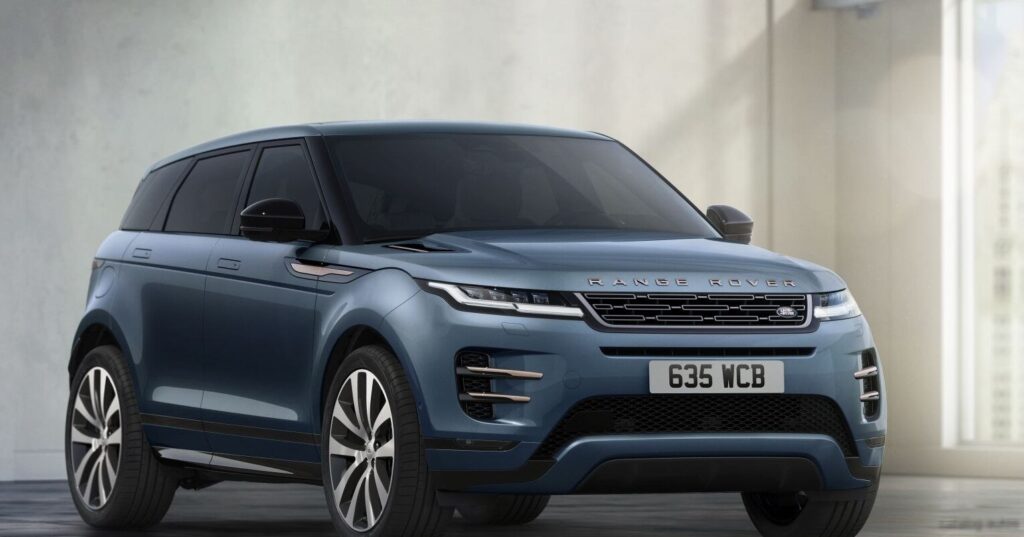
The Land Rover Range Rover Evoque II (facelift 2023) 1.5 P300e represents a significant step in the Evoque lineage, blending internal combustion with electric power. Introduced in June 2023, this plug-in hybrid (PHEV) variant aimed to broaden the Evoque’s appeal by offering improved fuel efficiency and reduced emissions while maintaining the brand’s hallmark luxury and capability. Positioned as a mid-to-premium trim within the Evoque II range, the P300e caters to buyers seeking a sophisticated and environmentally conscious SUV. It builds upon the L551 platform, also known as the 1HX0/A3 platform, shared with other Jaguar Land Rover products.
Technical Specifications
| Brand | Land Rover |
| Model | Range Rover Evoque |
| Generation | Range Rover Evoque II (facelift 2023) |
| Type (Engine) | 1.5 P300e (309 Hp) Plug-in Hybrid AWD Automatic |
| Start of production | June, 2023 |
| Powertrain Architecture | PHEV (Plug-in Hybrid Electric Vehicle) |
| Body type | SUV |
| Seats | 5 |
| Doors | 5 |
| Combined fuel consumption (WLTP) | 1.4-1.5 l/100 km (168 – 156.8 US mpg, 201.8 – 188.3 UK mpg, 71.4 – 66.7 km/l) |
| CO2 emissions (WLTP) | 31-34 g/km |
| Fuel Type | Petrol / electricity |
| Acceleration 0 – 100 km/h | 6.4 sec |
| Acceleration 0 – 62 mph | 6.4 sec |
| Acceleration 0 – 60 mph | 6.1 sec |
| Maximum speed | 213 km/h (132.35 mph) |
| Emission standard | Euro 6d |
| Weight-to-power ratio | 6.7 kg/Hp, 148.4 Hp/tonne |
| Weight-to-torque ratio | 3.9 kg/Nm, 259.4 Nm/tonne |
| Gross battery capacity | 14.9 kWh |
| Net (usable) battery capacity | 11.5 kWh |
| Battery technology | Lithium-ion (Li-Ion) |
| Battery location | Below the floor, under the rear seats |
| All-electric range (WLTP) | 62 km (38.53 mi) / 48 km (29.83 mi) |
| Electric motor power | 109 Hp |
| Electric motor model/code | TZ-180-X-S-C01 |
| Electric motor location | Rear axle, Transverse |
| Electric motor type | Synchronous |
| System power | 309 Hp @ 5500 rpm |
| System torque | 540 Nm @ 2000-2500 rpm (398.28 lb.-ft. @ 2000-2500 rpm) |
| Power | 200 Hp |
| Power per litre | 133.5 Hp/l |
| Engine layout | Front, Transverse |
| Engine Model/Code | Ingenium |
| Engine displacement | 1498 cm3 (91.41 cu. in.) |
| Number of cylinders | 3 |
| Engine configuration | Inline |
| Cylinder Bore | 83 mm (3.27 in.) |
| Piston Stroke | 92.29 mm (3.63 in.) |
| Compression ratio | 10.5:1 |
| Number of valves per cylinder | 4 |
| Fuel injection system | Direct injection |
| Engine aspiration | Turbocharger, Intercooler |
| Valvetrain | DOHC |
| Kerb Weight | 2082 kg (4590.02 lbs.) |
| Trunk (boot) space – minimum | 591 l (20.87 cu. ft.) |
| Trunk (boot) space – maximum | 1383 l (48.84 cu. ft.) |
| Fuel tank capacity | 56 l (14.79 US gal | 12.32 UK gal) |
| Permitted trailer load with brakes (12%) | 1600 kg (3527.4 lbs.) |
| Permitted trailer load without brakes | 750 kg (1653.47 lbs.) |
| Length | 4371 mm (172.09 in.) |
| Width with mirrors folded | 1996 mm (78.58 in.) |
| Width including mirrors | 2100 mm (82.68 in.) |
| Height | 1649 mm (64.92 in.) |
| Wheelbase | 2681 mm (105.55 in.) |
| Front track | 1625 mm (63.98 in.) |
| Rear (Back) track | 1632 mm (64.25 in.) |
| Front overhang | 880 mm (34.65 in.) |
| Rear overhang | 810 mm (31.89 in.) |
| Ride height (ground clearance) | 212 mm (8.35 in.) |
| Drag coefficient (Cd) | 0.34 |
| Minimum turning circle (turning diameter) | 11.6 m (38.06 ft.) |
| Approach angle | 22.2° |
| Departure angle | 30.6° |
| Ramp-over (brakeover) angle | 19.5° |
| Wading depth | 530 mm (20.87 in.) |
| Drivetrain Architecture | ICE permanently drives front wheels, electric motor drives rear wheels. Capable of full electric, ICE only, or mixed modes. |
| Drive wheel | All wheel drive (4×4) |
| Number of gears and type of gearbox | 8 gears, automatic transmission |
| Front suspension | Independent, type McPherson with coil spring and anti-roll bar |
| Rear suspension | Independent multi-link spring suspension with stabilizer |
| Front brakes | Ventilated discs, 349 mm |
| Rear brakes | Ventilated discs, 325 mm |
| Steering type | Steering rack and pinion |
| Power steering | Electric Steering |
| Wheel rims size | 18; 19; 20 |
Powertrain & Engine Architecture
The 1.5 P300e utilizes a sophisticated powertrain combining a 1.5-liter three-cylinder Ingenium gasoline engine with an electric motor. The engine, producing 200 horsepower, is turbocharged and features direct fuel injection. The electric motor, located on the rear axle, contributes an additional 109 horsepower. Combined, the system delivers a total output of 309 horsepower and 540 Nm (398.28 lb.-ft.) of torque. The engine code is part of the broader Ingenium family, known for its modularity and efficiency. The eight-speed automatic transmission, a ZF unit, is standard, optimized for both fuel economy and smooth shifting. The 14.9 kWh battery pack, positioned under the rear seats, provides an all-electric range of up to 62 km (38.53 miles) under WLTP testing. The powertrain operates in several modes, including EV (electric only), Hybrid, and Save (prioritizes engine use to preserve battery charge).
Driving Characteristics
The P300e offers a unique driving experience. In electric mode, it provides near-silent acceleration and instant torque, making it ideal for urban driving. Switching to Hybrid mode seamlessly blends the power of the engine and motor, delivering brisk acceleration – 0-60 mph in approximately 6.1 seconds. While the three-cylinder engine isn’t as refined as the four- or six-cylinder options available in other Evoque trims, the electric motor effectively fills in torque gaps, resulting in a responsive feel. The rear-mounted electric motor contributes to a subtle all-wheel-drive bias, enhancing traction. Compared to the 2.0-liter four-cylinder models, the P300e prioritizes efficiency over outright performance, but the combined output provides ample power for most driving situations. The automatic transmission is well-tuned, offering smooth gear changes and contributing to a comfortable ride.
Equipment & Trim Levels
The 1.5 P300e typically came well-equipped, reflecting its mid-to-premium positioning. Standard features included leather upholstery, a touchscreen infotainment system with Apple CarPlay and Android Auto compatibility, navigation, climate control, and a suite of advanced driver-assistance systems (ADAS) such as lane-keeping assist, adaptive cruise control, and automatic emergency braking. Optional extras included a panoramic sunroof, premium audio system, and upgraded interior trim materials. Trim levels varied by market, but generally offered increasing levels of luxury and technology. The P300e was often available in SE, HSE, and Autobiography trims, with the latter offering the most comprehensive feature set.
Chassis & Braking
The Evoque II utilizes a robust chassis with independent suspension at all four corners. The front suspension employs a McPherson strut setup, while the rear features a multi-link design. Stabilizer bars are fitted front and rear to minimize body roll. Braking duties are handled by ventilated discs on all wheels, with the front discs measuring 349mm and the rear discs 325mm. The P300e’s added weight due to the battery pack necessitated slightly firmer suspension tuning compared to the standard Evoque models. The electric motor’s regenerative braking system contributes to improved stopping power and energy recovery.
Market Reception & Comparison
The Range Rover Evoque P300e was generally well-received by automotive critics. Praise was directed towards its fuel efficiency, smooth electric driving experience, and luxurious interior. However, some reviewers noted the three-cylinder engine’s lack of refinement compared to the larger engines in the Evoque lineup. Compared to the 2.0-liter gasoline and diesel models, the P300e offered significantly better fuel economy and lower emissions, particularly for drivers who frequently commute in urban areas. The P300e’s price point was higher than the base models, reflecting the added cost of the hybrid technology. Reliability reports have been generally positive, with the Ingenium engine family proving to be relatively robust.
Legacy
The Range Rover Evoque P300e represents a pivotal moment in Land Rover’s transition towards electrification. It demonstrated the brand’s commitment to reducing its environmental impact while maintaining its reputation for luxury and capability. On the used car market, the P300e holds its value relatively well, appealing to buyers seeking a stylish and efficient SUV. The powertrain’s long-term reliability appears promising, although regular maintenance of the battery pack and hybrid components is crucial. The P300e paved the way for Land Rover’s broader range of plug-in hybrid and fully electric vehicles, solidifying its position as a leader in the premium SUV segment.