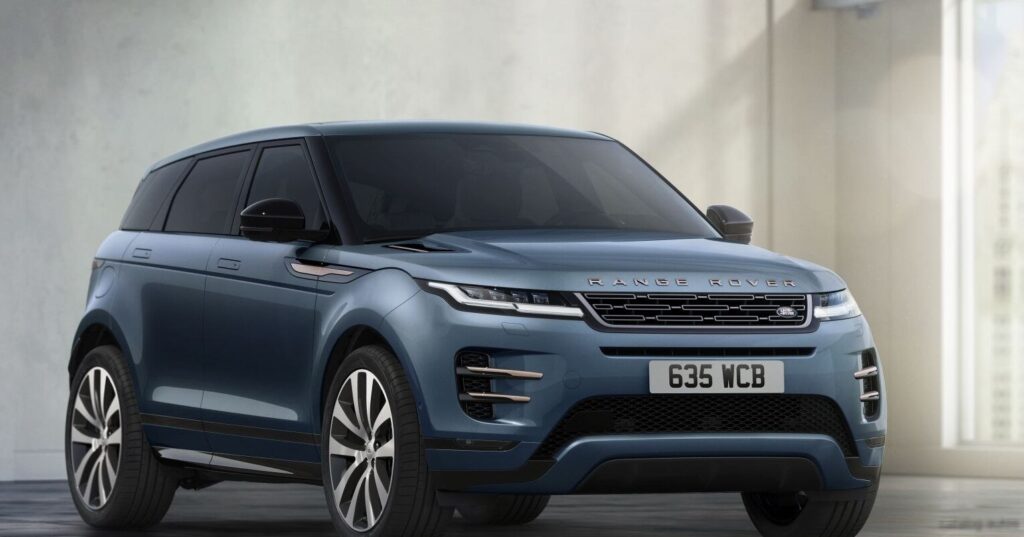
The Land Rover Range Rover Evoque II facelift, introduced in June 2023, represents a mid-cycle refresh of the second-generation Evoque (L551). The 2.0 D200 variant, equipped with a 204 horsepower turbocharged diesel engine and a mild-hybrid system paired with an automatic transmission and all-wheel drive, occupies a significant position in the Evoque lineup. It’s positioned as a balance between fuel efficiency and performance, appealing to buyers seeking a premium compact SUV experience without the higher costs associated with the more powerful trims. This model is primarily aimed at the European and global markets, offering a sophisticated blend of luxury, technology, and capability within the Range Rover family.
Technical Specifications
| Brand | Land Rover |
| Model | Range Rover Evoque |
| Generation | Range Rover Evoque II (facelift 2023) |
| Type (Engine) | 2.0 D200 (204 Hp) Mild Hybrid AWD Automatic |
| Start of production | June, 2023 |
| Powertrain Architecture | MHEV (Mild Hybrid Electric Vehicle) |
| Body type | SUV |
| Seats | 5 |
| Doors | 5 |
| Combined fuel consumption (WLTP) | 6.3-6.9 l/100 km (37.3 – 34.1 US mpg) |
| CO2 emissions (WLTP) | 166-181 g/km |
| Fuel consumption (NEDC) | 5.3 l/100 km (44.4 US mpg) |
| CO2 emissions (NEDC) | 139 g/km |
| Fuel Type | Diesel |
| Acceleration 0 – 100 km/h | 8.5 sec |
| Acceleration 0 – 62 mph | 8.5 sec |
| Acceleration 0 – 60 mph | 7.9 sec |
| Maximum speed | 213 km/h (132.35 mph) |
| Emission standard | Euro 6d |
| Weight-to-power ratio | 9.1 kg/Hp |
| Weight-to-torque ratio | 4.3 kg/Nm |
| Gross battery capacity | 0.2 kWh |
| Battery voltage | 48 V |
| Battery technology | Lithium-ion (Li-Ion) |
| Power | 204 Hp @ 3750 rpm |
| Torque | 430 Nm @ 1750-2500 rpm (317.15 lb.-ft. @ 1750-2500 rpm) |
| Engine layout | Front, Transverse |
| Engine Model/Code | Ingenium |
| Engine displacement | 1997 cm3 (121.86 cu. in.) |
| Number of cylinders | 4 |
| Engine configuration | Inline |
| Cylinder Bore | 83 mm (3.27 in.) |
| Piston Stroke | 92.31 mm (3.63 in.) |
| Compression ratio | 16.5:1 |
| Number of valves per cylinder | 4 |
| Fuel injection system | Diesel Commonrail |
| Engine aspiration | Turbocharger, Intercooler |
| Valvetrain | DOHC |
| Kerb Weight | 1866 kg (4113.83 lbs.) |
| Max. weight | 2490 kg (5489.51 lbs.) |
| Max load | 624 kg (1375.68 lbs.) |
| Trunk (boot) space – minimum | 591 l (20.87 cu. ft.) |
| Trunk (boot) space – maximum | 1383 l (48.84 cu. ft.) |
| Fuel tank capacity | 65 l (17.17 US gal) |
| AdBlue tank | 17.3 l (4.57 US gal) |
| Max. roof load | 75 kg (165.35 lbs.) |
| Permitted trailer load with brakes (12%) | 2000 kg (4409.25 lbs.) |
| Permitted trailer load without brakes | 750 kg (1653.47 lbs.) |
| Permitted towbar download | 100 kg (220.46 lbs.) |
| Length | 4371 mm (172.09 in.) |
| Width with mirrors folded | 1996 mm (78.58 in.) |
| Width including mirrors | 2100 mm (82.68 in.) |
| Height | 1649 mm (64.92 in.) |
| Wheelbase | 2681 mm (105.55 in.) |
| Front track | 1625 mm (63.98 in.) |
| Rear track | 1632 mm (64.25 in.) |
| Front overhang | 880 mm (34.65 in.) |
| Rear overhang | 810 mm (31.89 in.) |
| Ride height (ground clearance) | 212 mm (8.35 in.) |
| Drag coefficient (Cd) | 0.32 |
| Minimum turning circle | 11.6 m (38.06 ft.) |
| Front suspension | Independent, McPherson with coil spring and anti-roll bar |
| Rear suspension | Independent multi-link spring suspension with stabilizer |
| Front brakes | Ventilated discs, 349 mm |
| Rear brakes | Disc, 300 mm |
| Number of gears | 9 |
| Type of gearbox | automatic transmission |
INTRODUCTION
The 2023 Range Rover Evoque II D200 represents Land Rover’s commitment to offering a refined and efficient compact SUV. Built on the Premium Transverse Architecture (PTA), the Evoque II, and specifically this D200 variant, aims to deliver a luxurious experience with a focus on modern technology and sustainable performance. The facelift brought subtle styling updates, enhanced interior features, and improvements to the infotainment system. The D200 trim, with its mild-hybrid diesel powertrain, is designed to appeal to buyers who prioritize fuel economy and lower running costs without sacrificing the Range Rover brand’s hallmark comfort and capability.
Powertrain & Engine Architecture
At the heart of the Evoque D200 lies the Ingenium 2.0-liter four-cylinder diesel engine. This engine, designated as part of the Ingenium family, utilizes a sophisticated diesel commonrail fuel injection system and a single turbocharger with an intercooler to deliver a balance of power and efficiency. The engine produces 204 horsepower at 3750 rpm and 430 Nm (317 lb-ft) of torque between 1750 and 2500 rpm. The mild-hybrid system, incorporating a 48V electrical architecture, utilizes a belt-integrated starter generator (BiSG) to provide a small power boost during acceleration and enable smoother start-stop operation. This system also allows for regenerative braking, capturing energy during deceleration to recharge the battery. The engine features a double overhead camshaft (DOHC) valvetrain with four valves per cylinder. The powertrain is mated to a nine-speed automatic transmission, carefully tuned to optimize fuel economy and provide smooth gear changes.
Driving Characteristics
The 2.0 D200 automatic offers a comfortable and refined driving experience. While not overtly sporty, the engine provides adequate power for everyday driving and highway cruising. The nine-speed automatic transmission contributes to relaxed long-distance journeys, with well-chosen gear ratios that keep the engine within its optimal torque band. Acceleration from 0-60 mph takes approximately 7.9 seconds. Compared to higher-output petrol variants, the D200 prioritizes fuel efficiency over outright performance. The mild-hybrid system provides a subtle but noticeable boost during acceleration, improving responsiveness. The all-wheel-drive system provides confident traction in various weather conditions, enhancing stability and control.
Equipment & Trim Levels
The D200 trim typically includes a generous level of standard equipment. Interior features generally include leather upholstery, heated front seats, a touchscreen infotainment system with Apple CarPlay and Android Auto compatibility, and a suite of advanced driver-assistance systems (ADAS) such as lane keep assist, emergency braking, and adaptive cruise control. Optional extras often include a panoramic sunroof, premium audio system, and upgraded interior trim materials. The dashboard layout is modern and minimalist, with a focus on intuitive controls and a high-quality finish.
Chassis & Braking
The Evoque D200 utilizes an independent suspension system, with McPherson struts at the front and a multi-link setup at the rear. This configuration provides a comfortable ride quality and good handling characteristics. Stabilizer bars are fitted to both axles to reduce body roll during cornering. The braking system consists of ventilated discs at the front and solid discs at the rear. Anti-lock braking system (ABS) and electronic stability control (ESC) are standard features, enhancing safety and control. The vehicle’s weight of approximately 1866 kg (4114 lbs) is managed effectively by the suspension and braking systems.
Market Reception & Comparison
The Range Rover Evoque II D200 has been generally well-received by automotive critics. It’s praised for its stylish design, luxurious interior, and comfortable ride. The mild-hybrid diesel powertrain is appreciated for its fuel efficiency and reduced emissions. Compared to the petrol-powered Evoque variants, the D200 offers superior fuel economy, making it a more cost-effective option for high-mileage drivers. However, some critics note that the diesel engine can be slightly noisier than the petrol alternatives. Compared to competitors such as the Audi Q3 and BMW X1, the Evoque D200 stands out with its distinctive styling and premium brand image.
Legacy
The Ingenium engine family, including the 2.0-liter diesel used in the Evoque D200, has proven to be relatively reliable. The mild-hybrid system adds a layer of complexity, but early reports suggest it has been robust. On the used car market, the Evoque II D200 is expected to hold its value well due to the Range Rover brand’s reputation for quality and desirability. Regular maintenance, including oil changes and adherence to the manufacturer’s service schedule, is crucial for ensuring the long-term reliability of this powertrain. The D200 variant represents a significant step towards Land Rover’s electrification strategy, offering a bridge between traditional internal combustion engines and fully electric vehicles.