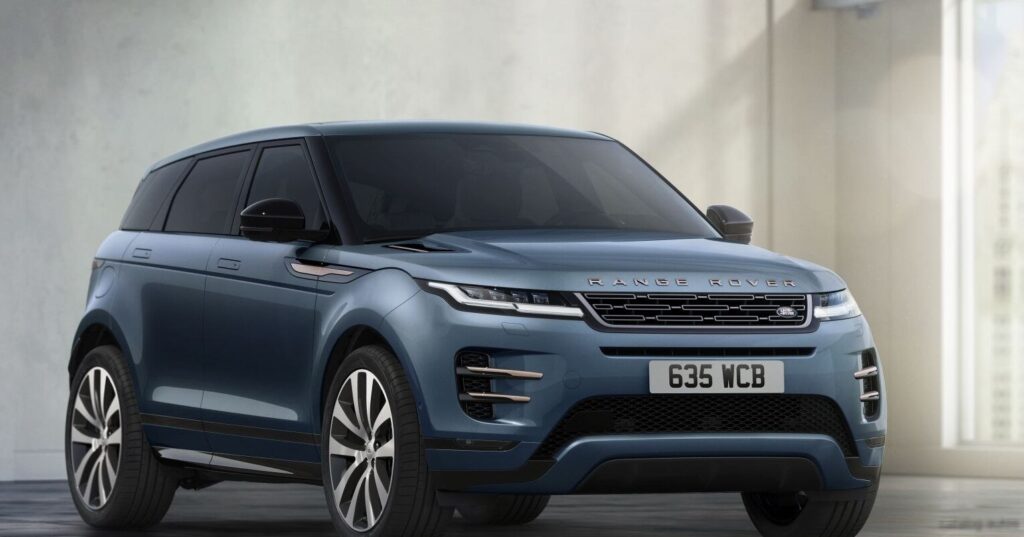
The Land Rover Range Rover Evoque II facelift, specifically the 2.0 P250 variant introduced in June 2023, represents a mid-cycle refresh of the second-generation Evoque (L551). Positioned as a mid-range offering within the Evoque lineup, this model combines a 2.0-liter turbocharged four-cylinder engine with mild hybrid technology and an all-wheel-drive system, paired with a nine-speed automatic transmission. It builds upon the success of the original Evoque, aiming to refine the vehicle’s styling, technology, and efficiency while maintaining its premium compact SUV appeal for the North American and global markets.
Technical Specifications
| Brand | Land Rover |
| Model | Range Rover Evoque |
| Generation | Range Rover Evoque II (facelift 2023) |
| Type (Engine) | 2.0 P250 (249 Hp) Mild Hybrid AWD Automatic |
| Start of production | June, 2023 |
| Powertrain Architecture | MHEV (Mild Hybrid Electric Vehicle) |
| Body type | SUV |
| Seats | 5 |
| Doors | 5 |
| Combined fuel consumption (WLTP) | 8.6-9.3 l/100 km (27.4 – 25.3 US mpg) |
| CO2 emissions (WLTP) | 195-211 g/km |
| Fuel consumption (NEDC) | 7.7 l/100 km (30.5 US mpg) |
| CO2 emissions (NEDC) | 175 g/km |
| Fuel Type | Petrol (Gasoline) |
| Acceleration 0 – 100 km/h | 7.6 sec |
| Acceleration 0 – 62 mph | 7.6 sec |
| Acceleration 0 – 60 mph | 7 sec |
| Maximum speed | 230 km/h (142.92 mph) |
| Emission standard | Euro 6d |
| Weight-to-power ratio | 7.3 kg/Hp |
| Weight-to-torque ratio | 5 kg/Nm |
| Gross battery capacity | 0.2 kWh |
| Battery voltage | 48 V |
| Battery technology | Lithium-ion (Li-Ion) |
| Power | 249 Hp @ 5500 rpm |
| Torque | 365 Nm @ 1300-4500 rpm (269.21 lb.-ft. @ 1300-4500 rpm) |
| Engine layout | Front, Transverse |
| Engine Model/Code | Ingenium |
| Engine displacement | 1997 cm3 (121.86 cu. in.) |
| Number of cylinders | 4 |
| Engine configuration | Inline |
| Cylinder Bore | 83 mm (3.27 in.) |
| Piston Stroke | 92.29 mm (3.63 in.) |
| Compression ratio | 10.5:1 |
| Number of valves per cylinder | 4 |
| Fuel injection system | Direct injection |
| Engine aspiration | Twin-scroll turbo, Intercooler |
| Valvetrain | DOHC |
| Kerb Weight | 1818 kg (4008 lbs.) |
| Max. weight | 2430 kg (5357.23 lbs.) |
| Max load | 612 kg (1349.23 lbs.) |
| Trunk (boot) space – minimum | 591 l (20.87 cu. ft.) |
| Trunk (boot) space – maximum | 1383 l (48.84 cu. ft.) |
| Fuel tank capacity | 67 l (17.7 US gal) |
| Length | 4371 mm (172.09 in.) |
| Width with mirrors folded | 1996 mm (78.58 in.) |
| Width including mirrors | 2100 mm (82.68 in.) |
| Height | 1649 mm (64.92 in.) |
| Wheelbase | 2681 mm (105.55 in.) |
| Front track | 1625 mm (63.98 in.) |
| Rear track | 1632 mm (64.25 in.) |
| Number of gears and type of gearbox | 9 gears, automatic transmission |
INTRODUCTION
The 2023 Range Rover Evoque II P250 represents Land Rover’s continued refinement of the compact luxury SUV segment. Built on the Premium Transverse Architecture (PTA), the Evoque aims to deliver a blend of style, capability, and technology. The facelift introduced in 2023 brought updated exterior styling, an enhanced interior with new technology features, and powertrain improvements, including the integration of mild hybrid technology. This P250 variant serves as a sweet spot in the range, offering a significant power upgrade over the base models without reaching the price point of the higher-performance trims.
Powertrain & Engine Architecture
At the heart of the Evoque P250 lies Land Rover’s Ingenium 2.0-liter turbocharged four-cylinder engine. This engine, designated as part of the Ingenium family, utilizes direct fuel injection and a twin-scroll turbocharger to deliver 249 horsepower and 269 lb-ft of torque. The mild hybrid system, a 48-volt electrical architecture, incorporates a belt-integrated starter generator (BiSG) that assists the engine during acceleration and enables smoother start-stop functionality. This system contributes to improved fuel economy and reduced emissions. The engine’s DOHC valvetrain and carefully tuned engine management system optimize combustion efficiency. The engine is transversely mounted, driving all four wheels through a sophisticated nine-speed automatic transmission. This transmission is known for its smooth shifts and wide gear ratio spread, contributing to both fuel efficiency and performance.
Driving Characteristics
The Evoque P250 offers a comfortable and refined driving experience. The mild hybrid system provides a noticeable boost in responsiveness during acceleration, masking some of the turbo lag that can be present in smaller displacement turbocharged engines. The nine-speed automatic transmission is well-programmed, offering smooth and timely gear changes. While not a sports car, the P250 provides adequate power for everyday driving and highway passing maneuvers, achieving 0-60 mph in around 7 seconds. Compared to lower-powered Evoque variants, the P250 feels significantly more capable, especially when fully loaded or tackling inclines. The all-wheel-drive system provides confident traction in various weather conditions, making it a suitable vehicle for year-round use. The steering is light and precise, offering a good balance between comfort and control.
Equipment & Trim Levels
The P250 trim typically includes a generous array of standard features. Interior appointments generally include leather upholstery, power-adjustable front seats, a touchscreen infotainment system with Apple CarPlay and Android Auto compatibility, and a suite of advanced driver-assistance systems (ADAS) such as lane keeping assist, automatic emergency braking, and adaptive cruise control. Optional extras often include a panoramic sunroof, premium audio system, heated and ventilated seats, and upgraded interior trim materials. The 2023 facelift brought a redesigned dashboard with a larger touchscreen and a more minimalist aesthetic. Exterior features typically include LED headlights, alloy wheels (ranging in size from 18 to 21 inches), and a power liftgate.
Chassis & Braking
The Evoque P250 utilizes an independent suspension system at all four corners, with McPherson struts at the front and a multi-link setup at the rear. This configuration provides a comfortable ride quality while maintaining good handling characteristics. Stabilizer bars are fitted front and rear to reduce body roll during cornering. The braking system consists of ventilated discs on all four wheels, providing ample stopping power. The electronic parking brake with automatic hold assist is standard. The vehicle’s Terrain Response system allows drivers to select different driving modes optimized for various surfaces, such as grass, gravel, snow, and mud.
Market Reception & Comparison
The Range Rover Evoque, in general, has been well-received by critics and consumers alike, praised for its stylish design, luxurious interior, and capable performance. The P250 variant strikes a good balance between performance and fuel economy, making it a popular choice for buyers who want a more powerful engine without sacrificing efficiency. Compared to the base Evoque models, the P250 offers a noticeable performance upgrade. While the higher-end trims offer even more power and luxury features, the P250 provides a compelling value proposition. Fuel economy figures are competitive within the luxury compact SUV segment, although not class-leading. Reliability has been generally good, although some owners have reported minor issues with the infotainment system.
Legacy
The Land Rover Range Rover Evoque II P250, as a representative of the facelifted second generation, is expected to maintain a strong position in the used car market. The Ingenium engine, while relatively new, has proven to be generally reliable, and the mild hybrid system adds a layer of future-proofing. The Evoque’s enduring appeal, based on its distinctive styling and brand cachet, should ensure continued demand for this model in the years to come. Its blend of luxury, capability, and technology makes it a desirable option for buyers seeking a premium compact SUV.