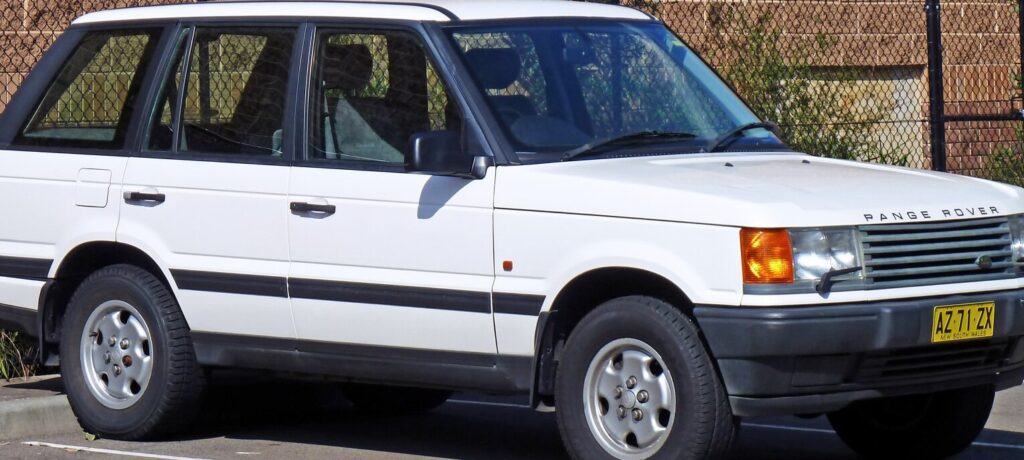
The Land Rover Range Rover II, produced from 1994 to 2002, represented a significant evolution of the original Range Rover, blending luxury with off-road capability. The 4.0-liter (3947 cc) variant, generating 185 horsepower, was introduced in 1998 and continued through 2001. This engine option positioned itself as a mid-range offering within the Range Rover II lineup, slotting between the base 2.5-liter diesel and the more potent 4.6-liter V8 models. It aimed to provide a balance of performance and fuel economy for buyers seeking a capable luxury SUV. This particular configuration was primarily sold in European and select international markets, with limited availability in the United States.
Technical Specifications
| Brand | Land Rover |
| Model | Range Rover |
| Generation | Range Rover II |
| Type (Engine) | 4.0 (185 Hp) 4×4 |
| Start of production | 1998 |
| End of production | 2001 |
| Powertrain Architecture | Internal Combustion engine |
| Body type | SUV |
| Seats | 5 |
| Doors | 5 |
| Fuel consumption (urban) | 22.5 l/100 km (10.5 US mpg) |
| Fuel consumption (extra urban) | 12.6 l/100 km (18.7 US mpg) |
| Fuel Type | Petrol (Gasoline) |
| Acceleration 0 – 100 km/h | 10.5 sec |
| Acceleration 0 – 62 mph | 10.5 sec |
| Acceleration 0 – 60 mph | 10 sec |
| Maximum speed | 190 km/h (118.06 mph) |
| Weight-to-power ratio | 11.5 kg/Hp |
| Weight-to-torque ratio | 6.2 kg/Nm |
| Power | 185 Hp @ 4750 rpm |
| Power per litre | 46.9 Hp/l |
| Torque | 340 Nm @ 2600 rpm (250.77 lb.-ft. @ 2600 rpm) |
| Engine layout | Front, Longitudinal |
| Engine displacement | 3947 cm3 (240.86 cu. in.) |
| Number of cylinders | 8 |
| Engine configuration | V-engine |
| Cylinder Bore | 94 mm (3.7 in.) |
| Piston Stroke | 71.1 mm (2.8 in.) |
| Compression ratio | 9.35:1 |
| Number of valves per cylinder | 2 |
| Fuel injection system | Multi-port manifold injection |
| Engine aspiration | Naturally aspirated engine |
| Engine oil capacity | 6.6 l (6.97 US qt | 5.81 UK qt) |
| Coolant | 11.3 l (11.94 US qt | 9.94 UK qt) |
| Kerb Weight | 2120 kg (4673.8 lbs.) |
| Max. weight | 2780 kg (6128.85 lbs.) |
| Max load | 660 kg (1455.05 lbs.) |
| Trunk (boot) space – maximum | 520 l (18.36 cu. ft.) |
| Fuel tank capacity | 100 l (26.42 US gal | 22 UK gal) |
| Length | 4713 mm (185.55 in.) |
| Width | 1853 mm (72.95 in.) |
| Height | 1853 mm (72.95 in.) |
| Wheelbase | 2745 mm (108.07 in.) |
| Front track | 1540 mm (60.63 in.) |
| Rear (Back) track | 1530 mm (60.24 in.) |
| Drive wheel | All wheel drive (4×4) |
| Number of gears and type of gearbox | 5 gears, manual transmission |
| Front suspension | Air suspension |
| Rear suspension | Air suspension |
| Front brakes | Ventilated discs |
| Rear brakes | Disc |
| Assisting systems | ABS (Anti-lock braking system) |
| Power steering | Hydraulic Steering |
| Tires size | 235/70R16 |
Powertrain & Engine Architecture
The heart of this Range Rover II variant is the 4.0-liter V8 engine, internally designated as the 4.0 GEMS (Global Engine Management System). This engine, a descendant of the Buick-Rover V8 collaboration, featured a 90-degree V-angle and a cast-iron block with aluminum cylinder heads. The GEMS system employed multi-port fuel injection and a distributorless ignition system for improved efficiency and reliability. The engine produced 185 horsepower at 4750 rpm and 340 Nm (250.77 lb-ft) of torque at 2600 rpm. The five-speed manual transmission was the standard offering for this engine, providing drivers with greater control over the vehicle’s power delivery. While an automatic transmission was available, the manual was favored by enthusiasts for its responsiveness and engagement.
Driving Characteristics
The 4.0-liter engine, coupled with the manual transmission, offered a respectable driving experience for its time. Acceleration to 60 mph took approximately 10 seconds, and the vehicle could reach a top speed of 118 mph. The engine’s torque output provided adequate pulling power for both on-road cruising and off-road excursions. Compared to the 4.6-liter V8, the 4.0-liter felt less powerful, but it offered a more balanced feel and slightly improved fuel economy. The manual transmission allowed for precise gear selection, enhancing driver control, particularly in challenging terrain. The gear ratios were well-suited for both highway driving and low-speed off-road maneuvering.
Equipment & Trim Levels
The 4.0-liter manual Range Rover II typically came equipped with a respectable level of standard features. These included power windows, power locks, air conditioning, and a basic audio system. Interior upholstery was typically cloth, although leather was available as an optional upgrade. Dashboard configuration was relatively straightforward, with analog gauges providing essential information. Common optional extras included a sunroof, upgraded audio systems, and heated seats. The trim level was generally considered a step up from the base models, offering a more refined interior and a more comprehensive feature set.
Chassis & Braking
The Range Rover II utilized a robust ladder-frame chassis, providing a solid foundation for both on-road comfort and off-road durability. The suspension system featured air springs on both the front and rear axles, offering adjustable ride height and a comfortable ride quality. Braking duties were handled by ventilated discs at the front and solid discs at the rear, assisted by an anti-lock braking system (ABS). The vehicle’s weight of approximately 2120 kg (4673.8 lbs) required a capable braking system to ensure safe stopping distances.
Market Reception & Comparison
The 4.0-liter manual Range Rover II received generally positive reviews from automotive critics. It was praised for its blend of luxury, capability, and relative affordability. Compared to the more expensive 4.6-liter V8 models, the 4.0-liter offered a compelling value proposition. Fuel economy, while not exceptional, was better than that of the larger engine. Reliability was generally good, although Range Rovers of this era were known to require regular maintenance. The manual transmission was appreciated by enthusiasts who preferred a more engaging driving experience.
Legacy
The 4.0-liter engine in the Range Rover II proved to be a relatively durable and reliable powertrain. Today, these vehicles are sought after by enthusiasts and collectors. While maintenance costs can be significant due to the vehicle’s age and complexity, the 4.0-liter engine is generally considered to be less problematic than the 4.6-liter V8. The manual transmission variants are particularly desirable, as they offer a more unique and engaging driving experience. The Range Rover II 4.0 remains a capable and comfortable luxury SUV, representing a significant chapter in Land Rover’s history.