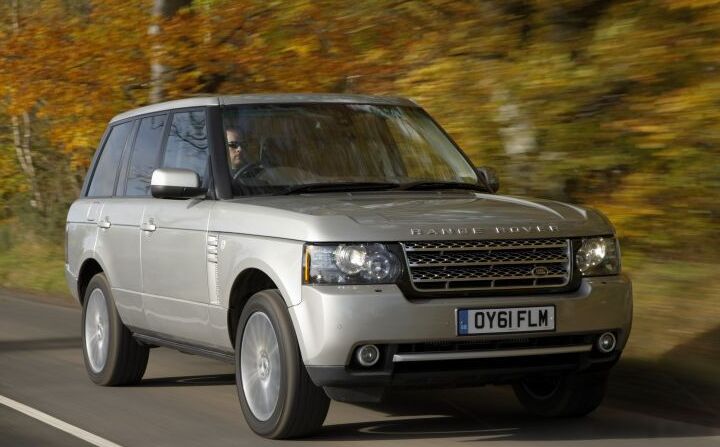
The Land Rover Range Rover III, specifically the facelifted version introduced in 2009, represented a significant evolution of the iconic luxury SUV. Production of the 5.0 LR V8 (510 Hp) AWD Automatic variant spanned from 2011 to 2012, positioning it as the flagship performance model within the Range Rover III lineup. This iteration built upon the established reputation for off-road capability and opulent interiors, adding a substantial boost in power and refinement. It was primarily marketed towards buyers seeking a high-performance luxury SUV with uncompromising capability, competing with vehicles like the Porsche Cayenne Turbo and BMW X5 M.
Technical Specifications
| Brand | Land Rover |
| Model | Range Rover |
| Generation | Range Rover III (facelift 2009) |
| Type (Engine) | 5.0 LR V8 (510 Hp) AWD Automatic |
| Start of production | 2011 |
| End of production | 2012 |
| Powertrain Architecture | Internal Combustion engine |
| Body type | SUV |
| Seats | 5 |
| Doors | 5 |
| Fuel consumption (urban) | 22.6 l/100 km (10.4 US mpg, 12.5 UK mpg, 4.4 km/l) |
| Fuel consumption (extra urban) | 10.4 l/100 km (22.6 US mpg, 27.2 UK mpg, 9.6 km/l) |
| Fuel consumption (combined) | 14.9 l/100 km (15.8 US mpg, 19 UK mpg, 6.7 km/l) |
| CO2 emissions | 348 g/km |
| Fuel Type | Petrol (Gasoline) |
| Acceleration 0 – 100 km/h | 6.2 sec |
| Acceleration 0 – 62 mph | 6.2 sec |
| Acceleration 0 – 60 mph | 5.9 sec |
| Maximum speed | 225 km/h (139.81 mph) |
| Emission standard | Euro 5 |
| Power | 510 Hp @ 6000-6500 rpm |
| Power per litre | 102 Hp/l |
| Torque | 625 Nm @ 2500-5500 rpm (460.98 lb.-ft. @ 2500-5500 rpm) |
| Engine layout | Front, Longitudinal |
| Engine Model/Code | 508PS |
| Engine displacement | 4999 cm3 (305.06 cu. in.) |
| Number of cylinders | 8 |
| Engine configuration | V-engine |
| Cylinder Bore | 92.5 mm (3.64 in.) |
| Piston Stroke | 93 mm (3.66 in.) |
| Compression ratio | 11.5:1 |
| Number of valves per cylinder | 4 |
| Fuel injection system | Multi-port manifold injection |
| Engine aspiration | Supercharger, Intercooler |
| Valvetrain | OHC |
| Engine oil capacity | 8 l (8.45 US qt | 7.04 UK qt) |
| Coolant | 19.8 l (20.92 US qt | 17.42 UK qt) |
| Fuel tank capacity | 101 l (26.68 US gal | 22.22 UK gal) |
| Length | 4972 mm (195.75 in.) |
| Width including mirrors | 2216 mm (87.24 in.) |
| Height | 1865 mm (73.43 in.) |
| Wheelbase | 2880 mm (113.39 in.) |
| Drag coefficient (Cd) | 0.38 |
| Minimum turning circle | 12.6 m (41.34 ft.) |
| Drive wheel | All wheel drive (4×4) |
| Number of gears | 6 |
| Gearbox type | Automatic transmission |
| Front suspension | Independent type McPherson |
| Rear suspension | Double wishbone |
| Front brakes | Ventilated discs |
| Rear brakes | Ventilated discs |
| Assisting systems | ABS (Anti-lock braking system) |
| Steering type | Steering rack and pinion |
| Power steering | Electric Steering |
Powertrain & Engine Architecture
At the heart of the 2011-2012 Range Rover III 5.0 LR V8 was the 5.0-liter supercharged V8 engine, internally designated as the 508PS. This engine represented a significant upgrade over the naturally aspirated 5.0-liter V8 offered in other trims. The engine utilized a Roots-type supercharger with an intercooler to force air into the cylinders, boosting power output to 510 horsepower and 625 Nm (460.98 lb-ft) of torque. Fuel delivery was managed by a multi-port fuel injection system. The engine featured double overhead camshafts (DOHC) and four valves per cylinder, contributing to its high volumetric efficiency. The engine was mounted longitudinally in the chassis. The six-speed automatic transmission, sourced from ZF, was specifically tuned to handle the increased power and torque. This transmission featured a torque converter and offered both manual shift control and a fully automatic mode.
Driving Characteristics
The 5.0 LR V8 Automatic variant delivered a markedly different driving experience compared to the lower-powered Range Rover III models. Acceleration was brisk, with 0-60 mph times consistently around 5.9 seconds. The supercharger provided immediate throttle response and a broad torque curve, making overtaking effortless. While the six-speed automatic transmission was smooth and responsive, it wasn’t as quick-shifting as some of the newer eight or nine-speed automatics found in later Range Rover models. The all-wheel-drive system provided excellent traction in various conditions, and the air suspension offered a comfortable ride, even on rough terrain. However, the added weight of the supercharged engine and drivetrain did slightly impact handling agility compared to lighter Range Rover trims.
Equipment & Trim Levels
The 5.0 LR V8 Automatic typically came equipped with a high level of standard features. These included leather upholstery, heated and ventilated front seats, a premium audio system, navigation, and a panoramic sunroof. Optional extras included rear-seat entertainment, adaptive cruise control, and upgraded interior trim materials. The exterior styling was largely consistent across the Range Rover III range, but the 5.0 LR V8 often featured unique badging and larger alloy wheels. The interior typically featured wood or metal trim accents, depending on the specific package selected.
Chassis & Braking
The Range Rover III chassis was built around a robust monocoque construction. The 5.0 LR V8 variant utilized an independent McPherson strut front suspension and a double wishbone rear suspension. Air suspension was standard, providing adjustable ride height and damping. Braking duties were handled by ventilated discs on all four wheels, coupled with an anti-lock braking system (ABS). The braking system was adequately sized for the vehicle’s weight and performance, providing confident stopping power. Electric power steering offered a precise and responsive feel.
Market Reception & Comparison
The 5.0 LR V8 Automatic Range Rover III was generally well-received by automotive critics. It was praised for its powerful engine, luxurious interior, and off-road capability. However, its fuel economy was a common criticism, with combined fuel consumption averaging around 14.9 l/100 km (15.8 US mpg). Compared to the naturally aspirated 5.0-liter V8, the supercharged version offered a significant performance boost but at the cost of increased fuel consumption and a slightly higher price tag. Against competitors like the Porsche Cayenne Turbo, the Range Rover offered a more luxurious and comfortable ride, while the Cayenne provided sharper handling.
Legacy
The 5.0 LR V8 engine proved to be a relatively reliable powertrain, although regular maintenance is crucial. Common issues include oil leaks and occasional problems with the supercharger. In the used car market, the 2011-2012 Range Rover III 5.0 LR V8 Automatic commands a premium price due to its performance and exclusivity. These vehicles are sought after by enthusiasts who appreciate the combination of luxury, capability, and power. While fuel economy remains a concern, the 5.0 LR V8 continues to be a desirable and capable luxury SUV.