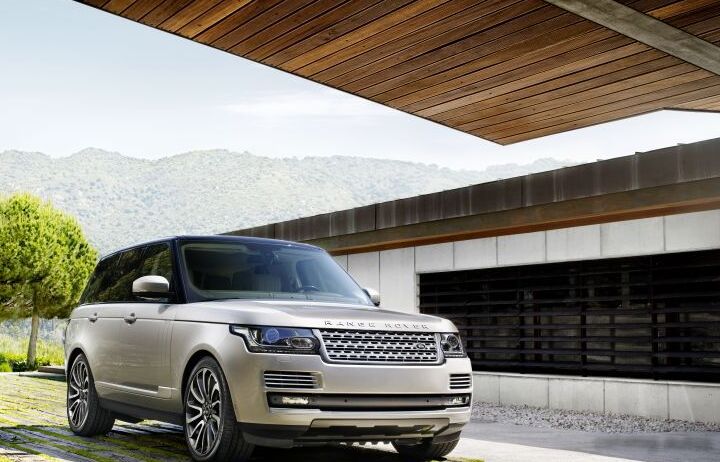
The Land Rover Range Rover IV, produced from 2012 to 2013, represented a significant evolution in the iconic luxury SUV’s lineage. The 5.0 V8 (375 Hp) AWD Automatic variant occupied a prominent position within the fourth-generation Range Rover (L405) lineup, offering a compelling blend of performance, refinement, and off-road capability. This model year marked the initial launch phase of the L405, introducing a fully aluminum body structure – a first for Land Rover – resulting in substantial weight savings compared to its predecessor. The 5.0L V8 with 375 horsepower served as a mid-range offering, positioned between the entry-level TDV6 diesel and the higher-performance Supercharged V8 models.
Technical Specifications
| Brand | Land Rover |
| Model | Range Rover |
| Generation | Range Rover IV |
| Type (Engine) | 5.0 V8 (375 Hp) AWD Automatic |
| Start of production | 2012 |
| End of production | 2013 |
| Powertrain Architecture | Internal Combustion engine |
| Body type | SUV |
| Seats | 5 |
| Doors | 5 |
| Fuel consumption (economy) – urban (NEDC) | 18 l/100 km (13.1 US mpg, 15.7 UK mpg, 5.6 km/l) |
| Fuel consumption (economy) – extra urban (NEDC) | 9.5 l/100 km (24.8 US mpg, 29.7 UK mpg, 10.5 km/l) |
| Fuel consumption (economy) – combined (NEDC) | 12.8 l/100 km (18.4 US mpg, 22.1 UK mpg, 7.8 km/l) |
| CO2 emissions (NEDC) | 299 g/km |
| Fuel Type | Petrol (Gasoline) |
| Acceleration 0 – 100 km/h | 6.8 sec |
| Acceleration 0 – 62 mph | 6.8 sec |
| Acceleration 0 – 60 mph | 6.5 sec |
| Maximum speed | 209 km/h (129.87 mph) |
| Emission standard | Euro 4 |
| Weight-to-power ratio | 5.9 kg/Hp, 170.5 Hp/tonne |
| Weight-to-torque ratio | 4.3 kg/Nm, 231.8 Nm/tonne |
| Power | 375 Hp @ 6500 rpm |
| Power per litre | 75 Hp/l |
| Torque | 510 Nm @ 3500 rpm (376.16 lb.-ft. @ 3500 rpm) |
| Engine layout | Front, Longitudinal |
| Engine Model/Code | 508PN |
| Engine displacement | 5000 cm3 (305.12 cu. in.) |
| Number of cylinders | 8 |
| Engine configuration | V-engine |
| Cylinder Bore | 92.5 mm (3.64 in.) |
| Piston Stroke | 93 mm (3.66 in.) |
| Compression ratio | 11.5:1 |
| Number of valves per cylinder | 4 |
| Fuel injection system | Direct injection |
| Engine aspiration | Naturally aspirated engine |
| Valvetrain | DOHC, DIVCT |
| Engine oil capacity | 8 l (8.45 US qt | 7.04 UK qt) |
| Coolant | 15.9 l (16.8 US qt | 13.99 UK qt) |
| Kerb Weight | 2200 kg (4850.17 lbs.) |
| Trunk (boot) space – minimum | 550 l (19.42 cu. ft.) |
| Trunk (boot) space – maximum | 2030 l (71.69 cu. ft.) |
| Fuel tank capacity | 105 l (27.74 US gal | 23.1 UK gal) |
| Length | 4999 mm (196.81 in.) |
| Width | 1983 mm (78.07 in.) |
| Width with mirrors folded | 2073 mm (81.61 in.) |
| Height | 1835 mm (72.24 in.) |
| Wheelbase | 2922 mm (115.04 in.) |
| Front track | 1690 mm (66.54 in.) |
| Rear (Back) track | 1683 mm (66.26 in.) |
| Drag coefficient (Cd) | 0.35 |
| Minimum turning circle (turning diameter) | 12.3 m (40.35 ft.) |
| Approach angle | 26-34.7° |
| Departure angle | 24.6-29.6° |
| Ramp-over (brakeover) angle | 20.1-28.3° |
| Wading depth | 900 mm (35.43 in.) |
| Drivetrain Architecture | The Internal combustion engine (ICE) drives permanently the four wheels of the vehicle. |
| Drive wheel | All wheel drive (4×4) |
| Number of gears and type of gearbox | 8 gears, automatic transmission |
| Front suspension | Independent multi-link suspension, Transverse stabilizer, Air suspension |
| Rear suspension | Independent multi-link suspension, Air suspension, Transverse stabilizer |
| Front brakes | Ventilated discs, 380 mm |
| Rear brakes | Ventilated discs, 365 mm |
| Assisting systems | ABS (Anti-lock braking system) |
| Steering type | Steering rack and pinion |
| Power steering | Electric Steering |
| Wheel rims size | 19; 20; 21; 22 |
INTRODUCTION
The 5.0-liter naturally aspirated V8 engine, designated 508PN, was a cornerstone of the Range Rover IV’s appeal. Introduced in 2012 with the L405 generation, this engine offered a substantial upgrade in both power and refinement compared to previous Range Rover engines. The 375 horsepower variant, coupled with the eight-speed automatic transmission and all-wheel drive, provided a balanced driving experience suitable for both on-road comfort and moderate off-road excursions. This configuration was aimed at buyers who desired a powerful and luxurious SUV without opting for the significantly more expensive and performance-focused Supercharged models.
Powertrain & Engine Architecture
The 5.0-liter V8 engine is a naturally aspirated powerplant featuring direct fuel injection and double overhead camshafts (DOHC) with variable valve timing (DIVCT) on both intake and exhaust valves. This configuration optimizes both power delivery and fuel efficiency. The engine utilizes a 92.5mm bore and 93mm stroke, resulting in a displacement of 5000cc. The eight-speed automatic transmission, sourced from ZF, was a key component of this powertrain. Its close gear ratios allowed for smooth acceleration and efficient cruising. The transmission featured a torque converter lock-up clutch to minimize slippage and improve fuel economy. The all-wheel-drive system employed a sophisticated electronic center differential that could distribute torque variably between the front and rear axles, enhancing traction in various conditions.
Driving Characteristics
The 5.0 V8 with 375 horsepower delivered a refined and capable driving experience. Acceleration from 0-60 mph took approximately 6.5 seconds, making it a brisk performer for a full-size luxury SUV. The eight-speed automatic transmission provided smooth and responsive shifts, and the torque converter lock-up contributed to a feeling of directness. Compared to the 3.0L TDV6 diesel, the V8 offered significantly more power and a more responsive throttle. However, it lacked the low-end torque of the diesel. Against the Supercharged V8, the 375 hp version offered a more relaxed driving experience, prioritizing comfort over outright performance. The air suspension provided a comfortable ride, absorbing bumps and irregularities in the road surface effectively.
Equipment & Trim Levels
The 5.0 V8 (375 Hp) variant typically came standard with a high level of equipment, reflecting the Range Rover’s luxury positioning. Standard features included leather upholstery, heated front and rear seats, a premium audio system, navigation, and a panoramic sunroof. Optional extras included upgraded leather trim, rear-seat entertainment, adaptive cruise control, and a variety of exterior styling enhancements. Trim levels varied depending on the market, but generally offered increasing levels of luxury and technology. The interior design emphasized elegance and sophistication, with high-quality materials and meticulous attention to detail.
Chassis & Braking
The Range Rover IV’s chassis was a revolutionary design, utilizing a fully aluminum monocoque construction. This resulted in a significant weight reduction compared to the previous steel-based chassis, improving both handling and fuel efficiency. The suspension system featured independent multi-link suspension at all four corners, along with air springs and adaptive dampers. This allowed for adjustable ride height and damping rates, providing a comfortable ride on-road and improved off-road capability. The braking system consisted of ventilated discs on all four wheels, providing ample stopping power. The front brakes measured 380mm in diameter, while the rear brakes were 365mm. An anti-lock braking system (ABS) was standard, along with electronic brake-force distribution and emergency brake assist.
Market Reception & Comparison
The Range Rover IV 5.0 V8 (375 Hp) AWD Automatic was generally well-received by automotive critics. It was praised for its luxurious interior, comfortable ride, and capable performance. Fuel economy, however, was a common criticism, with the combined fuel consumption of 12.8 l/100 km (18.4 US mpg) being relatively high for a vehicle of this type. Compared to the TDV6 diesel, the V8 offered more power but significantly lower fuel economy. Against the Supercharged V8, it provided a more balanced blend of performance and efficiency, appealing to buyers who prioritized refinement over outright speed.
Legacy
The 5.0-liter V8 engine proved to be a reliable and durable powerplant. While maintenance costs can be higher than those of smaller engines, the V8 has generally demonstrated good long-term reliability. In the used car market, the Range Rover IV 5.0 V8 (375 Hp) AWD Automatic remains a desirable option for buyers seeking a luxurious and capable SUV. The aluminum body construction and sophisticated technology of the L405 generation have helped to maintain its appeal over time. However, potential buyers should be aware of the potential for higher maintenance costs and the importance of regular servicing to ensure continued reliability.