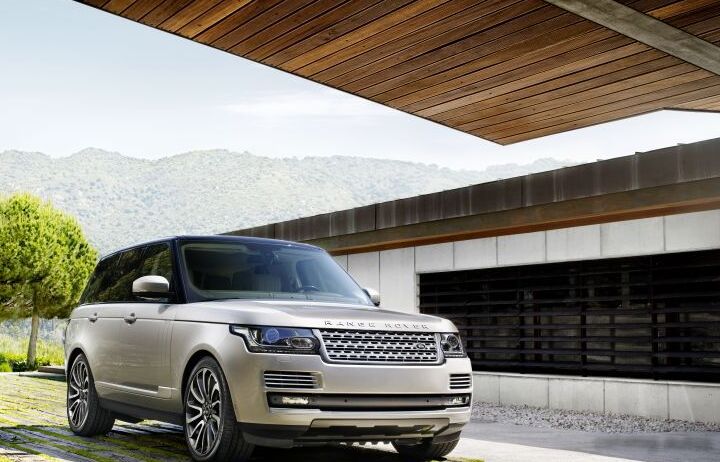
The Land Rover Range Rover IV, produced from 2012 to 2017, represented a significant evolution for the iconic luxury SUV. Among the various powertrains offered, the 5.0-liter supercharged V8 producing 510 horsepower paired with an eight-speed automatic transmission stands out as a performance-oriented offering within the fourth-generation (L405) Range Rover lineup. This variant occupied a premium position, sitting above the naturally aspirated V6 and V8 models, and below the even more potent supercharged V8 with higher horsepower figures. It aimed to deliver a blend of refined luxury, substantial power, and all-terrain capability, cementing the Range Rover’s reputation as a supremely capable and comfortable vehicle.
Technical Specifications
| Brand | Land Rover |
| Model | Range Rover |
| Generation | Range Rover IV |
| Type (Engine) | 5.0 V8 (510 Hp) AWD Automatic |
| Start of production | 2012 |
| End of production | 2017 |
| Powertrain Architecture | Internal Combustion engine |
| Body type | SUV |
| Seats | 5 |
| Doors | 5 |
| Fuel consumption (urban) | 20.6 l/100 km (11.4 US mpg, 13.7 UK mpg, 4.9 km/l) |
| Fuel consumption (extra urban) | 9.9 l/100 km (23.8 US mpg, 28.5 UK mpg, 10.1 km/l) |
| Fuel consumption (combined) | 13.8 l/100 km (17 US mpg, 20.5 UK mpg, 7.2 km/l) |
| CO2 emissions | 322 g/km |
| Fuel Type | Petrol (Gasoline) |
| Acceleration 0 – 100 km/h | 5.4 sec |
| Acceleration 0 – 62 mph | 5.4 sec |
| Acceleration 0 – 60 mph | 5.1 sec |
| Maximum speed | 225 km/h (139.81 mph) |
| Emission standard | Euro 5 |
| Weight-to-power ratio | 4.6 kg/Hp, 218.9 Hp/tonne |
| Weight-to-torque ratio | 3.7 kg/Nm, 268.2 Nm/tonne |
| Power | 510 Hp @ 6000-6500 rpm |
| Power per litre | 102 Hp/l |
| Torque | 625 Nm @ 2500-5500 rpm (460.98 lb.-ft. @ 2500-5500 rpm) |
| Engine layout | Front, Longitudinal |
| Engine Model/Code | 508PS |
| Engine displacement | 5000 cm3 (305.12 cu. in.) |
| Number of cylinders | 8 |
| Engine configuration | V-engine |
| Cylinder Bore | 92.5 mm (3.64 in.) |
| Piston Stroke | 93 mm (3.66 in.) |
| Compression ratio | 9.5:1 |
| Number of valves per cylinder | 4 |
| Fuel injection system | Multi-port manifold injection |
| Engine aspiration | Supercharger, Intercooler |
| Valvetrain | DIVCT |
| Engine oil capacity | 8 l (8.45 US qt | 7.04 UK qt) |
| Coolant | 8.83 l (9.33 US qt | 7.77 UK qt) |
| Kerb Weight | 2330 kg (5136.77 lbs.) |
| Trunk (boot) space – minimum | 550 l (19.42 cu. ft.) |
| Trunk (boot) space – maximum | 2030 l (71.69 cu. ft.) |
| Fuel tank capacity | 105 l (27.74 US gal | 23.1 UK gal) |
| Length | 4999 mm (196.81 in.) |
| Width | 1983 mm (78.07 in.) |
| Width with mirrors folded | 2073 mm (81.61 in.) |
| Height | 1835 mm (72.24 in.) |
| Wheelbase | 2922 mm (115.04 in.) |
| Front track | 1690 mm (66.54 in.) |
| Rear (Back) track | 1683 mm (66.26 in.) |
| Drag coefficient (Cd) | 0.36 |
| Minimum turning circle | 12.3 m (40.35 ft.) |
| Approach angle | 26-34.7° |
| Departure angle | 24.6-29.6° |
| Drive wheel | All wheel drive (4×4) |
| Number of gears | 8 |
| Gearbox type | automatic transmission |
| Front suspension | Air suspension |
| Rear suspension | Air suspension |
| Front brakes | Ventilated discs |
| Rear brakes | Ventilated discs |
| Assisting systems | ABS (Anti-lock braking system) |
| Steering type | Steering rack and pinion |
| Power steering | Electric Steering |
INTRODUCTION
The Range Rover IV 5.0 V8 (510 Hp) AWD Automatic, launched in 2012, was a key component of Land Rover’s strategy to modernize and elevate the Range Rover brand. Built on the aluminum-intensive L405 platform, this generation marked a significant weight reduction compared to its predecessor, contributing to improved fuel efficiency and handling. The 510 hp variant was positioned as a sweet spot in the range, offering substantial performance without the ultimate price tag of the higher-output supercharged models. It catered to buyers who desired a luxurious and capable SUV with genuine pace and refinement.
Powertrain & Engine Architecture
At the heart of this Range Rover variant lies Land Rover’s 5.0-liter supercharged V8 engine, internally designated as the 508PS. This engine utilizes a Roots-type supercharger, providing instant boost and a broad torque curve. The engine features direct fuel injection and variable valve timing (DIVCT – Dual Independent Variable Camshaft Timing) to optimize performance and efficiency. The eight-speed automatic transmission, sourced from ZF, was a crucial element in delivering smooth and responsive gear changes. This transmission offered both automatic and manual shift modes, allowing drivers to tailor the driving experience to their preferences. The transmission’s close gear ratios helped to maximize the engine’s power and torque, while also contributing to improved fuel economy at cruising speeds.
Driving Characteristics
The 510 hp Range Rover IV delivers a compelling driving experience. Acceleration from 0-60 mph takes approximately 5.1 seconds, making it a genuinely quick SUV for its size and weight. The supercharger provides immediate throttle response, and the engine pulls strongly throughout the rev range. The eight-speed automatic transmission shifts smoothly and efficiently, and the all-wheel-drive system provides excellent traction in all conditions. Compared to the naturally aspirated V8 models, the supercharged variant offers a significant performance advantage. While not as overtly sporty as some competitors, the Range Rover prioritizes comfort and refinement, delivering a composed and relaxed ride even at high speeds. The air suspension system further enhances ride quality, absorbing bumps and imperfections in the road surface with ease.
Equipment & Trim Levels
The 5.0 V8 (510 Hp) variant typically came well-equipped, reflecting its premium positioning. Standard features included leather upholstery, heated and ventilated front seats, a premium audio system, a touchscreen infotainment system, and a panoramic sunroof. Optional extras included rear-seat entertainment, adaptive cruise control, and a variety of interior trim options. Trim levels varied depending on the market, but generally offered increasing levels of luxury and technology. The Autobiography trim, for example, added even more luxurious features, such as massaging seats, extended leather trim, and unique exterior styling cues.
Chassis & Braking
The Range Rover IV’s chassis is built around a lightweight aluminum monocoque construction, contributing to its impressive strength and rigidity. The air suspension system provides adjustable ride height and damping, allowing drivers to optimize the vehicle’s performance for on-road or off-road conditions. All four wheels are equipped with ventilated disc brakes, providing ample stopping power. The electronic stability control system and anti-lock braking system (ABS) work together to enhance safety and control. The suspension geometry and stabilizer bar thicknesses were tuned to balance ride comfort with handling performance, considering the vehicle’s weight and center of gravity.
Market Reception & Comparison
The Range Rover IV 5.0 V8 (510 Hp) AWD Automatic was generally well-received by automotive critics. It was praised for its luxurious interior, comfortable ride, and strong performance. However, some critics noted its relatively high fuel consumption and complex electronics. Compared to the naturally aspirated V8 models, the supercharged variant offered a significant performance upgrade, but at a higher price point. Compared to the higher-output supercharged V8, it provided a more balanced combination of performance and fuel economy. The Range Rover’s main competitors included the Porsche Cayenne, BMW X5, and Mercedes-Benz GL-Class.
Legacy
The Range Rover IV 5.0 V8 (510 Hp) AWD Automatic remains a desirable vehicle in the used car market. While the supercharged V8 engine is generally reliable, it requires regular maintenance, including oil changes and spark plug replacements. The complex electronics can be prone to occasional issues, but these are typically covered by extended warranties. The L405 Range Rover’s aluminum construction has proven to be durable, and the air suspension system, while potentially requiring maintenance, provides a superior ride quality. This variant represents a sweet spot in the Range Rover IV lineup, offering a compelling blend of luxury, performance, and capability that continues to appeal to discerning buyers today.