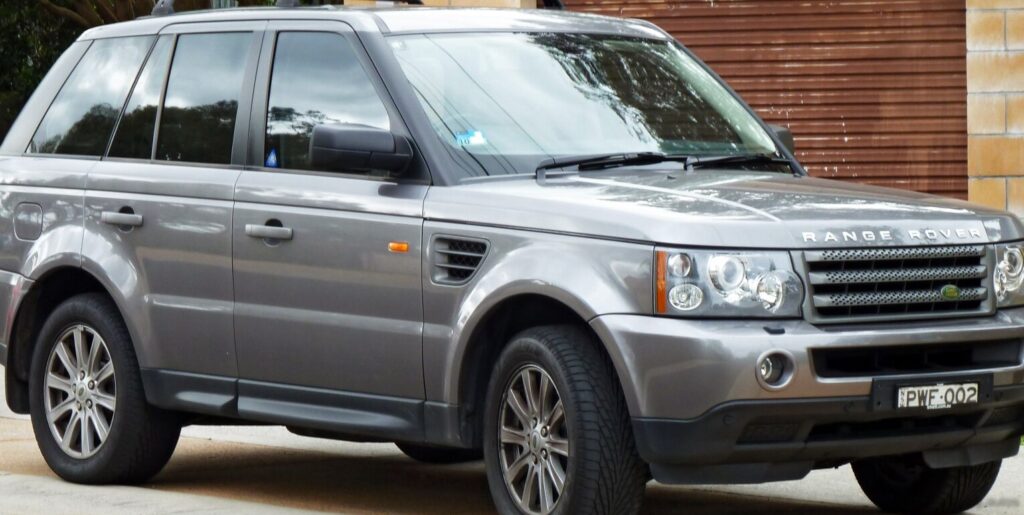
The Land Rover Range Rover Sport I 4.2 V8 Supercharged, produced from 2005 to 2009, represented a significant departure for Land Rover, aiming to blend the luxury and off-road capability of the Range Rover with a more sporting driving experience. Positioned as the performance variant within the first-generation Range Rover Sport (internally designated as the 4×4 platform), it offered a substantial power upgrade over the naturally aspirated engines available and served as a direct competitor to performance SUVs from Porsche and BMW. This model aimed to attract buyers seeking a luxurious SUV with genuine performance credentials.
Technical Specifications
| Brand | Land Rover |
| Model | Range Rover Sport |
| Generation | Range Rover Sport I |
| Type (Engine) | 4.2 V8 Supercharged (390 Hp) AWD Automatic |
| Start of production | 2005 |
| End of production | 2009 |
| Powertrain Architecture | Internal Combustion engine |
| Body type | SUV |
| Seats | 5 |
| Doors | 5 |
| Fuel consumption (urban) | 22.8 l/100 km (10.3 US mpg, 12.4 UK mpg, 4.4 km/l) |
| Fuel consumption (extra urban) | 11.9 l/100 km (19.8 US mpg, 23.7 UK mpg, 8.4 km/l) |
| Fuel consumption (combined) | 15.9 l/100 km (14.8 US mpg, 17.8 UK mpg, 6.3 km/l) |
| CO2 emissions | 374 g/km |
| Fuel Type | Petrol (Gasoline) |
| Acceleration 0 – 100 km/h | 7.6 sec |
| Acceleration 0 – 62 mph | 7.6 sec |
| Acceleration 0 – 60 mph | 7.2 sec |
| Maximum speed | 225 km/h (139.81 mph) |
| Emission standard | Euro 4 |
| Weight-to-power ratio | 6.6 kg/Hp, 151.6 Hp/tonne |
| Weight-to-torque ratio | 4.7 kg/Nm, 213.8 Nm/tonne |
| Power | 390 Hp @ 5750 rpm |
| Power per litre | 92.9 Hp/l |
| Torque | 550 Nm @ 3500 rpm (405.66 lb.-ft. @ 3500 rpm) |
| Engine layout | Front, Longitudinal |
| Engine Model/Code | AJ33S |
| Engine displacement | 4197 cm3 (256.12 cu. in.) |
| Number of cylinders | 8 |
| Engine configuration | V-engine |
| Cylinder Bore | 86 mm (3.39 in.) |
| Piston Stroke | 90.3 mm (3.56 in.) |
| Compression ratio | 9.1:1 |
| Number of valves per cylinder | 4 |
| Fuel injection system | Multi-port manifold injection |
| Engine aspiration | Supercharger, Intercooler |
| Valvetrain | DOHC |
| Engine oil capacity | 7.5 l (7.93 US qt | 6.6 UK qt) |
| Coolant | 12 l (12.68 US qt | 10.56 UK qt) |
| Kerb Weight | 2572 kg (5670.29 lbs.) |
| Max. weight | 3125 kg (6889.45 lbs.) |
| Max load | 553 kg (1219.16 lbs.) |
| Trunk (boot) space – minimum | 958 l (33.83 cu. ft.) |
| Trunk (boot) space – maximum | 2013 l (71.09 cu. ft.) |
| Fuel tank capacity | 88.1 l (23.27 US gal | 19.38 UK gal) |
| Permitted trailer load with brakes (12%) | 3500 kg (7716.18 lbs.) |
| Permitted trailer load without brakes | 750 kg (1653.47 lbs.) |
| Length | 4788 mm (188.5 in.) |
| Width with mirrors folded | 1983 mm (78.07 in.) |
| Width including mirrors | 2170 mm (85.43 in.) |
| Height | 1762-1812 mm (69.37 – 71.34 in.) |
| Wheelbase | 2745 mm (108.07 in.) |
| Front track | 1605 mm (63.19 in.) |
| Rear (Back) track | 1612 mm (63.46 in.) |
| Ride height (ground clearance) | 172-227 mm (6.77 – 8.94 in.) |
| Minimum turning circle (turning diameter) | 11.9 m (39.04 ft.) |
| Approach angle | 30.2-34° |
| Departure angle | 26-29° |
| Ramp-over (brakeover) angle | 20-25° |
| Wading depth | 700 mm (27.56 in.) |
| Drivetrain Architecture | The Internal combustion engine (ICE) drives permanently the four wheels of the vehicle. |
| Drive wheel | All wheel drive (4×4) |
| Number of gears and type of gearbox | 6 gears, automatic transmission |
| Front suspension | Air suspension |
| Rear suspension | Air suspension |
| Front brakes | Ventilated discs, 360 mm |
| Rear brakes | Ventilated discs, 350 mm |
| Assisting systems | ABS (Anti-lock braking system) |
| Steering type | Steering rack and pinion |
| Power steering | Hydraulic Steering |
| Tires size | 275/40 R20 |
| Wheel rims size | 9.5J x 20 |
Powertrain & Engine Architecture
At the heart of the Range Rover Sport I 4.2 V8 Supercharged lies the AJ33S engine, a 4.2-liter naturally aspirated V8 engine augmented by a mechanically driven supercharger. This engine, developed by Jaguar Land Rover, produces 390 horsepower at 5750 rpm and 405.66 lb-ft of torque at 3500 rpm. The engine utilizes multi-port fuel injection and a double overhead camshaft (DOHC) valvetrain. The supercharger, an Eaton Roots-type unit, provides instant boost, enhancing low-end torque and responsiveness. The engine is longitudinally mounted in the front of the vehicle. The transmission is a six-speed automatic gearbox, designed to handle the engine’s substantial output. This transmission features a torque converter and provides smooth, albeit not particularly quick, gear changes.
Driving Characteristics
The 4.2 V8 Supercharged powertrain delivers impressive acceleration, achieving 0-60 mph in approximately 7.2 seconds. The supercharger provides a broad torque curve, making the vehicle feel powerful and responsive in most driving situations. However, the substantial weight of the Range Rover Sport (over 5,600 lbs) does limit outright performance. Compared to the naturally aspirated 4.2-liter engine, the supercharged version offers a significant performance boost. The automatic transmission, while smooth, isn’t as engaging as the manual options available in other Range Rover Sport models. The gear ratios are tuned for a balance of acceleration and fuel economy, but prioritize effortless cruising over sporty driving.
Equipment & Trim Levels
The 4.2 V8 Supercharged trim typically included a high level of standard equipment. This included leather upholstery, heated front seats, automatic climate control, a premium audio system, and parking sensors. Optional extras included a panoramic sunroof, upgraded leather trim, rear seat entertainment, and adaptive cruise control. The interior design was luxurious, with a focus on comfort and convenience. The dashboard layout was relatively straightforward, with easy-to-use controls.
Chassis & Braking
The Range Rover Sport I features an independent air suspension system on both the front and rear axles, providing a comfortable ride and adjustable ride height for off-road capability. The braking system consists of ventilated discs on all four wheels, providing ample stopping power. The front brakes measure 360mm in diameter, while the rear brakes are 350mm. An anti-lock braking system (ABS) is standard. The steering is a hydraulic rack and pinion system, offering precise control and good feedback.
Market Reception & Comparison
The Range Rover Sport I 4.2 V8 Supercharged was generally well-received by critics, who praised its performance, luxury, and off-road capability. However, its fuel economy was a common criticism, with combined fuel consumption averaging around 14.8 US mpg. Compared to the naturally aspirated 4.2-liter and the diesel-powered models, the supercharged version offered the highest performance but also the lowest fuel economy. Reliability was generally good, but some owners reported issues with the air suspension system and the electronic parking brake.
Legacy
The Range Rover Sport I 4.2 V8 Supercharged remains a desirable vehicle in the used car market, particularly for those seeking a luxurious and capable SUV with a powerful engine. The AJ33S engine is generally considered to be reliable, although regular maintenance is essential. The air suspension system can be prone to leaks and failures, requiring periodic attention. Overall, the 4.2 V8 Supercharged variant represents a compelling combination of performance, luxury, and off-road capability, cementing its place as a significant model in the Range Rover Sport lineage.