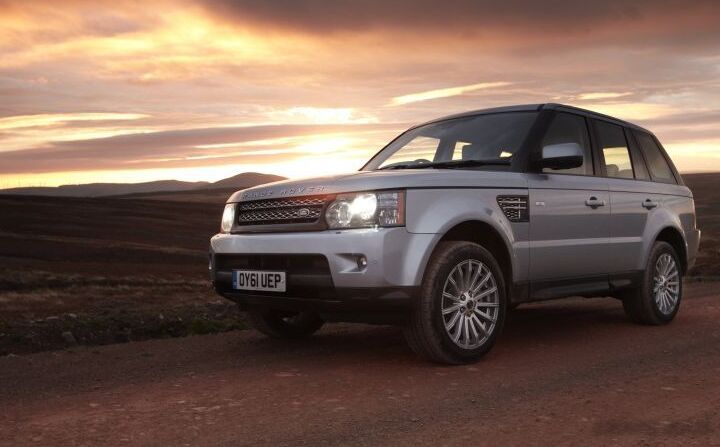
The Land Rover Range Rover Sport I, specifically the facelifted version produced from 2009 to 2010, represented a significant refinement of the original Sport model launched in 2005. This iteration aimed to bridge the gap between the full-size Range Rover’s luxury and the more accessible, performance-oriented Sport. The 3.6 LR-TD V8 (272 hp) AWD Automatic variant occupied a key position in the lineup, offering a compelling blend of power, efficiency, and capability for the European and international markets. It was positioned as a premium offering, appealing to buyers seeking a powerful diesel SUV with all-wheel drive and a luxurious interior, but perhaps not requiring the ultimate refinement or expense of the top-tier petrol models.
Technical Specifications
| Brand | Land Rover |
| Model | Range Rover Sport |
| Generation | Range Rover Sport I (facelift 2009) |
| Type (Engine) | 3.6 LR-TD V8 (272 Hp) AWD Automatic |
| Start of production | 2009 |
| End of production | 2010 |
| Powertrain Architecture | Internal Combustion engine |
| Body type | SUV |
| Seats | 5 |
| Doors | 5 |
| Fuel consumption (combined) | 11.1 l/100 km |
| Fuel consumption (US mpg) | 21.2 US mpg |
| Fuel consumption (UK mpg) | 25.4 UK mpg |
| Fuel consumption (km/l) | 9 km/l |
| CO2 emissions | 294 g/km |
| Fuel Type | Diesel |
| Acceleration 0 – 100 km/h | 9.2 sec |
| Acceleration 0 – 62 mph | 9.2 sec |
| Acceleration 0 – 60 mph | 8.7 sec |
| Maximum speed | 209 km/h (129.87 mph) |
| Emission standard | Euro 5 |
| Power | 272 Hp @ 3750 rpm |
| Power per litre | 75 Hp/l |
| Torque | 640 Nm @ 2000 rpm (472.04 lb.-ft. @ 2000 rpm) |
| Engine layout | Front, Longitudinal |
| Engine Model/Code | 368DT |
| Engine displacement | 3628 cm3 (221.39 cu. in.) |
| Number of cylinders | 8 |
| Engine configuration | V-engine |
| Cylinder Bore | 81 mm (3.19 in.) |
| Piston Stroke | 88 mm (3.46 in.) |
| Compression ratio | 17.3:1 |
| Number of valves per cylinder | 4 |
| Fuel injection system | Diesel Commonrail |
| Engine aspiration | BiTurbo, Intercooler |
| Engine oil capacity | 9.5 l (10.04 US qt | 8.36 UK qt) |
| Coolant | 13 l (13.74 US qt | 11.44 UK qt) |
| Fuel tank capacity | 84.1 l (22.22 US gal | 18.5 UK gal) |
| Length | 4783 mm (188.31 in.) |
| Width with mirrors folded | 2004 mm (78.9 in.) |
| Height | 1784 mm (70.24 in.) |
| Wheelbase | 2745 mm (108.07 in.) |
| Front track | 1605 mm (63.19 in.) |
| Rear track | 1612 mm (63.46 in.) |
| Drive wheel | All wheel drive (4×4) |
| Number of gears and type of gearbox | 6 gears, automatic transmission |
| Front brakes | Ventilated discs |
| Rear brakes | Ventilated discs |
| Assisting systems | ABS (Anti-lock braking system) |
| Steering type | Steering rack and pinion |
| Power steering | Electric Steering |
Powertrain & Engine Architecture
The heart of this Range Rover Sport variant is the 3.6-liter LR-TD V8 engine, designated as the 368DT. This engine is a sophisticated diesel powerplant featuring a bi-turbocharger setup and a common rail direct injection system. The twin turbochargers, one of smaller size and one larger, work in sequence to minimize turbo lag and provide a broad torque curve. The common rail system, operating at extremely high pressures, ensures precise fuel delivery and efficient combustion. The engine boasts a high compression ratio of 17.3:1, contributing to its power output and efficiency. The six-speed automatic transmission, sourced from ZF, was a crucial component, offering smooth shifts and optimized gear ratios for both on-road comfort and off-road capability. This transmission was known for its durability and responsiveness, although it wasn’t as quick-shifting as some of the newer automatic transmissions available in later models.
Driving Characteristics
The 272 hp and 472 lb-ft of torque delivered by the 3.6 LR-TD V8 provided ample power for the Range Rover Sport. While not as overtly sporty as the supercharged petrol versions, this diesel offered strong acceleration, achieving 0-60 mph in around 8.7 seconds. The automatic transmission, while smooth, did slightly dull the responsiveness compared to the six-speed manual option available on some models. The torque curve was exceptionally flat, providing strong pulling power from low engine speeds, making it ideal for towing and off-road driving. The all-wheel-drive system, a permanent four-wheel drive setup with electronic traction control, ensured excellent grip in various conditions. The ride quality, a hallmark of the Range Rover brand, was generally comfortable, although the Sport’s shorter wheelbase and stiffer suspension compared to the full-size Range Rover resulted in a slightly firmer ride.
Equipment & Trim Levels
The 3.6 LR-TD V8 Automatic typically came well-equipped, reflecting its position as a premium trim level. Standard features included leather upholstery, automatic climate control, a premium audio system, and parking sensors. Optional extras included heated seats, a panoramic sunroof, upgraded navigation system, and various cosmetic enhancements. The interior design was luxurious, with high-quality materials and a focus on comfort. The dashboard layout was functional and relatively straightforward, although it lacked some of the more advanced infotainment features found in contemporary rivals.
Chassis & Braking
The Range Rover Sport I utilized a robust chassis based on the D7 platform, a monocoque construction designed for both on-road handling and off-road durability. The suspension system consisted of independent double wishbones at the front and a multi-link setup at the rear. Stabilizer bars were fitted front and rear to reduce body roll during cornering. Braking duties were handled by ventilated discs on all four wheels, providing ample stopping power. The anti-lock braking system (ABS) was standard, enhancing safety and control. The steering was a rack-and-pinion system with electric power assistance, offering a good balance of feel and ease of use.
Market Reception & Comparison
The 3.6 LR-TD V8 Automatic Range Rover Sport was generally well-received by automotive critics. It was praised for its powerful engine, comfortable ride, and luxurious interior. However, some reviewers noted that the fuel economy, while reasonable for a vehicle of its size and capability, wasn’t class-leading. Compared to the supercharged petrol versions, the diesel offered better fuel economy and torque, but lacked the ultimate performance. Against other diesel SUVs, such as the BMW X5 and Porsche Cayenne, the Range Rover Sport offered a more luxurious and capable off-road experience, but potentially at a higher price point.
Legacy
The 3.6 LR-TD V8 engine proved to be a relatively reliable powerplant, although, like all diesel engines, it’s susceptible to issues related to the diesel particulate filter (DPF) if not properly maintained. The ZF six-speed automatic transmission is also known for its durability. In the used car market, these Range Rover Sports represent a good value proposition for buyers seeking a capable and luxurious SUV. However, potential buyers should be aware of the potential maintenance costs associated with a vehicle of this complexity and ensure a thorough inspection is conducted before purchase. The 3.6 LR-TD V8 variant remains a popular choice for those who prioritize torque, fuel efficiency, and all-weather capability in a premium SUV package.