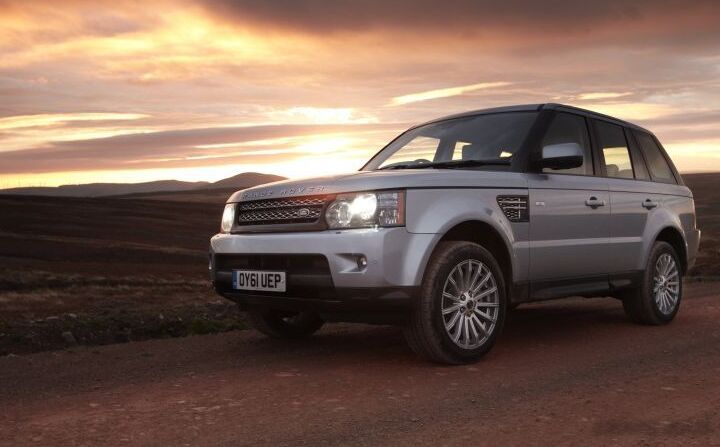
The Land Rover Range Rover Sport I, specifically the facelifted version produced from 2009 to 2013, represented a significant evolution of the original Range Rover Sport launched in 2005. Positioned as a more dynamic and driver-focused alternative to its larger, more luxurious Range Rover sibling, the Sport aimed to attract buyers seeking a blend of on-road performance and off-road capability. The 5.0 LR V8 (375 Hp) AWD Automatic variant occupied the upper-mid range of the lineup, offering a substantial power upgrade over the base models while remaining below the supercharged variants. This configuration was a popular choice for buyers prioritizing performance and refinement in a versatile SUV package.
Technical Specifications
| Brand | Land Rover |
| Model | Range Rover Sport |
| Generation | Range Rover Sport I (facelift 2009) |
| Type (Engine) | 5.0 LR V8 (375 Hp) AWD Automatic |
| Start of production | 2009 |
| End of production | 2013 |
| Powertrain Architecture | Internal Combustion engine |
| Body type | SUV |
| Seats | 5 |
| Doors | 5 |
| Fuel consumption (urban) | 19.8 l/100 km (11.9 US mpg, 14.3 UK mpg, 5.1 km/l) |
| Fuel consumption (extra urban) | 10.5 l/100 km (22.4 US mpg, 26.9 UK mpg, 9.5 km/l) |
| Fuel consumption (combined) | 13.9 l/100 km (16.9 US mpg, 20.3 UK mpg, 7.2 km/l) |
| CO2 emissions | 327 g/km |
| Fuel Type | Petrol (Gasoline) |
| Acceleration 0 – 100 km/h | 7.6 sec |
| Acceleration 0 – 62 mph | 7.6 sec |
| Acceleration 0 – 60 mph | 7.2 sec |
| Maximum speed | 200 km/h (124.27 mph) |
| Emission standard | Euro 5 |
| Weight-to-power ratio | 6.6 kg/Hp, 150.7 Hp/tonne |
| Weight-to-torque ratio | 4.9 kg/Nm, 204.9 Nm/tonne |
| Power | 375 Hp @ 6500 rpm |
| Power per litre | 75 Hp/l |
| Torque | 510 Nm @ 3500 rpm (376.16 lb.-ft. @ 3500 rpm) |
| Engine layout | Front, Longitudinal |
| Engine Model/Code | 508PN |
| Engine displacement | 5000 cm3 (305.12 cu. in.) |
| Number of cylinders | 8 |
| Engine configuration | V-engine |
| Cylinder Bore | 92.5 mm (3.64 in.) |
| Piston Stroke | 93 mm (3.66 in.) |
| Compression ratio | 11.5:1 |
| Number of valves per cylinder | 4 |
| Fuel injection system | Direct injection |
| Engine aspiration | Naturally aspirated engine |
| Valvetrain | DOHC |
| Engine oil capacity | 8 l (8.45 US qt | 7.04 UK qt) |
| Coolant | 15.9 l (16.8 US qt | 13.99 UK qt) |
| Kerb Weight | 2489 kg (5487.31 lbs.) |
| Max. weight | 3070 kg (6768.19 lbs.) |
| Max load | 581 kg (1280.89 lbs.) |
| Trunk (boot) space – minimum | 958 l (33.83 cu. ft.) |
| Trunk (boot) space – maximum | 2013 l (71.09 cu. ft.) |
| Fuel tank capacity | 88.1 l (23.27 US gal | 19.38 UK gal) |
| Permitted trailer load with brakes (12%) | 3500 kg (7716.18 lbs.) |
| Permitted trailer load without brakes | 750 kg (1653.47 lbs.) |
| Length | 4783 mm (188.31 in.) |
| Width with mirrors folded | 2004 mm (78.9 in.) |
| Width including mirrors | 2158 mm (84.96 in.) |
| Height | 1739-1789 mm (68.46 – 70.43 in.) |
| Wheelbase | 2745 mm (108.07 in.) |
| Front track | 1605 mm (63.19 in.) |
| Rear (Back) track | 1612 mm (63.46 in.) |
| Ride height (ground clearance) | 172-227 mm (6.77 – 8.94 in.) |
| Drag coefficient (Cd) | 0.37 |
| Minimum turning circle (turning diameter) | 11.9 m (39.04 ft.) |
| Approach angle | 30.3-34.6° |
| Departure angle | 26-29° |
| Ramp-over (brakeover) angle | 20-25° |
| Wading depth | 700 mm (27.56 in.) |
| Drivetrain Architecture | The Internal combustion engine (ICE) drives permanently the four wheels of the vehicle. |
| Drive wheel | All wheel drive (4×4) |
| Number of gears and type of gearbox | 6 gears, automatic transmission |
| Front suspension | Air suspension |
| Rear suspension | Air suspension |
| Front brakes | Ventilated discs, 380 mm |
| Rear brakes | Ventilated discs, 350 mm |
| Assisting systems | ABS (Anti-lock braking system) |
| Steering type | Steering rack and pinion |
| Power steering | Hydraulic Steering |
| Tires size | 255/50 R19 |
| Wheel rims size | 9J x 19 |
Powertrain & Engine Architecture
The heart of this Range Rover Sport variant is the 5.0 LR V8 engine, designated as the 508PN. This naturally aspirated V8 is a member of the Jaguar Land Rover AJ-V8 engine family, known for its smooth power delivery and robust construction. The 375 horsepower version utilizes direct fuel injection, optimizing combustion efficiency and contributing to its respectable power output. The engine features a double overhead camshaft (DOHC) valvetrain with four valves per cylinder, further enhancing its breathing and performance. The engine’s 510 Nm (376 lb-ft) of torque is readily available at 3500 rpm, providing strong acceleration in various driving conditions. Paired with the engine is a six-speed automatic transmission, designed to handle the engine’s torque and provide smooth shifts. This transmission was a ZF 6HP26 unit, known for its reliability and adaptability.
Driving Characteristics
The 5.0 LR V8 Automatic Range Rover Sport delivers a compelling driving experience. Acceleration from 0-60 mph takes approximately 7.2 seconds, making it noticeably quicker than the base models equipped with smaller engines. The automatic transmission provides seamless gear changes, contributing to a refined and comfortable ride. While not as overtly sporty as some competitors, the Range Rover Sport offers a good balance between performance and luxury. The air suspension system provides a comfortable ride quality, absorbing bumps and irregularities in the road. The permanent all-wheel-drive system ensures excellent traction in various conditions, making it capable both on and off-road. Compared to the supercharged variants, this 375 hp version offers a more relaxed driving experience, prioritizing refinement over outright speed.
Equipment & Trim Levels
The 5.0 LR V8 Automatic trim typically included a generous array of standard features. These included leather upholstery, heated front seats, dual-zone climate control, a premium audio system, and parking sensors. Optional extras could include a panoramic sunroof, upgraded leather trim, adaptive cruise control, and a rear-seat entertainment system. The interior design was characterized by a blend of luxury and functionality, with a focus on providing a comfortable and spacious cabin for both driver and passengers.
Chassis & Braking
The Range Rover Sport I utilizes a robust chassis designed to handle both on-road and off-road driving. The suspension system features air springs, allowing for adjustable ride height and improved comfort. The front suspension employs double wishbones, while the rear utilizes a multi-link setup. Braking duties are handled by ventilated discs on all four wheels, providing ample stopping power. The front discs measure 380mm, while the rear discs are 350mm in diameter. An anti-lock braking system (ABS) is standard, enhancing safety and control during emergency braking situations.
Market Reception & Comparison
The 5.0 LR V8 Automatic Range Rover Sport was generally well-received by automotive critics. It was praised for its powerful engine, comfortable ride, and luxurious interior. However, its fuel economy was often criticized, as expected for a vehicle of its size and performance. Compared to the 3.6L V8 and the diesel variants, the 5.0 LR V8 offered a significant performance advantage, but at the cost of increased fuel consumption. The supercharged variants provided even more power, but came with a higher price tag. The combination of performance and relative affordability made the 375 hp version a popular choice for buyers seeking a well-rounded luxury SUV.
Legacy
The 5.0 LR V8 engine proved to be a reliable and durable powerplant, and examples of this Range Rover Sport continue to be found on the used car market today. While maintenance costs can be higher than those of more mainstream SUVs, the engine’s robust construction and readily available parts supply contribute to its longevity. The facelifted Range Rover Sport I, particularly the 5.0 LR V8 Automatic variant, remains a desirable vehicle for those seeking a blend of luxury, performance, and off-road capability. Its timeless design and refined driving experience continue to appeal to enthusiasts and buyers alike.