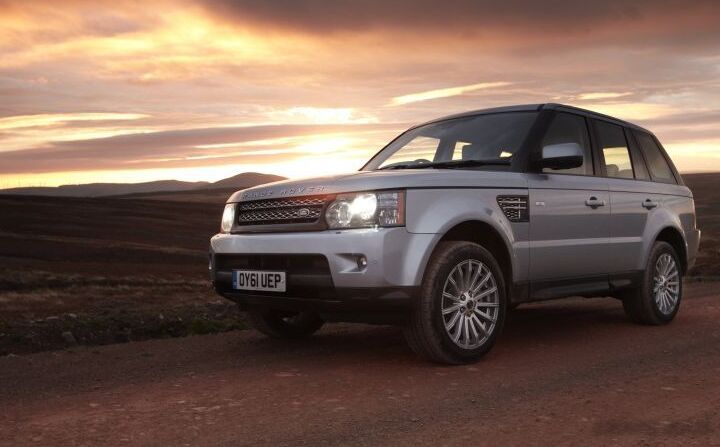
The Land Rover Range Rover Sport I, specifically the facelifted version produced from 2009 to 2013, represented a significant evolution of the original Range Rover Sport launched in 2005. Positioned as a more dynamic and driver-focused alternative to its larger, more luxurious Range Rover sibling, the Sport aimed to attract buyers seeking a blend of on-road performance and off-road capability. The 5.0 LR V8 Supercharged AWD Automatic variant, producing 510 horsepower, sat at the very top of the Range Rover Sport lineup, offering the highest level of performance and a comprehensive equipment list. This model was a key offering in markets like North America, Europe, and the Middle East, where buyers demanded a high-performance luxury SUV.
Technical Specifications
| Brand | Land Rover |
| Model | Range Rover Sport |
| Generation | Range Rover Sport I (facelift 2009) |
| Type (Engine) | 5.0 LR V8 Supercharged (510 Hp) AWD Automatic |
| Start of production | 2009 |
| End of production | 2013 |
| Powertrain Architecture | Internal Combustion engine |
| Body type | SUV |
| Seats | 5 |
| Doors | 5 |
| Fuel consumption (urban) | 21.8 l/100 km (10.8 US mpg, 13 UK mpg, 4.6 km/l) |
| Fuel consumption (extra urban) | 10.7 l/100 km (22 US mpg, 26.4 UK mpg, 9.3 km/l) |
| Fuel consumption (combined) | 14.9 l/100 km (15.8 US mpg, 19 UK mpg, 6.7 km/l) |
| CO2 emissions | 348 g/km |
| Fuel Type | Petrol (Gasoline) |
| Acceleration 0 – 100 km/h | 6.2 sec |
| Acceleration 0 – 62 mph | 6.2 sec |
| Acceleration 0 – 60 mph | 5.9 sec |
| Maximum speed | 225 km/h (139.81 mph) |
| Emission standard | Euro 5 |
| Weight-to-power ratio | 5.1 kg/Hp, 196.9 Hp/tonne |
| Weight-to-torque ratio | 4.1 kg/Nm, 241.3 Nm/tonne |
| Power | 510 Hp @ 6000-6500 rpm |
| Power per litre | 102 Hp/l |
| Torque | 625 Nm @ 2500-5500 rpm (460.98 lb.-ft. @ 2500-5500 rpm) |
| Engine layout | Front, Longitudinal |
| Engine Model/Code | 508PS |
| Engine displacement | 5000 cm3 (305.12 cu. in.) |
| Number of cylinders | 8 |
| Engine configuration | V-engine |
| Cylinder Bore | 92.5 mm (3.64 in.) |
| Piston Stroke | 93 mm (3.66 in.) |
| Compression ratio | 9.5:1 |
| Number of valves per cylinder | 4 |
| Fuel injection system | Direct injection |
| Engine aspiration | Supercharger, Intercooler |
| Valvetrain | DOHC, DIVCT |
| Engine oil capacity | 8 l (8.45 US qt | 7.04 UK qt) |
| Coolant | 14.1 l (14.9 US qt | 12.41 UK qt) |
| Kerb Weight | 2590 kg (5709.97 lbs.) |
| Max. weight | 3125 kg (6889.45 lbs.) |
| Max load | 535 kg (1179.47 lbs.) |
| Trunk (boot) space – minimum | 958 l (33.83 cu. ft.) |
| Trunk (boot) space – maximum | 2013 l (71.09 cu. ft.) |
| Fuel tank capacity | 88.1 l (23.27 US gal | 19.38 UK gal) |
| Permitted trailer load with brakes (12%) | 3500 kg (7716.18 lbs.) |
| Permitted trailer load without brakes | 750 kg (1653.47 lbs.) |
| Length | 4783 mm (188.31 in.) |
| Width with mirrors folded | 2004 mm (78.9 in.) |
| Width including mirrors | 2158 mm (84.96 in.) |
| Height | 1739-1789 mm (68.46 – 70.43 in.) |
| Wheelbase | 2745 mm (108.07 in.) |
| Front track | 1605 mm (63.19 in.) |
| Rear (Back) track | 1612 mm (63.46 in.) |
| Ride height (ground clearance) | 172-227 mm (6.77 – 8.94 in.) |
| Minimum turning circle (turning diameter) | 11.9 m (39.04 ft.) |
| Approach angle | 30.3-34.6° |
| Departure angle | 26-29° |
| Ramp-over (brakeover) angle | 20-25° |
| Wading depth | 700 mm (27.56 in.) |
| Drivetrain Architecture | The Internal combustion engine (ICE) drives permanently the four wheels of the vehicle. |
| Drive wheel | All wheel drive (4×4) |
| Number of gears and type of gearbox | 6 gears, automatic transmission |
| Front suspension | Air suspension |
| Rear suspension | Air suspension |
| Front brakes | Ventilated discs, 380 mm |
| Rear brakes | Ventilated discs, 365 mm |
| Assisting systems | ABS (Anti-lock braking system) |
| Steering type | Steering rack and pinion |
| Power steering | Hydraulic Steering |
| Tires size | 275/40 R20 |
| Wheel rims size | 9.5J x 20 |
Powertrain & Engine Architecture
The heart of the 5.0 LR V8 Supercharged is the 5.0-liter naturally aspirated V8 engine, designated as the 508PS. This engine is a significant departure from earlier Land Rover V8s, utilizing an aluminum block and cylinder heads. The engine employs direct fuel injection, maximizing combustion efficiency and power output. A Roots-type supercharger, mounted centrally in the V, provides forced induction, delivering instant torque and a broad powerband. The engine also features variable valve timing (DIVCT) on both intake and exhaust valves, further optimizing performance and fuel economy. The engine’s code, 508PS, indicates its approximate power output in metric horsepower. The engine is longitudinally mounted in the chassis. The six-speed automatic transmission, sourced from ZF, is a crucial component of this powertrain. This transmission is known for its smooth shifting and durability, and was specifically calibrated to handle the high torque output of the supercharged V8.
Driving Characteristics
The 510 hp and 460 lb-ft of torque delivered by this powertrain translate into exhilarating performance. Acceleration from 0-60 mph takes approximately 5.9 seconds, and the vehicle feels remarkably composed even at high speeds. The automatic transmission provides seamless gear changes, although it may not be as responsive as some modern eight or nine-speed automatics. The supercharger provides immediate throttle response, eliminating any noticeable turbo lag. Compared to the naturally aspirated 4.4-liter V8 or the diesel variants, the supercharged engine offers a significantly more powerful and engaging driving experience. However, this comes at the cost of increased fuel consumption. The air suspension provides a comfortable ride, while also allowing for adjustable ride height for improved off-road capability.
Equipment & Trim Levels
The 5.0 LR V8 Supercharged came standard with a comprehensive list of features, including leather upholstery, heated and ventilated front seats, a premium audio system, navigation, and a sunroof. Optional extras included adaptive cruise control, rear-seat entertainment, and upgraded interior trim materials. The interior typically featured wood or aluminum trim accents, and the dashboard layout was relatively straightforward and functional. The exterior styling was distinguished by unique badging, larger alloy wheels, and a more aggressive front bumper design.
Chassis & Braking
The Range Rover Sport I utilized a robust chassis construction, incorporating a monocoque body with a full-length aluminum underbody. The suspension system employed air springs and adaptive dampers, providing a comfortable ride and excellent handling. The 5.0 Supercharged models featured larger brakes – ventilated discs measuring 380mm at the front and 365mm at the rear – to cope with the increased performance. Anti-lock brakes (ABS) and electronic stability control were standard safety features. The vehicle’s all-wheel-drive system provides excellent traction in a variety of conditions.
Market Reception & Comparison
The 5.0 LR V8 Supercharged Range Rover Sport was generally well-received by automotive critics, who praised its powerful engine, comfortable ride, and luxurious interior. However, its high fuel consumption and relatively high price tag were often cited as drawbacks. Compared to the 4.4-liter V8, the supercharged model offered a substantial performance upgrade, but at a significant cost premium. The diesel variants provided better fuel economy, but lacked the outright performance of the supercharged engine. Reliability was generally good, although some owners reported issues with the air suspension system.
Legacy
The 5.0 LR V8 Supercharged Range Rover Sport I remains a desirable vehicle in the used car market today, particularly for those seeking a high-performance luxury SUV. The powertrain, while thirsty, is generally considered to be robust and reliable, provided it has been properly maintained. The vehicle’s combination of performance, luxury, and off-road capability continues to appeal to a wide range of buyers. The 2009-2013 facelifted model is often preferred over earlier versions due to its updated styling and improved interior features. Parts availability is generally good, although specialized components may be more expensive.