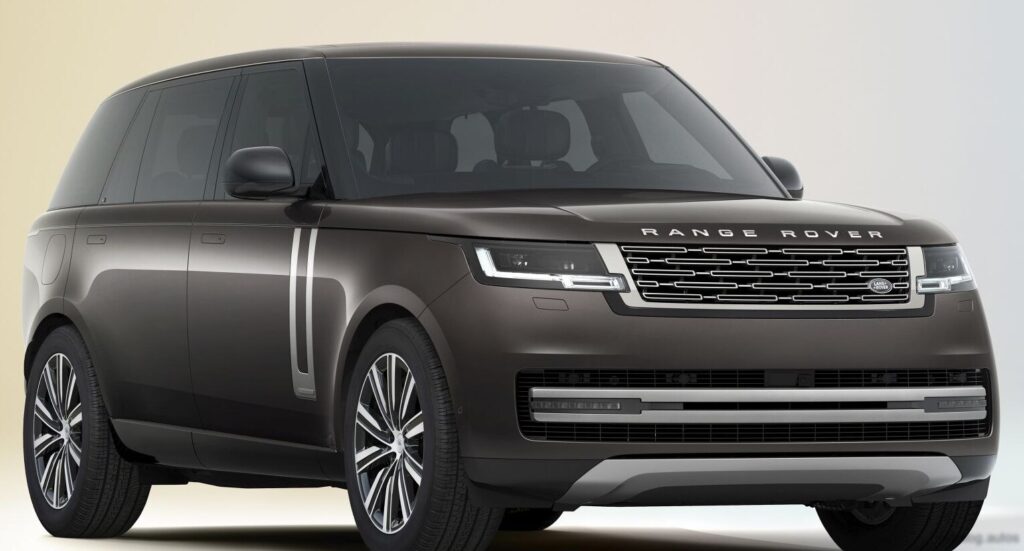
The Land Rover Range Rover V LWB 4.4 V8 P615, introduced in May 2023, represents the pinnacle of luxury and performance within the fifth-generation Range Rover (L460) lineup. Positioned as a flagship model, the “P615” designation signifies its 615 horsepower output derived from a 4.4-liter twin-turbocharged V8 engine, enhanced with mild-hybrid technology. The “LWB” indicates a long wheelbase configuration, prioritizing rear passenger space and comfort. This variant caters to buyers seeking the utmost in refinement, power, and all-terrain capability, solidifying the Range Rover’s reputation as a globally recognized luxury SUV.
Technical Specifications
| Brand | Land Rover |
| Model | Range Rover |
| Generation | Range Rover V LWB |
| Type (Engine) | 4.4 V8 P615 (615 Hp) Mild Hybrid AWD Automatic |
| Start of production | May, 2023 |
| Powertrain Architecture | MHEV (Mild Hybrid Electric Vehicle) |
| Body type | SUV |
| Seats | 4-5 |
| Doors | 5 |
| Fuel consumption at Low speed (WLTP) | 19.5-19.6 l/100 km (12.1 – 12 US mpg, 14.5 – 14.4 UK mpg, 5.1 – 5.1 km/l) |
| Fuel consumption at Medium speed (WLTP) | 11.4-11.8 l/100 km (20.6 – 19.9 US mpg, 24.8 – 23.9 UK mpg, 8.8 – 8.5 km/l) |
| Fuel consumption at high speed (WLTP) | 9.5-9.9 l/100 km (24.8 – 23.8 US mpg, 29.7 – 28.5 UK mpg, 10.5 – 10.1 km/l) |
| Fuel consumption at very high speed (WLTP) | 10.6-11.2 l/100 km (22.2 – 21 US mpg, 26.6 – 25.2 UK mpg, 9.4 – 8.9 km/l) |
| Combined fuel consumption (WLTP) | 11.6-12 l/100 km (20.3 – 19.6 US mpg, 24.4 – 23.5 UK mpg, 8.6 – 8.3 km/l) |
| CO2 emissions (WLTP) | 263-272 g/km |
| Fuel Type | Petrol (Gasoline) |
| Acceleration 0 – 100 km/h | 4.6 sec |
| Acceleration 0 – 62 mph | 4.6 sec |
| Acceleration 0 – 60 mph | 4.4 sec |
| Maximum speed | 261 km/h (162.18 mph) |
| Emission standard | Euro 6d |
| Weight-to-power ratio | 4.4 kg/Hp, 226.9 Hp/tonne |
| Weight-to-torque ratio | 3.6 kg/Nm, 276.8 Nm/tonne |
| Power | 615 Hp @ 5855-7000 rpm |
| Power per litre | 139.9 Hp/l |
| Torque | 750 Nm @ 1800-5400 rpm (553.17 lb.-ft. @ 1800-5400 rpm) |
| Engine layout | Front, Longitudinal |
| Engine Model/Code | S68B44B |
| Engine displacement | 4395 cm3 (268.2 cu. in.) |
| Number of cylinders | 8 |
| Engine configuration | V-engine |
| Cylinder Bore | 89 mm (3.5 in.) |
| Piston Stroke | 88.3 mm (3.48 in.) |
| Compression ratio | 10.5:1 |
| Number of valves per cylinder | 4 |
| Fuel injection system | Direct injection |
| Engine aspiration | Twin-Turbo, Intercooler |
| Engine oil capacity | 11 l (11.62 US qt | 9.68 UK qt) |
| Kerb Weight | 2710-2725 kg (5974.53 – 6007.6 lbs.) |
| Max. weight | 3400 kg (7495.72 lbs.) |
| Max load | 675-690 kg (1488.12 – 1521.19 lbs.) |
| Trunk (boot) space – minimum | 818 l (28.89 cu. ft.) |
| Trunk (boot) space – maximum | 2176 l (76.84 cu. ft.) |
| Fuel tank capacity | 90 l (23.78 US gal | 19.8 UK gal) |
| Max. roof load | 100 kg (220.46 lbs.) |
| Permitted trailer load with brakes (12%) | 3500 kg (7716.18 lbs.) |
| Permitted trailer load without brakes | 750 kg (1653.47 lbs.) |
| Permitted towbar download | 150 kg (330.69 lbs.) |
| Length | 5252 mm (206.77 in.) |
| Width with mirrors folded | 2047 mm (80.59 in.) |
| Width including mirrors | 2209 mm (86.97 in.) |
| Height | 1870 mm (73.62 in.) |
| Wheelbase | 3197 mm (125.87 in.) |
| Front track | 1700 mm (66.93 in.) |
| Rear (Back) track | 1702 mm (67.01 in.) |
| Ride height (ground clearance) | 219-294 mm (8.62 – 11.57 in.) |
| Minimum turning circle (turning diameter) | 11.96 m (39.24 ft.) |
| Approach angle | 26.1-34.7° |
| Departure angle | 24.5-29° |
| Ramp-over (brakeover) angle | 20.1-25.9° |
| Wading depth | 900 mm (35.43 in.) |
| Drivetrain Architecture | ICE and electric motor permanently drive all four wheels. |
| Drive wheel | All wheel drive (4×4) |
| Number of gears and type of gearbox | 8 gears, automatic transmission |
| Front suspension | Double wishbone |
| Rear suspension | Independent multi-link suspension |
| Front brakes | Ventilated discs, 400 mm |
| Rear brakes | Ventilated discs, 370 mm |
| Assisting systems | ABS (Anti-lock braking system) |
| Steering type | Steering rack and pinion |
| Power steering | Electric Steering |
Powertrain & Engine Architecture
At the heart of the Range Rover V LWB P615 lies the BMW S68B44B 4.4-liter twin-turbocharged V8 engine. This engine, a collaboration between BMW and Land Rover, benefits from a sophisticated mild-hybrid system (MHEV) utilizing a 48-volt electrical architecture. The mild-hybrid system incorporates a Belt-integrated Starter Generator (BSG) which assists the engine during acceleration, enables smoother start-stop functionality, and facilitates regenerative braking to improve fuel efficiency. The engine employs direct fuel injection and variable valve timing (both intake and exhaust) to optimize combustion efficiency and power delivery. The eight-speed ZF automatic transmission, renowned for its smoothness and responsiveness, is standard. This transmission is electronically controlled and features adaptive shift programming, adjusting to driving style and conditions.
Driving Characteristics
The P615 delivers exhilarating performance, achieving 0-60 mph in just 4.4 seconds. The twin-turbochargers provide ample torque throughout the rev range, resulting in effortless acceleration and strong in-gear passing power. The long wheelbase contributes to a remarkably comfortable ride, absorbing road imperfections with ease. While the vehicle’s substantial weight (approximately 5,975 lbs) is noticeable, the powerful engine and well-tuned suspension mitigate any sense of sluggishness. The automatic transmission shifts smoothly and intelligently, although some drivers may prefer the more engaging control offered by manual shift modes. Compared to lower-powered Range Rover variants, the P615 offers a significantly more dynamic driving experience, prioritizing performance over ultimate fuel economy.
Equipment & Trim Levels
The Range Rover V LWB P615 comes standard with a comprehensive suite of luxury features. Interior appointments include premium leather upholstery, heated and ventilated front and rear seats with massage functions, a panoramic sunroof, and a Meridian Signature Sound System. Advanced driver-assistance systems, such as adaptive cruise control, lane-keeping assist, and a 360-degree camera system, are also standard. Optional extras include executive-class rear seating with individual entertainment screens, a refrigerated compartment, and a variety of bespoke interior trim options. The LWB configuration specifically focuses on rear passenger comfort, offering increased legroom and dedicated climate control settings.
Chassis & Braking
The Range Rover V LWB P615 utilizes a lightweight aluminum body structure, contributing to its impressive strength and rigidity. The suspension system features a sophisticated air suspension with electronic dampers and adaptive dynamics, providing a refined ride quality and excellent body control. The vehicle is equipped with ventilated disc brakes on all four wheels, with larger front rotors (400mm) for enhanced stopping power. The electronic stability control system incorporates Terrain Response 2 technology, allowing the driver to select different driving modes optimized for various surfaces, including grass, gravel, snow, mud, and sand.
Market Reception & Comparison
The Range Rover V LWB P615 has been widely praised by automotive critics for its luxurious interior, powerful engine, and refined driving experience. However, its high price tag and relatively low fuel economy are often cited as drawbacks. Compared to other high-performance luxury SUVs, such as the Porsche Cayenne Turbo GT or the BMW X7 M60i, the Range Rover offers a unique blend of on-road comfort and off-road capability. While the Cayenne Turbo GT prioritizes outright performance, and the X7 M60i focuses on spaciousness, the Range Rover strikes a balance between both, while also offering a more prestigious brand image.
Legacy
The BMW-sourced V8 engine, while relatively new to the Range Rover lineup, has proven to be robust and reliable in other applications. The mild-hybrid system adds a layer of complexity, but is generally considered to be well-engineered. Early reports suggest good long-term reliability, although the vehicle’s advanced technology may require specialized maintenance. On the used car market, the Range Rover V LWB P615 is expected to hold its value well, appealing to buyers seeking a luxurious and capable SUV with a powerful engine and a prestigious pedigree. Its combination of performance, luxury, and off-road ability ensures its place as a desirable and collectible vehicle.