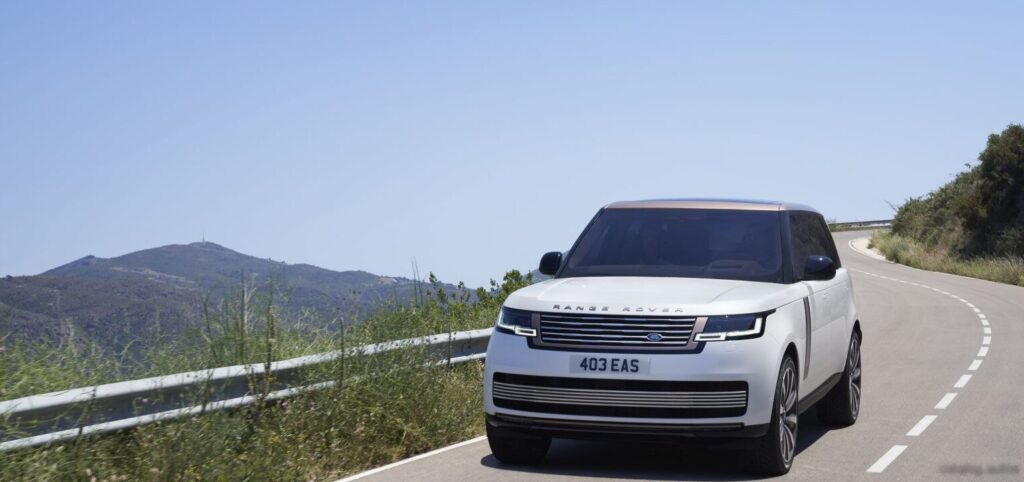
The Land Rover Range Rover V LWB SV 3.0 D350, introduced in January 2022, represents the pinnacle of luxury and capability within the fifth-generation Range Rover (L460) family. This long-wheelbase (LWB) variant, designated as ‘SV’ signifying Special Vehicle Operations, caters to buyers seeking an elevated level of refinement and personalization. Positioned as a premium offering within the Range Rover lineup, the D350 utilizes a mild-hybrid diesel powertrain, balancing performance with improved fuel efficiency. It’s built on the MLA3 platform, Land Rover’s new modular longitudinal architecture, designed to accommodate both internal combustion engines and fully electric powertrains.
Technical Specifications
| Brand | Land Rover |
| Model | Range Rover |
| Generation | Range Rover V LWB |
| Type (Engine) | SV 3.0 D350 (351 Hp) Mild Hybrid AWD Automatic |
| Start of production | January, 2022 |
| Powertrain Architecture | MHEV (Mild Hybrid Electric Vehicle) |
| Body type | SUV |
| Seats | 4 |
| Doors | 5 |
| Combined fuel consumption (WLTP) | 7.9-8.3 l/100 km (29.8 – 28.3 US mpg, 35.8 – 34 UK mpg, 12.7 – 12 km/l) |
| CO2 emissions (WLTP) | 208-217 g/km |
| Fuel Type | Diesel |
| Acceleration 0 – 100 km/h | 6.3 sec |
| Acceleration 0 – 62 mph | 6.3 sec |
| Acceleration 0 – 60 mph | 5.9 sec |
| Maximum speed | 234 km/h (145.4 mph) |
| Emission standard | Euro 6d Final |
| Weight-to-power ratio | 7.1 kg/Hp, 140.7 Hp/tonne |
| Weight-to-torque ratio | 3.6 kg/Nm, 280.7 Nm/tonne |
| Power | 351 Hp |
| Power per litre | 117.1 Hp/l |
| Torque | 700 Nm (516.29 lb.-ft.) |
| Engine layout | Front, Longitudinal |
| Engine displacement | 2997 cm3 (182.89 cu. in.) |
| Number of cylinders | 6 |
| Engine configuration | Inline |
| Cylinder Bore | 83 mm (3.27 in.) |
| Piston Stroke | 92.31 mm (3.63 in.) |
| Compression ratio | 15.5:1 |
| Number of valves per cylinder | 4 |
| Fuel injection system | Diesel Commonrail |
| Engine aspiration | Turbocharger, Intercooler |
| Engine oil capacity | 10.4 l (10.99 US qt | 9.15 UK qt) |
| Kerb Weight | 2494 kg (5498.33 lbs.) |
| Trunk (boot) space – minimum | 725 l (25.6 cu. ft.) |
| Trunk (boot) space – maximum | 2727 l (96.3 cu. ft.) |
| Fuel tank capacity | 80 l (21.13 US gal | 17.6 UK gal) |
| AdBlue tank | 20 l (5.28 US gal | 4.4 UK gal) |
| Permitted trailer load with brakes (12%) | 3500 kg (7716.18 lbs.) |
| Permitted trailer load without brakes | 750 kg (1653.47 lbs.) |
| Length | 5258 mm (207.01 in.) |
| Width with mirrors folded | 2047 mm (80.59 in.) |
| Width including mirrors | 2209 mm (86.97 in.) |
| Height | 1870 mm (73.62 in.) |
| Wheelbase | 3197 mm (125.87 in.) |
| Front track | 1702 mm (67.01 in.) |
| Rear (Back) track | 1704 mm (67.09 in.) |
| Front overhang | 866 mm (34.09 in.) |
| Rear overhang | 1195 mm (47.05 in.) |
| Ride height (ground clearance) | 294 mm (11.57 in.) |
| Drag coefficient (Cd) | 0.319 |
| Minimum turning circle (turning diameter) | 11.96 m (39.24 ft.) |
| Approach angle | 32.1° |
| Departure angle | 29° |
| Ramp-over (brakeover) angle | 25.2° |
| Wading depth | 900 mm (35.43 in.) |
| Drivetrain Architecture | ICE and electric motor, permanent all-wheel drive |
| Drive wheel | All wheel drive (4×4) |
| Number of gears and type of gearbox | 8 gears, automatic transmission |
| Front suspension | Double wishbone |
| Rear suspension | Independent multi-link suspension |
| Front brakes | Ventilated discs, 380 mm |
| Rear brakes | Ventilated discs, 355 mm |
| Assisting systems | ABS (Anti-lock braking system) |
| Steering type | Steering rack and pinion |
| Power steering | Electric Steering |
Powertrain & Engine Architecture
The heart of the Range Rover D350 is the Ingenium 3.0-liter inline-six cylinder diesel engine, internally designated as the D350. This engine utilizes a sophisticated mild-hybrid (MHEV) system, incorporating a 48-volt electrical architecture. The MHEV system employs a Belt-integrated Starter Generator (BiSG) which assists the engine during acceleration, enabling smoother starts and improved fuel economy. The engine features a cast aluminum block, a forged steel crankshaft, and direct injection with a common rail system operating at pressures up to 2,500 bar. A single variable geometry turbocharger (VGT) with an intercooler delivers boosted air to the cylinders. The engine produces 351 horsepower and a substantial 700 Nm (516 lb-ft) of torque. The eight-speed automatic transmission, sourced from ZF, is a key component of the powertrain. It’s known for its smooth shifts and wide gear ratios, optimized for both on-road comfort and off-road capability.
Driving Characteristics
The D350 powertrain delivers a refined and effortless driving experience. While not as overtly sporty as the higher-powered gasoline variants, the D350 provides ample torque for confident acceleration and relaxed cruising. The 0-60 mph sprint takes approximately 5.9 seconds. The eight-speed automatic transmission is well-tuned, providing seamless gear changes and contributing to the vehicle’s overall composure. The MHEV system helps to mitigate turbo lag, resulting in a more responsive throttle feel. Compared to the petrol engines, the D350 offers superior fuel economy, making it a more practical choice for long-distance travel. However, it lacks the outright performance and aural excitement of the higher-output engines.
Equipment & Trim Levels
The SV trim level represents the highest echelon of luxury within the Range Rover range. Standard features include premium leather upholstery, heated and ventilated front and rear seats with massage function, a Meridian Signature sound system, and a panoramic sunroof. The interior is adorned with unique SV badging and offers a vast array of customization options, including bespoke color schemes and trim materials. Available options include executive-class rear seating with a central console, a rear entertainment system, and advanced driver-assistance systems. The LWB configuration provides significantly more rear legroom than the standard wheelbase model, enhancing passenger comfort.
Chassis & Braking
The Range Rover V LWB SV utilizes a sophisticated chassis featuring double-wishbone front suspension and an independent multi-link rear suspension. Air suspension with electronic dampers and adaptive dynamics is standard, providing a supremely comfortable ride. The vehicle also incorporates Terrain Response 2, Land Rover’s advanced terrain management system, which allows the driver to optimize the vehicle’s settings for various off-road conditions. Braking duties are handled by ventilated discs all around, measuring 380mm at the front and 355mm at the rear. The braking system is augmented by ABS, electronic brakeforce distribution, and emergency brake assist.
Market Reception & Comparison
The Range Rover V LWB SV 3.0 D350 has been well-received by automotive critics, praised for its luxurious interior, comfortable ride, and refined powertrain. The diesel engine offers a compelling blend of performance and fuel efficiency, making it a popular choice for buyers who prioritize long-distance comfort. Compared to the petrol-powered Range Rovers, the D350 offers superior fuel economy, but lacks the same level of outright performance. Against competitors such as the Bentley Bentayga Diesel and the Porsche Cayenne Diesel, the Range Rover SV D350 offers a unique combination of luxury, capability, and brand prestige.
Legacy
The Ingenium diesel engine family has proven to be relatively reliable, although early versions experienced some issues with the diesel particulate filter (DPF). The MHEV system adds complexity, but has generally proven to be durable. The Range Rover V LWB SV 3.0 D350 is expected to hold its value well due to its premium positioning and desirable features. On the used car market, these vehicles command a premium price, reflecting their high level of luxury and refinement. The MLA3 platform and the Ingenium engine family represent a significant investment by Land Rover, and are expected to underpin future generations of Range Rover vehicles.