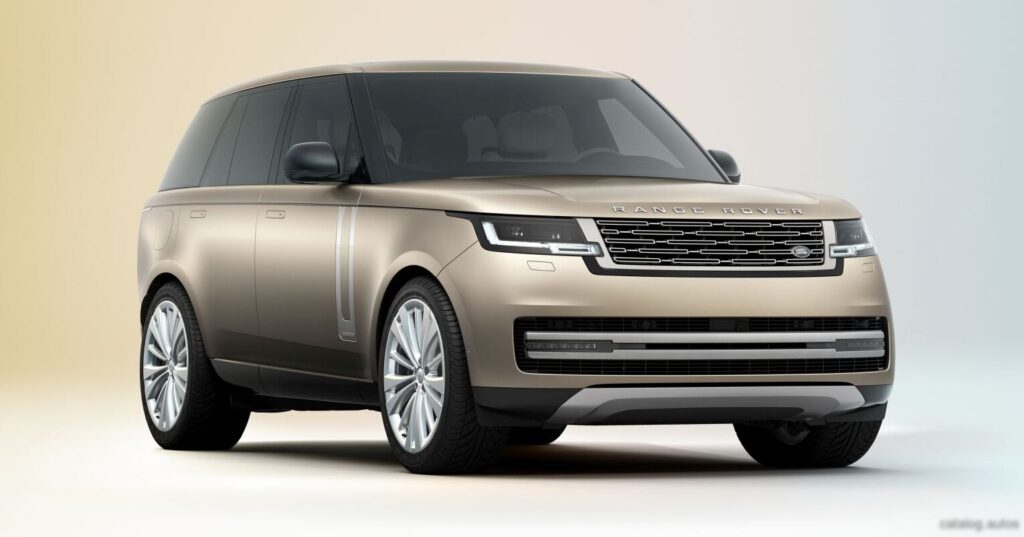
The Land Rover Range Rover V SWB 3.0 P510e, a plug-in hybrid variant of the fifth-generation Range Rover (L461), was produced from January 2022 to May 2023. Positioned as a premium offering within the Range Rover lineup, the P510e combined a 3.0-liter inline-six cylinder engine with an electric motor, delivering a total system output of 510 horsepower. The “SWB” designation indicates a short wheelbase model, offering enhanced maneuverability compared to the standard-length variant. This model aimed to appeal to buyers seeking a luxurious SUV with reduced emissions and the capability of all-electric driving for shorter commutes.
Technical Specifications
| Brand | Land Rover |
| Model | Range Rover |
| Generation | Range Rover V SWB |
| Type (Engine) | 3.0 P510e (510 Hp) Plug-in Hybrid AWD Automatic |
| Start of production | January, 2022 |
| End of production | May, 2023 |
| Powertrain Architecture | PHEV (Plug-in Hybrid Electric Vehicle) |
| Body type | SUV |
| Seats | 5 |
| Doors | 5 |
| Combined fuel consumption (WLTP) | 0.8-0.9 l/100 km (294 – 261.3 US mpg, 353.1 – 313.9 UK mpg, 125 – 111.1 km/l) |
| CO2 emissions (WLTP) | 18-21 g/km |
| Fuel Type | Petrol / electricity |
| Acceleration 0 – 100 km/h | 5.5 sec |
| Acceleration 0 – 62 mph | 5.5 sec |
| Acceleration 0 – 60 mph | 5.2 sec |
| Maximum speed | 242 km/h (150.37 mph) |
| Emission standard | Euro 6d Final |
| Weight-to-power ratio | 5.4 kg/Hp, 186.5 Hp/tonne |
| Weight-to-torque ratio | 3.9 kg/Nm, 255.9 Nm/tonne |
| Gross battery capacity | 38.2 kWh |
| Net (usable) battery capacity | 31.8 kWh |
| Battery technology | Lithium-ion (Li-Ion) |
| Battery location | Below the floor, between front and rear seats |
| All-electric range (WLTP) | 113 km (70.21 mi) |
| Electric motor power | 143 Hp |
| Electric motor location | Between the combustion engine and the transmission |
| System power | 510 Hp |
| System torque | 700 Nm (516.29 lb.-ft.) |
| Power | 400 Hp |
| Power per litre | 133.5 Hp/l |
| Engine displacement | 2996 cm3 (182.83 cu. in.) |
| Number of cylinders | 6 |
| Engine configuration | Inline |
| Cylinder Bore | 83 mm (3.27 in.) |
| Piston Stroke | 92.29 mm (3.63 in.) |
| Compression ratio | 10.5:1 |
| Number of valves per cylinder | 4 |
| Fuel injection system | Direct injection |
| Engine aspiration | Turbocharger, Intercooler |
| Engine oil capacity | 9.4 l (9.93 US qt | 8.27 UK qt) |
| Kerb Weight | 2735 kg (6029.64 lbs.) |
| Trunk (boot) space – minimum | 725 l (25.6 cu. ft.) |
| Trunk (boot) space – maximum | 1841 l (65.01 cu. ft.) |
| Fuel tank capacity | 71.5 l (18.89 US gal | 15.73 UK gal) |
| Permitted trailer load with brakes (12%) | 2500 kg (5511.56 lbs.) |
| Permitted trailer load without brakes | 750 kg (1653.47 lbs.) |
| Length | 5052 mm (198.9 in.) |
| Width with mirrors folded | 2047 mm (80.59 in.) |
| Width including mirrors | 2209 mm (86.97 in.) |
| Height | 1870 mm (73.62 in.) |
| Wheelbase | 2997 mm (117.99 in.) |
| Front track | 1702 mm (67.01 in.) |
| Rear (Back) track | 1704 mm (67.09 in.) |
| Front overhang | 860 mm (33.86 in.) |
| Rear overhang | 1195 mm (47.05 in.) |
| Ride height (ground clearance) | 284 mm (11.18 in.) |
| Drag coefficient (Cd) | 0.30 |
| Minimum turning circle (turning diameter) | 11.37 m (37.3 ft.) |
| Approach angle | 34.7° |
| Departure angle | 29° |
| Ramp-over (brakeover) angle | 25.2° |
| Wading depth | 900 mm (35.43 in.) |
| Drivetrain Architecture | The Internal combustion engine (ICE) and the electric motor permanently drive the four wheels of the car with the ability to work in full electric or mixed mode. |
| Drive wheel | All wheel drive (4×4) |
| Number of gears and type of gearbox | 8 gears, automatic transmission |
| Front suspension | Double wishbone |
| Rear suspension | Independent multi-link suspension |
| Front brakes | Ventilated discs, 400 mm |
| Rear brakes | Ventilated discs, 370 mm |
| Steering type | Steering rack and pinion |
| Power steering | Electric Steering |
Powertrain & Engine Architecture
The heart of the P510e is Land Rover’s Ingenium 3.0-liter inline-six cylinder engine, designated as the P360. This engine utilizes a turbocharger and direct fuel injection to produce 400 horsepower. Coupled with the 143 horsepower electric motor integrated between the engine and the eight-speed automatic transmission, the total system output reaches 510 horsepower and 700 Nm (516 lb-ft) of torque. The electric motor draws power from a 38.2 kWh (gross) / 31.8 kWh (net) lithium-ion battery pack positioned under the vehicle floor. The Ingenium engine features a relatively high compression ratio of 10.5:1 and employs variable valve timing for optimized efficiency and performance. The eight-speed automatic transmission, a ZF unit, is calibrated to work seamlessly with both the combustion engine and the electric motor, providing smooth and efficient gear changes.
Driving Characteristics
The P510e delivers a unique driving experience. In electric-only mode, it offers near-silent operation and brisk acceleration for urban driving, with a WLTP-rated range of 113 km (70.21 miles). Switching to hybrid mode allows the engine and motor to work in tandem, providing strong acceleration – 0-60 mph in 5.2 seconds – and ample power for highway cruising. The eight-speed automatic transmission is well-tuned, offering responsive shifts. Compared to the standard Range Rover with a gasoline engine, the P510e feels slightly heavier due to the battery pack, but the instant torque from the electric motor compensates for this, providing a more immediate response. Compared to the diesel variants, the P510e offers a quieter and more refined driving experience, albeit with potentially higher running costs depending on electricity prices.
Equipment & Trim Levels
The Range Rover V SWB 3.0 P510e typically came well-equipped, reflecting its premium positioning. Standard features included leather upholstery, a panoramic sunroof, a premium sound system, and a comprehensive suite of driver-assistance technologies such as adaptive cruise control, lane-keeping assist, and automatic emergency braking. The infotainment system featured a large touchscreen display with navigation, Apple CarPlay, and Android Auto compatibility. Optional extras included upgraded leather trims, rear-seat entertainment systems, and advanced off-road packages. The SWB model often featured unique interior trim options to differentiate it from the standard wheelbase version.
Chassis & Braking
The Range Rover V SWB utilizes a sophisticated chassis design featuring double-wishbone front suspension and an independent multi-link rear suspension. Air suspension is standard, providing a comfortable ride and adjustable ride height for off-road capability. The P510e is equipped with ventilated disc brakes on all four wheels, with larger front discs (400mm) than the rear (370mm). The braking system incorporates ABS, electronic brake-force distribution, and brake assist. Due to the added weight of the battery pack, the suspension was tuned to provide optimal handling and stability.
Market Reception & Comparison
The Range Rover P510e was generally well-received by automotive critics, who praised its luxurious interior, refined driving experience, and impressive electric range. However, some reviewers noted the relatively high price compared to other plug-in hybrid SUVs. Compared to the Range Rover P400 (gasoline) and D350 (diesel) models, the P510e offered lower emissions and the ability to drive in electric-only mode, but it came at a premium cost. Fuel economy in hybrid mode was competitive, but real-world figures varied depending on driving style and charging habits.
Legacy
The Land Rover Range Rover V SWB 3.0 P510e represents an important step in Land Rover’s electrification strategy. While production was relatively short-lived, the model demonstrated the brand’s commitment to offering sustainable luxury vehicles. On the used car market, these models hold their value well, appealing to buyers seeking a premium plug-in hybrid SUV with a strong brand reputation. The Ingenium powertrain, while complex, has proven to be generally reliable, although regular maintenance and software updates are crucial to ensure optimal performance and longevity.