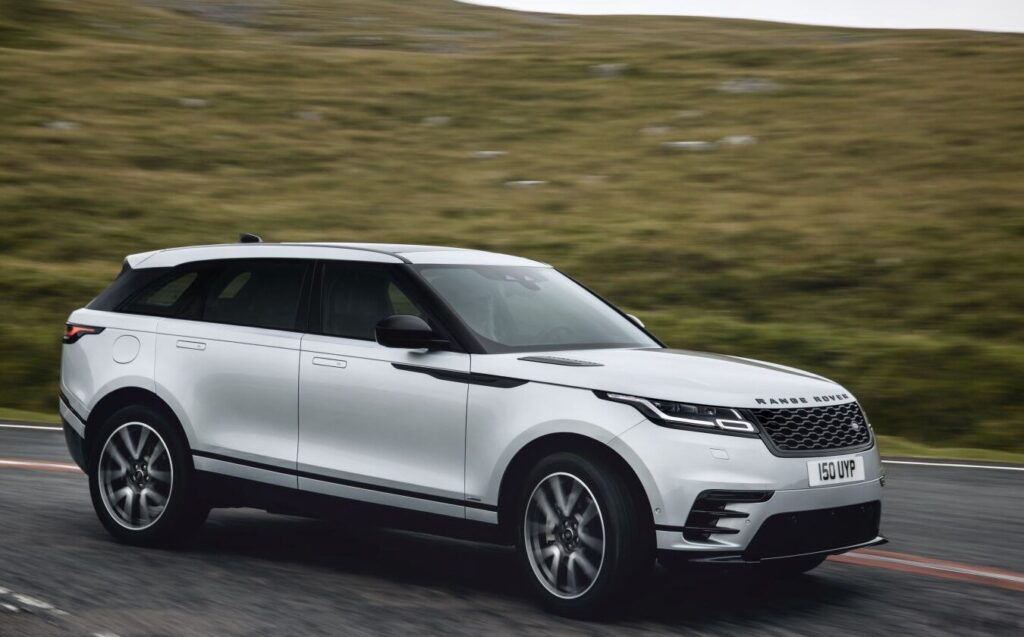
The Land Rover Range Rover Velar, introduced for the 2018 model year, quickly established itself as a stylish and technologically advanced mid-size luxury SUV. The facelifted version, launched in September 2020 and produced through February 2023, brought refinements to the exterior design, interior technology, and powertrain options. Among these, the 3.0 D300 variant – a 300 horsepower, 3.0-liter inline-six diesel engine paired with a mild-hybrid system and an eight-speed automatic transmission – represented a compelling blend of performance, efficiency, and luxury. This configuration positioned itself as a mid-to-upper tier offering within the Velar lineup, appealing to buyers seeking a refined driving experience without sacrificing capability.
Technical Specifications
| Brand | Land Rover |
| Model | Range Rover Velar |
| Generation | Range Rover Velar (facelift 2020) |
| Type (Engine) | 3.0 D300 (300 Hp) Mild Hybrid AWD Automatic |
| Start of production | September, 2020 |
| End of production | February, 2023 |
| Powertrain Architecture | MHEV (Mild Hybrid Electric Vehicle) |
| Body type | SUV |
| Seats | 5 |
| Doors | 5 |
| Combined fuel consumption (WLTP) | 7.4-8 l/100 km (31.8 – 29.4 US mpg) |
| CO2 emissions (WLTP) | 194-209 g/km |
| Fuel consumption (NEDC, WLTP equivalent) | 6.9 l/100 km (34.1 US mpg) |
| CO2 emissions (NEDC, WLTP equivalent) | 183 g/km |
| Fuel Type | Diesel |
| Acceleration 0 – 100 km/h | 6.5 sec |
| Acceleration 0 – 62 mph | 6.5 sec |
| Acceleration 0 – 60 mph | 6.1 sec |
| Maximum speed | 230 km/h (142.92 mph) |
| Emission standard | Euro 6d |
| Weight-to-power ratio | 6.8 kg/Hp |
| Weight-to-torque ratio | 3.2 kg/Nm |
| Power | 300 Hp @ 4000 rpm |
| Torque | 650 Nm @ 1500-2500 rpm (479.42 lb.-ft. @ 1500-2500 rpm) |
| Engine layout | Front, Longitudinal |
| Engine Model/Code | Ingenium / AJ20D6 |
| Engine displacement | 2996 cm3 (182.83 cu. in.) |
| Number of cylinders | 6 |
| Engine configuration | Inline |
| Cylinder Bore | 83.01 mm (3.27 in.) |
| Piston Stroke | 92.3 mm (3.63 in.) |
| Compression ratio | 15.5:1 |
| Number of valves per cylinder | 4 |
| Fuel injection system | Diesel Commonrail |
| Engine aspiration | Turbocharger, Intercooler |
| Engine oil capacity | 10 l (10.57 US qt | 8.8 UK qt) |
| Kerb Weight | 2049 kg (4517.27 lbs.) |
| Trunk (boot) space – minimum | 748 l (26.42 cu. ft.) |
| Trunk (boot) space – maximum | 1811 l (63.95 cu. ft.) |
| Fuel tank capacity | 66 l (17.44 US gal | 14.52 UK gal) |
| AdBlue tank | 17 l (4.49 US gal | 3.74 UK gal) |
| Permitted trailer load with brakes (12%) | 2500 kg (5511.56 lbs.) |
| Permitted trailer load without brakes | 750 kg (1653.47 lbs.) |
| Length | 4797 mm (188.86 in.) |
| Width with mirrors folded | 2041 mm (80.35 in.) |
| Width including mirrors | 2147 mm (84.53 in.) |
| Height | 1678-1683 mm (66.06 – 66.26 in.) |
| Wheelbase | 2874 mm (113.15 in.) |
| Front track | 1640-1644 mm (64.57 – 64.72 in.) |
| Rear (Back) track | 1657-1663 mm (65.24 – 65.47 in.) |
| Front overhang | 834 mm (32.83 in.) |
| Rear overhang | 1089 mm (42.87 in.) |
| Ride height (ground clearance) | 205-251 mm (8.07 – 9.88 in.) |
| Drag coefficient (Cd) | 0.33 |
| Minimum turning circle (turning diameter) | 11.94 m (39.17 ft.) |
| Front suspension | Double wishbone |
| Rear suspension | Independent multi-link suspension |
| Front brakes | Ventilated discs, 370 mm |
| Rear brakes | Ventilated discs, 325 mm |
| Gearbox | 8 gears, automatic transmission |
INTRODUCTION
The 2020-2023 facelift of the Range Rover Velar saw Land Rover refine an already successful formula. The D300 variant, powered by the Ingenium engine, was a key part of this update. It offered a significant step up in performance compared to the lower-powered four-cylinder options, while providing better fuel economy and a more refined driving experience than the supercharged gasoline V6. Positioned within the Velar range, it catered to buyers who prioritized a balance of luxury, performance, and efficiency in a stylish package. The Velar, as a whole, aimed to bridge the gap between the more utilitarian Discovery Sport and the flagship Range Rover, offering a more coupe-like silhouette and a focus on design and technology.
Powertrain & Engine Architecture
At the heart of the D300 lies Land Rover’s Ingenium engine family. Specifically, the AJ20D6 is a 3.0-liter inline-six cylinder diesel engine. This engine utilizes a sophisticated turbocharging system, incorporating a single twin-scroll turbocharger and direct injection, operating at a high compression ratio of 15.5:1. The mild-hybrid system, a 48-volt setup, employs a Belt-integrated Starter Generator (BiSG) to provide a small power boost during acceleration, enable smoother stop/start operation, and contribute to improved fuel economy. The engine produces 300 horsepower at 4000 rpm and a substantial 650 Nm (479.42 lb.-ft.) of torque between 1500 and 2500 rpm. This torque output is a key characteristic, providing strong pulling power across a wide rev range. The engine is longitudinally mounted, driving all four wheels through a ZF eight-speed automatic transmission. This transmission is known for its smooth and quick shifts, and is calibrated to provide a balance between performance and efficiency.
Driving Characteristics
The D300’s powertrain delivers a refined and capable driving experience. The abundance of torque makes for effortless acceleration in everyday driving situations, with strong responsiveness from low engine speeds. The eight-speed automatic transmission is well-matched to the engine’s characteristics, providing smooth gear changes and keeping the engine within its optimal power band. While not as overtly sporty as some competitors, the Velar D300 offers a composed and confident ride. Compared to the four-cylinder models, the D300 feels significantly more relaxed at highway speeds, with ample power for overtaking maneuvers. Against the higher-output gasoline V6, the D300 trades some outright horsepower for superior fuel economy and a broader, more usable torque curve. The mild-hybrid system contributes to a seamless stop/start experience and a slight improvement in responsiveness.
Equipment & Trim Levels
The D300 trim typically came well-equipped as standard. Key features included leather upholstery, a touchscreen infotainment system with Apple CarPlay and Android Auto integration, navigation, climate control, and a suite of driver-assistance systems such as lane keep assist, emergency braking, and adaptive cruise control. Optional extras included a panoramic sunroof, premium audio systems (Meridian), configurable ambient lighting, and various exterior styling packages. Interior trim options ranged from aluminum accents to wood veneers, allowing buyers to personalize the cabin to their preferences. The D300 often served as a base for higher trim levels, with buyers able to add further luxury and technology features.
Chassis & Braking
The Velar utilizes an aluminum-intensive chassis, contributing to its relatively low weight for a vehicle of its size. The suspension consists of double wishbones at the front and an independent multi-link setup at the rear, providing a comfortable and controlled ride. The D300 variant typically featured larger brakes than the lower-powered models, with ventilated discs all around – 370mm at the front and 325mm at the rear – providing ample stopping power. The steering is electrically assisted, offering a precise and responsive feel. The all-wheel-drive system is a full-time system, providing excellent traction in all weather conditions. Terrain Response 2, Land Rover’s signature off-road system, allows drivers to optimize the vehicle’s settings for various surfaces, including grass, gravel, snow, mud, and sand.
Market Reception & Comparison
The Range Rover Velar D300 was generally well-received by automotive critics. It was praised for its stylish design, luxurious interior, and refined driving experience. The D300 engine was noted for its strong performance and fuel efficiency. Compared to rivals such as the Porsche Macan and BMW X4, the Velar offered a unique blend of luxury, capability, and design flair. However, some critics pointed to the infotainment system as being somewhat complex and occasionally slow to respond. Fuel economy figures of 7.4-8 l/100 km (31.8-29.4 US mpg) were competitive for its class, offering a noticeable improvement over the gasoline V6. Reliability reports were generally positive, although, as with any complex vehicle, some owners reported minor issues with the infotainment system and electrical components.
Legacy
The Ingenium engine family, including the AJ20D6 found in the D300, has proven to be a reliable and durable powertrain. While long-term reliability data is still accumulating, early indications suggest that the engine is capable of high mileage with proper maintenance. On the used car market, the 2020-2023 Velar D300 holds its value relatively well, reflecting its desirable combination of performance, luxury, and efficiency. The facelifted Velar, and particularly the D300 variant, represents a significant step forward in Land Rover’s commitment to delivering a refined and technologically advanced SUV experience. It continues to be a popular choice for buyers seeking a stylish and capable luxury vehicle.