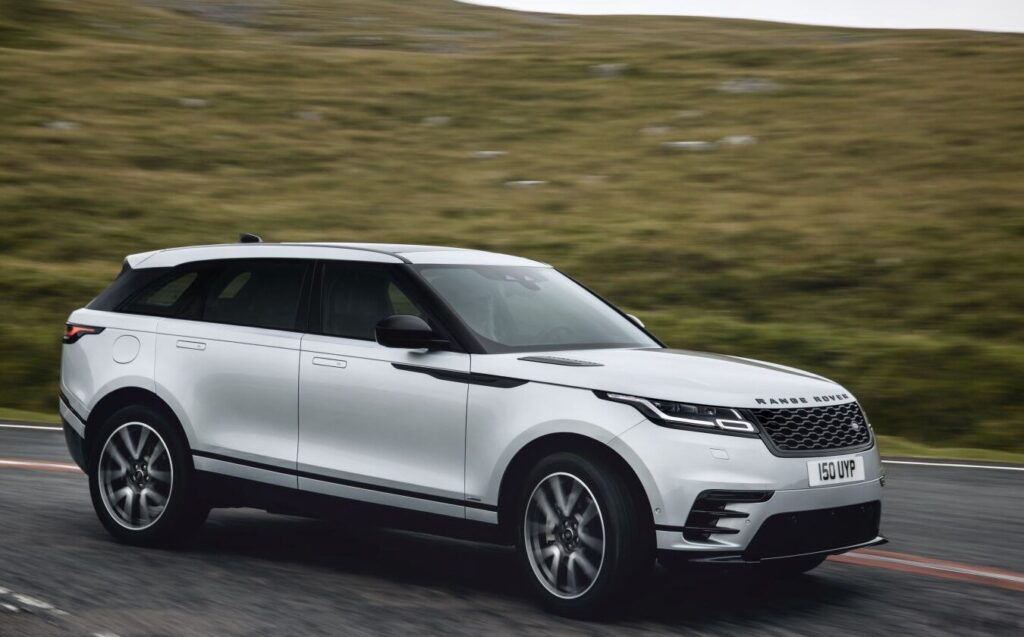
The Land Rover Range Rover Velar, introduced for the 2018 model year, quickly established itself as a stylish and technologically advanced mid-size luxury SUV. The facelifted version, launched in September 2020 and produced through February 2023, brought refinements to the exterior design, interior technology, and powertrain options. Among these, the 3.0 P400 Mild Hybrid AWD Automatic variant represented a compelling blend of performance, efficiency, and luxury, positioned as a high-end offering within the Velar lineup. This model aimed to deliver a sophisticated driving experience while incorporating Land Rover’s renowned off-road capability.
Technical Specifications
| Brand | Land Rover |
| Model | Range Rover Velar |
| Generation | Range Rover Velar (facelift 2020) |
| Type (Engine) | 3.0 P400 (400 Hp) Mild Hybrid AWD Automatic |
| Start of production | September, 2020 |
| End of production | February, 2023 |
| Powertrain Architecture | MHEV (Mild Hybrid Electric Vehicle) |
| Body type | SUV |
| Seats | 5 |
| Doors | 5 |
| Combined fuel consumption (WLTP) | 9.8-10.5 l/100 km (24 – 22.4 US mpg) |
| CO2 emissions (WLTP) | 221-238 g/km |
| Fuel consumption (NEDC, WLTP equivalent) | 8.9 l/100 km (26.4 US mpg) |
| CO2 emissions (NEDC, WLTP equivalent) | 202 g/km |
| Fuel Type | Petrol (Gasoline) |
| Acceleration 0 – 100 km/h | 5.5 sec |
| Acceleration 0 – 62 mph | 5.5 sec |
| Acceleration 0 – 60 mph | 5.2 sec |
| Maximum speed | 250 km/h (155.34 mph) |
| Emission standard | Euro 6d |
| Weight-to-power ratio | 5 kg/Hp, 199 Hp/tonne |
| Weight-to-torque ratio | 3.7 kg/Nm, 273.6 Nm/tonne |
| Power | 400 Hp @ 5500-6500 rpm |
| Power per litre | 133.6 Hp/l |
| Torque | 550 Nm @ 2000-5000 rpm (405.66 lb.-ft. @ 2000-5000 rpm) |
| Engine layout | Front, Longitudinal |
| Engine Model/Code | Ingenium / AJ20P6 |
| Engine displacement | 2995 cm3 (182.77 cu. in.) |
| Number of cylinders | 6 |
| Engine configuration | Inline |
| Cylinder Bore | 83.01 mm (3.27 in.) |
| Piston Stroke | 92.28 mm (3.63 in.) |
| Compression ratio | 10.5:1 |
| Number of valves per cylinder | 4 |
| Fuel injection system | Direct injection |
| Engine oil capacity | 9 l (9.51 US qt | 7.92 UK qt) |
| Kerb Weight | 2010 kg (4431.29 lbs.) |
| Trunk (boot) space – minimum | 748 l (26.42 cu. ft.) |
| Trunk (boot) space – maximum | 1811 l (63.95 cu. ft.) |
| Fuel tank capacity | 82 l (21.66 US gal | 18.04 UK gal) |
| Permitted trailer load with brakes (12%) | 2500 kg (5511.56 lbs.) |
| Permitted trailer load without brakes | 750 kg (1653.47 lbs.) |
| Length | 4797 mm (188.86 in.) |
| Width with mirrors folded | 2041 mm (80.35 in.) |
| Width including mirrors | 2147 mm (84.53 in.) |
| Height | 1678-1683 mm (66.06 – 66.26 in.) |
| Wheelbase | 2874 mm (113.15 in.) |
| Front track | 1640-1644 mm (64.57 – 64.72 in.) |
| Rear (Back) track | 1657-1663 mm (65.24 – 65.47 in.) |
| Front overhang | 834 mm (32.83 in.) |
| Rear overhang | 1089 mm (42.87 in.) |
| Ride height (ground clearance) | 205-251 mm (8.07 – 9.88 in.) |
| Drag coefficient (Cd) | 0.33 |
| Minimum turning circle (turning diameter) | 11.94 m (39.17 ft.) |
| Approach angle | 22.5-27.5° |
| Departure angle | 24.8-29.5° |
| Ramp-over (brakeover) angle | 18.3-23.5° |
| Wading depth | 530-580 mm (20.87 – 22.83 in.) |
| Drivetrain Architecture | ICE and electric motor drive rear wheels, front wheels engaged as needed. |
| Drive wheel | All wheel drive (4×4) |
| Number of gears and type of gearbox | 8 gears, automatic transmission |
| Front suspension | Double wishbone |
| Rear suspension | Independent multi-link suspension |
| Front brakes | Ventilated discs, 370 mm |
| Rear brakes | Ventilated discs, 325 mm |
| Steering type | Steering rack and pinion |
| Power steering | Electric |
INTRODUCTION
The 2020-2023 facelift of the Range Rover Velar saw Land Rover refine an already successful formula. The 3.0 P400 Mild Hybrid AWD Automatic variant occupied a sweet spot in the range, offering a significant step up in performance from the four-cylinder options while remaining more accessible than the full-hybrid or supercharged models. Built on the Premium Longitudinal Architecture (PLA), also known as the 1HX0/A3 platform, this Velar aimed to provide a luxurious and capable SUV experience for buyers seeking both on-road comfort and off-road prowess. It was marketed towards buyers who desired a premium SUV with a powerful engine and sophisticated technology.
Powertrain & Engine Architecture
At the heart of the 3.0 P400 lies Land Rover’s Ingenium engine family, specifically the AJ20P6, a 2.995-liter inline-six cylinder gasoline engine. This engine utilizes a twin-scroll turbocharger and direct fuel injection to produce 400 horsepower at 5500-6500 rpm and 550 Nm (405.66 lb.-ft.) of torque between 2000-5000 rpm. The “P400” designation directly reflects the metric horsepower output. The mild-hybrid system incorporates a 48-volt electric motor that assists the engine during acceleration and allows for smoother start-stop operation, improving fuel efficiency. The engine’s architecture is longitudinally mounted, contributing to the Velar’s balanced handling characteristics. The eight-speed automatic transmission, sourced from ZF, is a crucial component of the powertrain. It’s known for its smooth and quick shifts, and is calibrated to provide a balance between performance and fuel economy. The transmission features selectable drive modes, allowing the driver to tailor the shift points to their preferences.
Driving Characteristics
The 3.0 P400 Velar delivers a noticeably more engaging driving experience than the lower-powered variants. The ample torque available from 2000 rpm provides strong acceleration in everyday driving situations, while the 400 hp output allows for confident overtaking maneuvers. The 0-60 mph sprint takes approximately 5.2 seconds. The eight-speed automatic transmission contributes to a refined driving experience, with smooth gear changes and a responsive feel. Compared to the four-cylinder models, the P400 offers a more relaxed cruising experience, with less need to downshift for passing. While not as overtly sporty as some competitors, the Velar P400 provides a comfortable and capable ride, with Land Rover’s Terrain Response system allowing drivers to optimize the vehicle’s settings for various off-road conditions. The mild-hybrid system is largely transparent to the driver, providing a subtle boost during acceleration and contributing to improved fuel economy.
Equipment & Trim Levels
The 3.0 P400 variant typically came equipped with a high level of standard features, reflecting its position as a premium trim. These included leather upholstery, heated and ventilated front seats, a panoramic sunroof, a premium sound system, and a comprehensive suite of driver-assistance technologies such as adaptive cruise control, lane-keeping assist, and automatic emergency braking. The infotainment system, featuring a 10.2-inch touchscreen, provided access to navigation, smartphone integration (Apple CarPlay and Android Auto), and vehicle settings. Optional extras included upgraded leather options, a head-up display, and a rear-seat entertainment system. The interior design emphasized luxury and modernity, with a minimalist aesthetic and high-quality materials.
Chassis & Braking
The Velar’s chassis is designed to provide a balance between on-road comfort and off-road capability. It features double-wishbone suspension at the front and an independent multi-link suspension at the rear. The P400 variant typically came with larger stabilizer bars compared to the lower-powered models, reducing body roll during cornering. The braking system consists of ventilated discs on all four wheels, with larger discs at the front (370mm) to provide ample stopping power. Anti-lock braking system (ABS) and electronic brake-force distribution (EBD) are standard features. The all-wheel-drive system provides excellent traction in a variety of conditions, and the Terrain Response system allows drivers to optimize the vehicle’s settings for different surfaces such as grass, gravel, snow, mud, and sand.
Market Reception & Comparison
The Range Rover Velar 3.0 P400 received generally positive reviews from automotive critics. It was praised for its stylish design, luxurious interior, and strong performance. The mild-hybrid system was also well-received, contributing to improved fuel economy without sacrificing performance. Compared to the four-cylinder Velar models, the P400 offered a significant upgrade in power and refinement. However, it was also more expensive. Compared to competitors such as the Porsche Macan and BMW X5, the Velar P400 offered a unique blend of luxury, capability, and style. Fuel economy figures of 9.8-10.5 l/100 km (24-22.4 US mpg) were competitive for its class, although not class-leading. Reliability reports were mixed, with some owners reporting minor issues with the infotainment system and electrical components.
Legacy
The 2020-2023 Range Rover Velar 3.0 P400 Mild Hybrid AWD Automatic remains a desirable vehicle in the used car market. Its combination of performance, luxury, and technology continues to appeal to buyers seeking a premium SUV. The Ingenium engine has proven to be relatively reliable, although regular maintenance is essential. The mild-hybrid system has also demonstrated good durability. As with any luxury vehicle, potential buyers should carefully inspect the vehicle’s history and maintenance records before making a purchase. The Velar P400 represents a significant step forward in Land Rover’s design and engineering, and it continues to be a stylish and capable SUV that offers a compelling alternative to its competitors.