
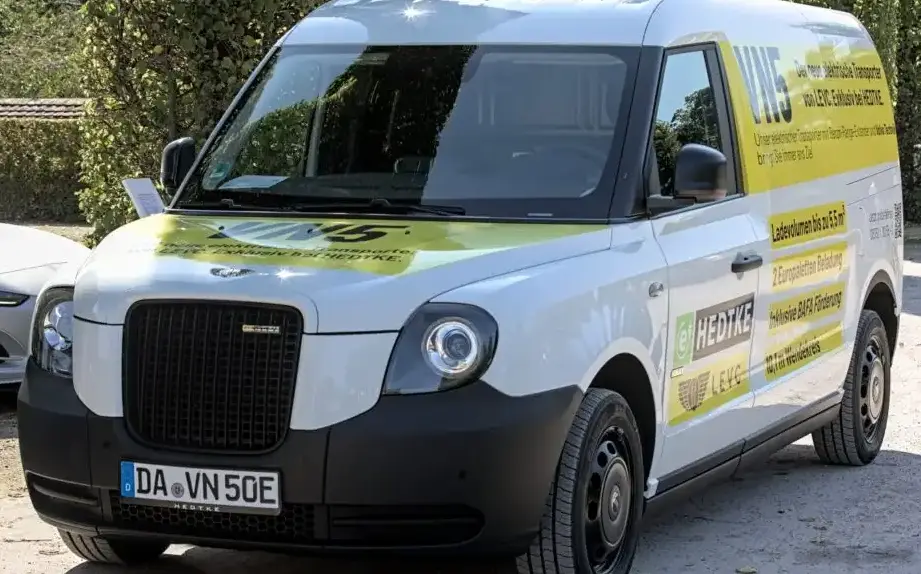
The LEVC VN5 1.5 Range Extender (150 Hp) Plug-in Hybrid Automatic is a commercial vehicle produced by the London Electric Vehicle Company (LEVC), beginning in November 2020. Designed primarily for the European and Asian markets, particularly for urban logistics and transportation, the VN5 represents LEVC’s expansion beyond the iconic London black cab. It’s built upon a dedicated electric vehicle architecture, utilizing a range-extending petrol engine to provide extended operational range. The VN5 is a direct response to growing demand for zero-emission capable commercial vehicles in congested city environments. This specific 150 hp variant occupies the mid-range position within the VN5 lineup, offering a balance between electric range, payload capacity, and overall cost.
Technical Specifications
| Brand | LEVC |
| Model | VN5 |
| Generation | VN5 |
| Type (Engine) | 1.5 Range Extender (150 Hp) Plug-in Hybrid Automatic |
| Start of production | November, 2020 |
| Powertrain Architecture | PHEV (Plug-in Hybrid Electric Vehicle) |
| Body type | Minivan |
| Seats | 2 |
| Doors | 4 |
| Combined fuel consumption (WLTP) | 0.8 l/100 km (294 US mpg, 353.1 UK mpg, 125 km/l) |
| CO2 emissions (WLTP) | 19 g/km |
| Fuel consumption (economy) – combined (NEDC) | 1.2 l/100 km (196 US mpg, 235.4 UK mpg, 83.3 km/l) |
| CO2 emissions (NEDC) | 27 g/km |
| Fuel Type | Petrol / electricity |
| Acceleration 0 – 100 km/h | 13.2 sec |
| Acceleration 0 – 62 mph | 13.2 sec |
| Acceleration 0 – 60 mph | 12.5 sec |
| Maximum speed | 129 km/h (80.16 mph) |
| Weight-to-power ratio | 13.8 kg/Hp, 72.5 Hp/tonne |
| Weight-to-torque ratio | 12.9 kg/Nm, 77.3 Nm/tonne |
| Gross battery capacity | 31 kWh |
| Battery technology | Lithium-ion (Li-Ion) |
| Battery location | Below the floor, under the front seats |
| All-electric range (WLTP) | 102.7 km (63.81 mi) |
| All-electric range (NEDC) | 125 km (77.67 mi) |
| Average Energy consumption (WLTP) | 23.6 kWh/100 km (37.98 kWh/100 mi, 89 MPGe, 4.2 km/kWh, 2.6 mi/kWh) |
| Average Energy consumption (NEDC) | 21.4 kWh/100 km (34.44 kWh/100 mi, 98 MPGe, 4.7 km/kWh, 2.9 mi/kWh) |
| Electric motor power | 150 Hp |
| Electric motor Torque | 250 Nm (184.39 lb.-ft.) |
| Maximum revolutions of the electric motor | 11500 rpm |
| Electric motor location | Rear axle, Transverse |
| Electric motor type | Synchronous |
| System power | 150 Hp |
| Power | 91 Hp |
| Torque | 160 Nm (118.01 lb.-ft.) |
| Engine layout | Front, Transverse |
| Engine Model/Code | B3154T |
| Engine displacement | 1477 cm3 (90.13 cu. in.) |
| Number of cylinders | 3 |
| Engine configuration | Inline |
| Number of valves per cylinder | 4 |
| Fuel injection system | Direct injection |
| Engine aspiration | Turbocharger, Intercooler |
| Valvetrain | DOHC |
| Engine oil capacity | 5.6 l (5.92 US qt | 4.93 UK qt) |
| Coolant | 18.5 l (19.55 US qt | 16.28 UK qt) |
| Kerb Weight | 2070-2222 kg (4563.57 – 4898.67 lbs.) |
| Max. weight | 2900 kg (6393.41 lbs.) |
| Max load | 678-830 kg (1494.73 – 1829.84 lbs.) |
| Trunk (boot) space – maximum | 5500 l (194.23 cu. ft.) |
| Fuel tank capacity | 38 l (10.04 US gal | 8.36 UK gal) |
| Max. roof load | 100 kg (220.46 lbs.) |
| Permitted trailer load with brakes (12%) | 2900 kg (6393.41 lbs.) |
| Length | 5233 mm (206.02 in.) |
| Width | 1945 mm (76.57 in.) |
| Width including mirrors | 2083 mm (82.01 in.) |
| Height | 1990 mm (78.35 in.) |
| Wheelbase | 3386 mm (133.31 in.) |
| Front track | 1622 mm (63.86 in.) |
| Rear (Back) track | 1637 mm (64.45 in.) |
| Front overhang | 941 mm (37.05 in.) |
| Rear overhang | 906 mm (35.67 in.) |
| Ride height (ground clearance) | 150 mm (5.91 in.) |
| Minimum turning circle (turning diameter) | 10.8 m (35.43 ft.) |
| Drivetrain Architecture | Rear wheel drive. PHEV. ICE and electric motor drive rear wheels. |
| Number of gears and type of gearbox | 1 gears, automatic transmission |
| Front suspension | Independent type McPherson, Transverse stabilizer |
| Rear suspension | Independent multi-link suspension, Leaf spring |
| Front brakes | Ventilated discs |
| Rear brakes | Ventilated discs |
| Assisting systems | ABS (Anti-lock braking system) |
| Steering type | Steering rack and pinion |
| Power steering | Electric Steering |
| Tires size | 215/60 R17 |
| Wheel rims size | 7J x 17 |
Powertrain & Engine Architecture
The VN5 utilizes a plug-in hybrid electric vehicle (PHEV) powertrain. The core of the system is a rear-mounted electric motor producing 150 hp and 250 Nm (184 lb-ft) of torque. This electric motor is powered by a 31 kWh lithium-ion battery pack located under the floor and front seats. Supplementing the electric motor is a 1.5-liter, three-cylinder turbocharged petrol engine, designated B3154T, producing 91 hp and 160 Nm (118 lb-ft) of torque. This engine acts as a range extender, generating electricity to recharge the battery when it’s depleted, or providing direct power to the wheels when needed. The engine features direct fuel injection and a double overhead camshaft (DOHC) valvetrain. Power is delivered to the rear wheels via a single-speed automatic transmission. The engine also incorporates a Start & Stop system to further improve fuel efficiency.
Driving Characteristics
The VN5 1.5 Range Extender offers a driving experience heavily biased towards electric operation. In typical urban driving scenarios, the vehicle operates solely on electric power, providing near-silent and emission-free operation. The 150 hp electric motor delivers adequate acceleration for city use, with a 0-60 mph time of around 12.5 seconds. When the battery is depleted or demands exceed the electric motor’s capacity, the petrol engine seamlessly kicks in to provide additional power. The single-speed transmission means there’s no gear shifting, resulting in smooth, linear acceleration. Compared to a potential higher-output petrol-only version, this variant prioritizes efficiency and refinement over outright performance. The rear-wheel drive configuration provides a stable and predictable handling balance, particularly when loaded.
Equipment & Trim Levels
The VN5 is designed as a commercial vehicle, so the trim levels are focused on functionality and practicality. Standard equipment includes air conditioning, a basic infotainment system with Bluetooth connectivity, and a driver’s seat with adjustable lumbar support. Safety features include ABS, electronic stability control, and multiple airbags. The interior is designed for durability and ease of cleaning, with hard-wearing materials used throughout. Optional extras include a rearview camera, parking sensors, and upgraded infotainment systems with navigation. The VN5’s large cargo area, with a maximum capacity of 5500 liters (194.23 cu. ft.), is a key selling point.
Chassis & Braking
The VN5 features an independent McPherson strut suspension at the front and an independent multi-link suspension with leaf springs at the rear. This setup is tuned to provide a comfortable ride quality while maintaining good handling characteristics, even when carrying a full load. The vehicle is equipped with ventilated disc brakes on all four wheels, providing ample stopping power. Electric power steering is standard, offering light and precise steering feel. The VN5’s relatively low ground clearance of 150 mm (5.91 in.) is suitable for typical urban roads.
Market Reception & Comparison
The LEVC VN5 has been generally well-received by critics as a viable alternative to traditional diesel-powered vans. Its low running costs, zero-emission capability in electric mode, and spacious cargo area are key advantages. Compared to other PHEV vans in the market, the VN5 offers a competitive electric range and a relatively efficient petrol engine. However, its higher initial purchase price compared to conventional vans is a potential drawback. The VN5’s focus on rear-wheel drive also differentiates it from many front-wheel drive competitors.
Legacy
The LEVC VN5 represents a significant step in the company’s transition towards electric mobility. The powertrain, while relatively new, is expected to be reliable due to the robust design of the electric motor and the proven technology of the 1.5-liter petrol engine. The long-term reliability of the battery pack will be a key factor in the VN5’s overall ownership costs. As urban areas increasingly implement emission restrictions, the VN5 is well-positioned to become a popular choice for businesses seeking a sustainable and efficient commercial vehicle. The used car market for the VN5 is still developing, but early indications suggest that well-maintained examples will hold their value reasonably well due to the growing demand for electric commercial vehicles.
