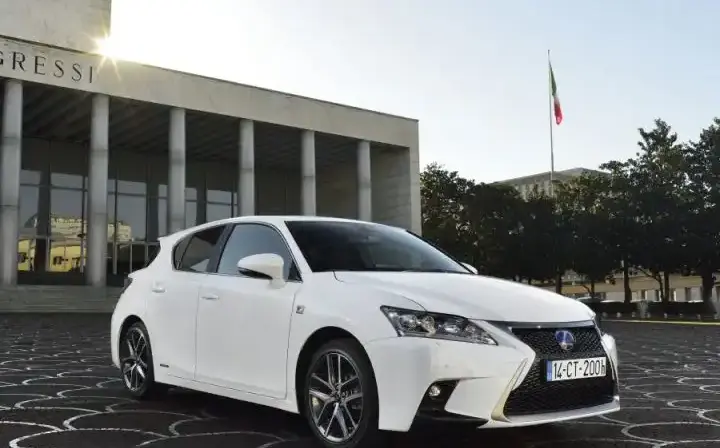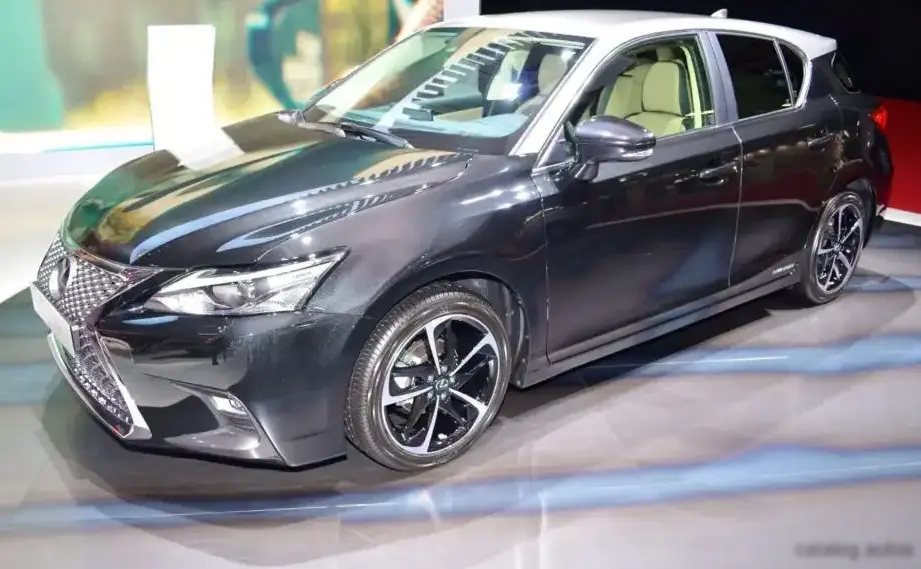
The Lexus CT 200h, specifically the facelifted model introduced in 2017, represents Lexus’s entry into the premium compact hybrid hatchback segment. Produced from 2011 to 2017, the CT 200h aimed to attract a younger demographic to the Lexus brand, offering a blend of fuel efficiency, distinctive styling, and Lexus’s renowned build quality. The 2017 facelift brought revised front-end styling, interior enhancements, and suspension tweaks. This variant, powered by a 1.8-liter gasoline engine paired with an electric motor and utilizing a continuously variable transmission (e-CVT), was a core offering within the CT 200h lineup, positioned as a balance between economy and usability. It was primarily marketed in Europe, North America, and Asia.
Technical Specifications
| Brand | Lexus |
| Model | CT |
| Generation | CT I (facelift 2017) |
| Type (Engine) | 200h (134 Hp) Hybrid e-CVT |
| Start of production | 2017 |
| Powertrain Architecture | FHEV (Full Hybrid Electric Vehicle) |
| Body type | Hatchback |
| Seats | 5 |
| Doors | 5 |
| Fuel consumption (urban) | 4.7 l/100 km (50 US mpg, 60.1 UK mpg, 21.3 km/l) |
| Fuel consumption (extra urban) | 4.1 l/100 km (57.4 US mpg, 68.9 UK mpg, 24.4 km/l) |
| Fuel consumption (combined) | 4.4 l/100 km (53.5 US mpg, 64.2 UK mpg, 22.7 km/l) |
| CO2 emissions | 101 g/km |
| Fuel Type | Petrol (Gasoline) |
| Acceleration 0 – 100 km/h | 10.3 sec |
| Acceleration 0 – 62 mph | 10.3 sec |
| Acceleration 0 – 60 mph | 9.8 sec |
| Maximum speed | 180 km/h (111.85 mph) |
| Weight-to-power ratio | 10.6 kg/Hp, 94.4 Hp/tonne |
| Weight-to-torque ratio | 10 kg/Nm, 100 Nm/tonne |
| Battery voltage | 201.6 V |
| Battery technology | Nickel-metal hydride (NiMH) |
| Battery location | Under the rear seats |
| Electric motor power | 82 Hp |
| System power | 134 Hp |
| Engine Power | 98 Hp @ 5200 rpm |
| Engine Torque | 142 Nm @ 4000 rpm (104.73 lb.-ft. @ 4000 rpm) |
| Engine layout | Front, Transverse |
| Engine Model/Code | 2ZR-FXE |
| Engine displacement | 1798 cm3 (109.72 cu. in.) |
| Number of cylinders | 4 |
| Engine configuration | Inline |
| Cylinder Bore | 80.5 mm (3.17 in.) |
| Piston Stroke | 88.4 mm (3.48 in.) |
| Compression ratio | 13:1 |
| Number of valves per cylinder | 4 |
| Fuel injection system | Multi-port manifold injection |
| Engine aspiration | Naturally aspirated engine |
| Valvetrain | DOHC-VVT-i |
| Engine oil capacity | 4.2 l (4.44 US qt | 3.7 UK qt) |
| Coolant capacity | 6.5 l (6.87 US qt | 5.72 UK qt) |
| Kerb Weight | 1420 kg (3130.56 lbs.) |
| Max. weight | 1844 kg (4065.32 lbs.) |
| Max load | 424 kg (934.76 lbs.) |
| Trunk (boot) space – minimum | 375 l (13.24 cu. ft.) |
| Trunk (boot) space – maximum | 985 l (34.78 cu. ft.) |
| Fuel tank capacity | 45 l (11.89 US gal | 9.9 UK gal) |
| Length | 4351 mm (171.3 in.) |
| Width | 1765 mm (69.49 in.) |
| Height | 1455 mm (57.28 in.) |
| Wheelbase | 2601 mm (102.4 in.) |
| Front track | 1524 mm (60 in.) |
| Rear track | 1519 mm (59.8 in.) |
| Ride height (ground clearance) | 145 mm (5.71 in.) |
| Drag coefficient (Cd) | 0.29 |
| Minimum turning circle | 10.4 m (34.12 ft.) |
| Drivetrain | Front wheel drive. FHEV. |
| Number of gears | automatic transmission e-CVT |
| Front suspension | Independent type McPherson |
| Rear suspension | Double wishbone |
| Front brakes | Ventilated discs, 254 mm |
| Rear brakes | Disc, 279.4 mm |
| Assisting systems | ABS (Anti-lock braking system) |
| Steering type | Steering rack and pinion |
| Power steering | Electric Steering |
| Tires size | 215/45 R17 |
| Wheel rims size | 7.0J x 17 |
INTRODUCTION
The Lexus CT 200h (facelift 2017) is a five-door hatchback that debuted as Lexus’s first dedicated hybrid model. Built on the Toyota/Lexus New Generation C (NGC) platform – also known as the 1HX0/A3 platform shared with the Toyota Prius – the CT 200h aimed to provide a more engaging driving experience than its Prius sibling, while maintaining excellent fuel economy. The 2017 facelift brought subtle but noticeable changes to the exterior, including a more aggressive front grille and revised headlights, along with interior upgrades focused on improving perceived quality and refinement. This 134 horsepower hybrid variant was a mainstay of the CT 200h range, offering a balance of performance and efficiency for urban and highway driving.
Powertrain & Engine Architecture
The heart of the CT 200h is the 2ZR-FXE 1.8-liter inline-four cylinder gasoline engine. This engine utilizes Toyota’s Valvematic technology, a continuously variable valve lift system, to optimize engine efficiency and responsiveness. It produces 98 horsepower at 5200 rpm and 142 Nm (104.73 lb.-ft.) of torque at 4000 rpm. The engine is paired with an electric motor producing 82 horsepower, resulting in a combined system output of 134 horsepower. The powertrain employs Toyota’s Hybrid Synergy Drive (HSD) system, a full hybrid architecture that allows the vehicle to operate in electric-only mode at low speeds and under light loads. The e-CVT (electronically controlled continuously variable transmission) doesn’t have fixed gears; instead, it uses a planetary gearset to seamlessly blend the power from the gasoline engine and electric motor. This system prioritizes fuel efficiency and smooth acceleration over outright performance. The Nickel-metal hydride (NiMH) battery pack is located under the rear seats, minimizing impact on cargo space.
Driving Characteristics
The CT 200h 134 hp/e-CVT combination delivers adequate, but not exhilarating, performance. Acceleration from 0-60 mph takes approximately 9.8 seconds, and 0-100 km/h in 10.3 seconds. The e-CVT prioritizes fuel economy, resulting in a somewhat “rubber band” feel during acceleration, where engine revs don’t always correlate directly with vehicle speed. Compared to the standard manual transmission offered on some markets, the e-CVT provides smoother, more effortless driving, particularly in urban environments. However, it lacks the direct engagement and responsiveness of a traditional automatic or manual gearbox. The hybrid system’s electric motor provides instant torque, which helps with initial acceleration and makes the car feel more responsive in city driving. The CT 200h’s suspension is tuned for comfort, providing a relatively smooth ride, but it’s not particularly sporty. The steering is light and precise, making it easy to maneuver in tight spaces.
Equipment & Trim Levels
The 2017 CT 200h typically came standard with features such as Lexus’s Display Audio system with a 7-inch screen, Bluetooth connectivity, automatic climate control, and power-adjustable front seats. Safety features included a suite of airbags, ABS, traction control, and stability control. Higher trim levels, such as the F Sport, added features like sport seats, unique exterior styling elements (including a mesh grille and rear diffuser), paddle shifters for simulated gear changes in the e-CVT, and a sport-tuned suspension. Optional extras included a navigation system, premium audio system, and leather upholstery. Interior upholstery was typically a combination of fabric and synthetic leather, with leather options available on higher trims.
Chassis & Braking
The CT 200h utilizes a front-wheel-drive layout. The front suspension consists of independent MacPherson struts, while the rear suspension employs a double wishbone setup. This configuration provides a good balance of ride comfort and handling. Braking duties are handled by ventilated discs at the front and solid discs at the rear. The hybrid system incorporates regenerative braking, which captures energy during deceleration and uses it to recharge the battery. The CT 200h’s relatively low weight (1420 kg / 3130.56 lbs) contributes to its fuel efficiency and manageable handling. The steering system is an electric power steering (EPS) rack and pinion, providing light and precise steering feel.
Market Reception & Comparison
The Lexus CT 200h was generally well-received by critics for its fuel efficiency, comfortable ride, and Lexus’s reputation for reliability. However, it was often criticized for its lack of outright performance and somewhat uninspiring driving dynamics. Compared to other trims in the CT 200h lineup, the 1.8L/e-CVT variant offered the best fuel economy, making it ideal for urban commuters. It was more affordable than potential rivals like the Audi A3 e-tron or BMW 225xe Active Tourer, but offered less performance. The 1.8L engine and e-CVT combination was considered a good choice for buyers prioritizing fuel efficiency and a comfortable driving experience over sporty handling.
Legacy
The Lexus CT 200h, while discontinued in 2017, remains a popular choice in the used car market, particularly for buyers seeking a reliable and fuel-efficient premium hatchback. The Hybrid Synergy Drive system has proven to be exceptionally durable, with many CT 200h models exceeding 200,000 miles with minimal issues. The NiMH battery pack, while requiring eventual replacement (typically after 10-15 years or 150,000-200,000 miles), is relatively affordable to replace. The CT 200h’s blend of Lexus quality, fuel efficiency, and relatively low maintenance costs continues to make it an attractive option for budget-conscious buyers seeking a premium hybrid vehicle.