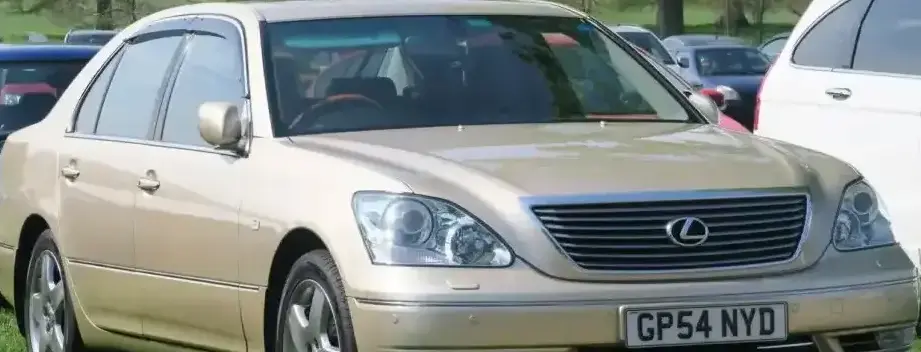
The Lexus LS 430, produced from 2001 to 2006, represented Lexus’s flagship sedan during its lifespan, and the 2004 facelift brought subtle but significant refinements. The 430 variant, powered by the 4.3-liter 3UZ-FE V8 engine paired with a six-speed automatic transmission, was the mainstay of the LS lineup. Production of this specific configuration ran from 2003 to 2005, solidifying its position as a luxury cruiser focused on refinement and a smooth driving experience. This model occupied the core of the LS range, offering a balance between performance and comfort, appealing to buyers who prioritized a serene and well-equipped vehicle over outright sportiness.
Technical Specifications
| Brand | Lexus |
| Model | LS |
| Generation | LS III (facelift 2004) |
| Type (Engine) | 430 V8 (282 Hp) Automatic |
| Start of production | 2003 |
| End of production | 2005 |
| Powertrain Architecture | Internal Combustion engine |
| Body type | Sedan |
| Seats | 5 |
| Doors | 4 |
| Fuel consumption (urban) | 16.3 l/100 km (14.4 US mpg, 17.3 UK mpg, 6.1 km/l) |
| Fuel consumption (extra urban) | 8.5 l/100 km (27.7 US mpg, 33.2 UK mpg, 11.8 km/l) |
| Fuel consumption (combined) | 11.4 l/100 km (20.6 US mpg, 24.8 UK mpg, 8.8 km/l) |
| CO2 emissions | 270 g/km |
| Fuel Type | Petrol (Gasoline) |
| Acceleration 0 – 100 km/h | 6.3 sec |
| Acceleration 0 – 62 mph | 6.3 sec |
| Acceleration 0 – 60 mph | 6 sec |
| Maximum speed | 250 km/h (155.34 mph) |
| Emission standard | Euro 4 |
| Weight-to-power ratio | 6.5 kg/Hp, 153.7 Hp/tonne |
| Weight-to-torque ratio | 4.4 kg/Nm, 227.2 Nm/tonne |
| Power | 282 Hp @ 5600 rpm |
| Torque | 417 Nm @ 3500 rpm (307.56 lb.-ft. @ 3500 rpm) |
| Engine layout | Front, Longitudinal |
| Engine Model/Code | 3UZ-FE |
| Engine displacement | 4293 cm3 (261.97 cu. in.) |
| Number of cylinders | 8 |
| Engine configuration | V-engine |
| Cylinder Bore | 91 mm (3.58 in.) |
| Piston Stroke | 82.5 mm (3.25 in.) |
| Compression ratio | 10.5:1 |
| Number of valves per cylinder | 4 |
| Fuel injection system | Multi-port manifold injection |
| Engine aspiration | Naturally aspirated engine |
| Valvetrain | DOHC |
| Engine oil capacity | 5.1 l (5.39 US qt, 4.49 UK qt) |
| Coolant capacity | 9.5 l (10.04 US qt, 8.36 UK qt) |
| Kerb Weight | 1835 kg (4045.48 lbs.) |
| Max. weight | 2340 kg (5158.82 lbs.) |
| Max load | 505 kg (1113.33 lbs.) |
| Trunk (boot) space – minimum | 570 l (20.13 cu. ft.) |
| Fuel tank capacity | 84 l (22.19 US gal, 18.48 UK gal) |
| Permitted trailer load with brakes (12%) | 2000 kg (4409.25 lbs.) |
| Permitted trailer load without brakes | 750 kg (1653.47 lbs.) |
| Length | 5025 mm (197.83 in.) |
| Width | 1830 mm (72.05 in.) |
| Height | 1470 mm (57.87 in.) |
| Wheelbase | 2925 mm (115.16 in.) |
| Front track | 1575 mm (62.01 in.) |
| Rear (Back) track | 1575 mm (62.01 in.) |
| Drag coefficient (Cd) | 0.25 |
| Minimum turning circle | 10.6 m (34.78 ft.) |
| Drivetrain Architecture | Rear wheel drive |
| Number of gears and type of gearbox | 6 gears, automatic transmission |
| Front suspension | Double wishbone |
| Rear suspension | Double wishbone |
| Front brakes | Ventilated discs, 315 mm |
| Rear brakes | Ventilated discs, 310 mm |
| Assisting systems | ABS (Anti-lock braking system) |
| Steering type | Steering rack and pinion |
| Tires size | 225/55 R17 |
| Wheel rims size | 7.5J x 17 |
Powertrain & Engine Architecture
The heart of the LS 430 is the 3UZ-FE, a 4.3-liter (4293 cc) naturally aspirated V8 engine. This engine is renowned for its smoothness and reliability. It features a 60-degree V-angle, dual overhead camshafts (DOHC) with four valves per cylinder, and a multi-port fuel injection system. The 3UZ-FE produces 282 horsepower at 5600 rpm and 307 lb-ft of torque at 3500 rpm. The engine’s design prioritized low-end torque and a refined power delivery, perfectly complementing the luxury sedan’s character. Paired with this engine is a six-speed automatic transmission, a significant upgrade from the four-speed units found in earlier Lexus models. This transmission offered smoother shifts and improved fuel efficiency. The transmission was electronically controlled, adapting to driving conditions and driver input for optimal performance.
Driving Characteristics
The LS 430 4.3L/Automatic combination delivers a driving experience focused on comfort and effortless cruising. Acceleration from 0 to 60 mph takes around 6 seconds, which was respectable for a large luxury sedan of its era. However, the emphasis wasn’t on outright speed but on a smooth, linear power delivery. The six-speed automatic transmission contributes to this, providing well-spaced gear ratios that keep the engine in its optimal power band. Compared to the more performance-oriented trims (which didn’t exist for the LS 430), this variant prioritizes a relaxed driving experience. The automatic transmission, while smooth, doesn’t offer the driver engagement of a manual gearbox, but it aligns with the target audience seeking a stress-free driving experience.
Equipment & Trim Levels
The LS 430, even in its standard form, was exceptionally well-equipped. Standard features included leather upholstery, power-adjustable heated front seats, a premium sound system (typically Mark Levinson), dual-zone automatic climate control, and a navigation system. The 2004 facelift brought minor interior updates, including revised trim materials and improved ergonomics. Optional extras included a rear-seat entertainment system, massaging seats, and adaptive cruise control. The LS 430 aimed for a high level of standard luxury, minimizing the need for extensive option packages.
Chassis & Braking
The LS 430 utilizes a double wishbone suspension setup at both the front and rear, providing a comfortable and controlled ride. The suspension is tuned for smoothness, absorbing bumps and imperfections in the road with ease. Braking duties are handled by ventilated disc brakes on all four wheels, providing ample stopping power. An Anti-lock Braking System (ABS) is standard, enhancing safety and stability during hard braking. The LS 430’s chassis is designed for rigidity, minimizing body roll and contributing to a stable driving experience. The rear brakes are slightly smaller than the front, reflecting the weight distribution of the vehicle.
Market Reception & Comparison
The Lexus LS 430 was consistently praised by automotive critics for its refinement, quiet cabin, and comfortable ride. The 4.3L/Automatic combination was particularly well-received for its smooth operation and ease of use. Fuel economy, while not exceptional at around 20 mpg combined, was acceptable for a V8-powered luxury sedan. Compared to its rivals, such as the Mercedes-Benz S-Class and BMW 7 Series, the LS 430 offered a compelling value proposition, often undercutting its competitors in price while delivering a comparable level of luxury and features. Reliability was a key strength, with the LS 430 consistently ranking highly in consumer reports.
Legacy
The Lexus LS 430, and specifically the 4.3L/Automatic variant, has proven to be a remarkably durable and reliable vehicle. Many examples are still on the road today, a testament to the quality of its engineering and construction. The 3UZ-FE engine is known for its longevity, often exceeding 200,000 miles with proper maintenance. In the used car market, the LS 430 remains a popular choice for buyers seeking a comfortable, reliable, and well-equipped luxury sedan at an affordable price. While newer Lexus models offer more advanced technology and features, the LS 430 continues to hold a special place as a benchmark for luxury and reliability.