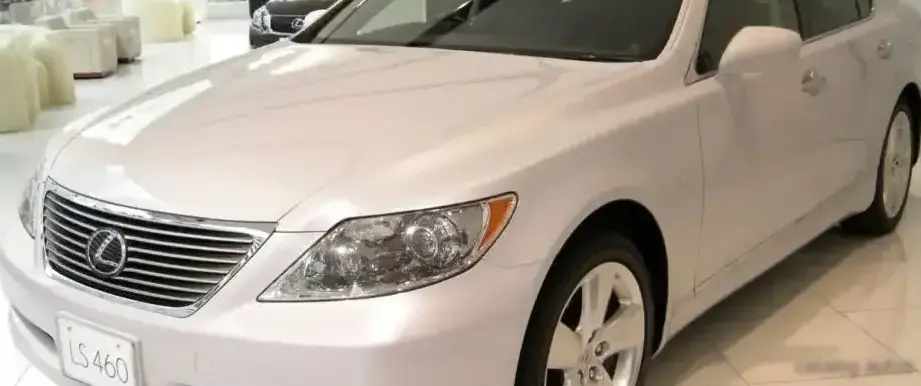
The Lexus LS 460, representing the fourth generation of Lexus’ flagship sedan (designated LS IV, chassis code UVF40), was produced from September 2006 through October 2009. This generation marked a significant step forward in luxury and technology for the brand, and the 460 variant, powered by a 4.6-liter V8 engine paired with an eight-speed automatic transmission (Super ECT), served as the primary offering in most markets, including the United States. It positioned itself as a direct competitor to established luxury sedans like the BMW 7 Series, Mercedes-Benz S-Class, and Audi A8, emphasizing refinement, comfort, and advanced features over outright sportiness.
Technical Specifications
| Brand | Lexus |
| Model | LS |
| Generation | LS IV |
| Type (Engine) | 460 V8 (381 Hp) Super ECT |
| Start of production | September, 2006 |
| End of production | October, 2009 |
| Powertrain Architecture | Internal Combustion engine |
| Body type | Sedan |
| Seats | 5 |
| Doors | 4 |
| Fuel consumption (economy) – urban (NEDC) | 16.5 l/100 km (14.3 US mpg, 17.1 UK mpg, 6.1 km/l) |
| Fuel consumption (economy) – extra urban (NEDC) | 7.9 l/100 km (29.8 US mpg, 35.8 UK mpg, 12.7 km/l) |
| Fuel consumption (economy) – combined (NEDC) | 11.1 l/100 km (21.2 US mpg, 25.4 UK mpg, 9 km/l) |
| CO2 emissions (NEDC) | 261 g/km |
| Fuel Type | Petrol (Gasoline) |
| Acceleration 0 – 100 km/h | 5.7 sec |
| Acceleration 0 – 62 mph | 5.7 sec |
| Acceleration 0 – 60 mph | 5.4 sec |
| Maximum speed | 250 km/h (155.34 mph), Electronically limited |
| Emission standard | Euro 4 |
| Weight-to-power ratio | 5.1 kg/Hp, 195.9 Hp/tonne |
| Weight-to-torque ratio | 3.9 kg/Nm, 257.1 Nm/tonne |
| Power | 381 Hp @ 6400 rpm |
| Power per litre | 82.7 Hp/l |
| Torque | 500 Nm @ 4100 rpm (368.78 lb.-ft. @ 4100 rpm) |
| Engine layout | Front, Longitudinal |
| Engine Model/Code | 1UR-FSE |
| Engine displacement | 4608 cm3 (281.2 cu. in.) |
| Number of cylinders | 8 |
| Engine configuration | V-engine |
| Cylinder Bore | 94 mm (3.7 in.) |
| Piston Stroke | 83 mm (3.27 in.) |
| Compression ratio | 11.8:1 |
| Number of valves per cylinder | 4 |
| Fuel injection system | Direct injection and Multi-port manifold injection |
| Engine aspiration | Naturally aspirated engine |
| Valvetrain | DOHC, Dual VVT-iE |
| Engine oil capacity | 8.6 l (9.09 US qt, 7.57 UK qt) |
| Coolant | 11 l (11.62 US qt, 9.68 UK qt) |
| Kerb Weight | 1945-2055 kg (4287.99 – 4530.5 lbs.) |
| Max. weight | 2495 kg (5500.53 lbs.) |
| Max load | 440-550 kg (970.03 – 1212.54 lbs.) |
| Trunk (boot) space – minimum | 565 l (19.95 cu. ft.) |
| Fuel tank capacity | 84 l (22.19 US gal, 18.48 UK gal) |
| Length | 5030 mm (198.03 in.) |
| Width | 1875 mm (73.82 in.) |
| Height | 1465-1475 mm (57.68 – 58.07 in.) |
| Wheelbase | 2970 mm (116.93 in.) |
| Front track | 1610-1615 mm (63.39 – 63.58 in.) |
| Rear (Back) track | 1615-1620 mm (63.58 – 63.78 in.) |
| Ride height (ground clearance) | 145 mm (5.71 in.) |
| Drag coefficient (Cd) | 0.26 |
| Minimum turning circle (turning diameter) | 10.8-11 m (35.43 – 36.09 ft.) |
| Drivetrain Architecture | The Internal combustion engine (ICE) drives the rear wheels of the vehicle. |
| Drive wheel | Rear wheel drive |
| Number of gears and type of gearbox | 8 gears, automatic transmission Super ECT |
| Front suspension | Independent multi-link suspension, Transverse stabilizer, Air Suspension – Optional |
| Rear suspension | Independent multi-link suspension, Transverse stabilizer, Air Suspension – Optional |
| Front brakes | Ventilated discs, 333 mm |
| Rear brakes | Ventilated discs, 315 mm |
| Assisting systems | ABS (Anti-lock braking system) |
| Steering type | Steering rack and pinion |
| Power steering | Electric Steering |
| Tires size | 235/50 R18; 245/45 R19 |
| Wheel rims size | 7.5J x 18; 8J x 19 |
Powertrain & Engine Architecture
The heart of the LS 460 is the 1UR-FSE 4.6-liter V8 engine. This engine utilizes a dual-injection system – direct injection (D-4S) combined with port injection – to optimize combustion efficiency and power delivery. The D-4S system allows for precise fuel control, enhancing both performance and fuel economy. The engine also features a sophisticated valve train with Dual Variable Valve Timing with intelligence (VVT-iE) on both intake and exhaust valves, further optimizing engine breathing and responsiveness. The eight-speed automatic transmission, dubbed “Super ECT,” was a key technological advancement. It offered smoother shifts and a wider gear ratio spread compared to traditional automatics, contributing to improved fuel efficiency and acceleration. The transmission featured manual shift control, allowing drivers to select gears for more engaging driving experience.
Driving Characteristics
The LS 460 4.6L/Super ECT combination prioritized a smooth, refined driving experience. Acceleration was brisk, with 0-60 mph times consistently in the mid-5-second range. However, the focus wasn’t on aggressive performance. The eight-speed transmission was programmed for seamless shifts, minimizing noticeable gear changes. Compared to potential upgrades like the LS 600h hybrid, the 460 offered a more traditional driving feel. The automatic transmission, while refined, didn’t offer the same level of driver engagement as a manual transmission. The gear ratios were tuned for comfortable cruising and effortless highway passing, rather than maximizing acceleration in every gear.
Equipment & Trim Levels
The LS 460 came standard with a comprehensive list of luxury features, including leather upholstery, wood trim, a premium sound system, navigation system, power-adjustable and heated/ventilated front seats, and a power rear sunshade. Optional extras included a Mark Levinson premium audio system, adaptive cruise control, a rear-seat entertainment system, and an air suspension system that further enhanced ride comfort. Trim levels were relatively simple, with most variations stemming from optional packages rather than distinct model designations. The emphasis was on providing a high level of standard equipment and allowing customers to personalize their vehicle with a range of options.
Chassis & Braking
The LS 460 utilized an independent multi-link suspension system at all four corners. The optional air suspension system provided adjustable ride height and damping, allowing drivers to tailor the ride to their preferences. Braking duties were handled by ventilated disc brakes on all four wheels, equipped with an Anti-lock Braking System (ABS) and Electronic Brake-force Distribution (EBD). The braking system provided ample stopping power and stability, befitting a luxury sedan of this caliber. Stabilizer bars were fitted front and rear to minimize body roll during cornering.
Market Reception & Comparison
The LS 460 was generally well-received by automotive critics. It was praised for its quiet cabin, comfortable ride, and advanced technology. However, some reviewers noted that its styling was conservative compared to its European rivals. Fuel economy, while improved over previous generations, remained a concern for some, given the engine’s displacement. Compared to the LS 600h hybrid, the 460 offered a lower price point but sacrificed fuel efficiency. Against competitors like the BMW 7 Series and Mercedes-Benz S-Class, the LS 460 often positioned itself as a value-oriented alternative, offering a similar level of luxury and features at a slightly lower price.
Legacy
The 1UR-FSE engine and Super ECT transmission have proven to be remarkably reliable powertrains. While maintenance costs for a luxury vehicle are inherently higher, the LS 460 has generally avoided major mechanical issues. On the used car market, the LS 460 remains a popular choice for buyers seeking a comfortable, well-equipped, and reliable luxury sedan. Its relatively simple mechanical design, compared to some of its more complex competitors, contributes to its long-term durability and lower ownership costs. The fourth-generation LS established Lexus as a serious contender in the luxury sedan segment, and the 460 variant remains a testament to the brand’s commitment to quality and refinement.