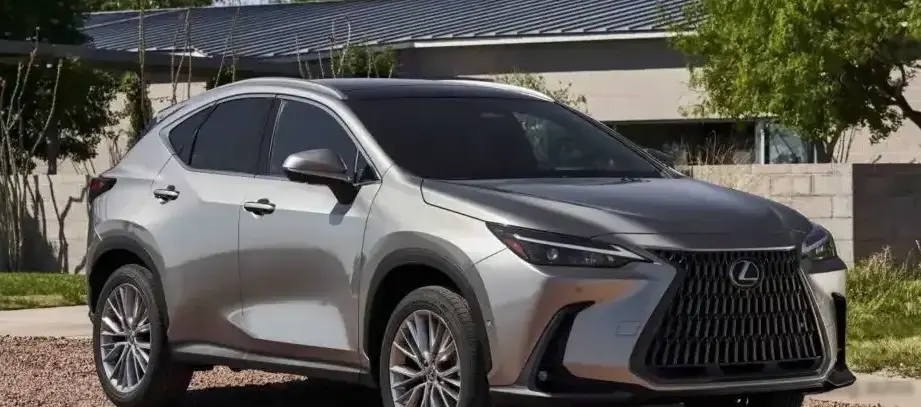
The Lexus NX 300h (AZ10) is a compact luxury crossover SUV produced by Lexus from October 2014 to November 2017. It represents the first generation of the NX model line, positioned as a competitor to vehicles like the Acura RDX and BMW X3. The 300h variant, equipped with a hybrid powertrain and all-wheel drive (e-Four), was a key offering within the NX range, emphasizing fuel efficiency and refined driving experience. It was built on the Toyota/Lexus New Global Architecture (NGAC) platform, also known internally as the 1HX0 platform.
Technical Specifications
| Brand | Lexus |
| Model | NX |
| Generation | NX I (AZ10) |
| Type (Engine) | 300h (197 Hp) Hybrid e-Four e-CVT |
| Start of production | October, 2014 |
| End of production | November, 2017 |
| Powertrain Architecture | FHEV (Full Hybrid Electric Vehicle) |
| Body type | SUV, Crossover |
| Seats | 5 |
| Doors | 5 |
| Fuel consumption (urban) | 5.3 l/100 km (44.4 US mpg, 53.3 UK mpg, 18.9 km/l) |
| Fuel consumption (extra urban) | 5.1 l/100 km (46.1 US mpg, 55.4 UK mpg, 19.6 km/l) |
| Fuel consumption (combined) | 5.2 l/100 km (45.2 US mpg, 54.3 UK mpg, 19.2 km/l) |
| CO2 emissions | 121 g/km |
| Fuel Type | Petrol (Gasoline) |
| Acceleration 0 – 100 km/h | 9.2 sec |
| Acceleration 0 – 62 mph | 9.2 sec |
| Acceleration 0 – 60 mph | 8.7 sec |
| Maximum speed | 180 km/h (111.85 mph) |
| Emission standard | Euro 6 b |
| Weight-to-power ratio | 9.1 kg/Hp, 110.4 Hp/tonne |
| Weight-to-torque ratio | 8.5 kg/Nm, 117.6 Nm/tonne |
| Battery voltage | 244.8 V |
| Battery technology | Nickel-metal hydride (NiMH) |
| Battery location | Under the rear seats |
| All-electric range | 2 km (1.24 mi) |
| Electric motor power (1) | 143 Hp |
| Electric motor Torque (1) | 270 Nm (199.14 lb.-ft.) |
| Electric motor location (1) | Integrated into the transmission |
| Electric motor type (1) | Synchronous |
| Electric motor power (2) | 68 Hp |
| Electric motor Torque (2) | 139 Nm (102.52 lb.-ft.) |
| Electric motor location (2) | Rear axle, Transverse |
| Electric motor type (2) | Synchronous |
| System power | 197 Hp @ 5700 rpm |
| System torque | 210 Nm @ 4200-4400 rpm (154.89 lb.-ft. @ 4200-4400 rpm) |
| Engine Power | 155 Hp @ 5700 rpm |
| Power per litre | 62.1 Hp/l |
| Engine Torque | 210 Nm @ 4200-4400 rpm (154.89 lb.-ft. @ 4200-4400 rpm) |
| Engine layout | Front, Transverse |
| Engine Model/Code | 2AR-FXE |
| Engine displacement | 2494 cm3 (152.19 cu. in.) |
| Number of cylinders | 4 |
| Engine configuration | Inline |
| Cylinder Bore | 90 mm (3.54 in.) |
| Piston Stroke | 98 mm (3.86 in.) |
| Compression ratio | 12.5:1 |
| Number of valves per cylinder | 4 |
| Fuel injection system | Multi-port manifold injection |
| Engine aspiration | Naturally aspirated engine |
| Valvetrain | DOHC, VVT-i |
| Engine oil capacity | 4.4 l (4.65 US qt | 3.87 UK qt) |
| Coolant capacity | 7.3 l (7.71 US qt | 6.42 UK qt) |
| Kerb Weight | 1785-1905 kg (3935.25 – 4199.81 lbs.) |
| Max. weight | 2395 kg (5280.07 lbs.) |
| Max load | 490-610 kg (1080.27 – 1344.82 lbs.) |
| Trunk (boot) space – minimum | 475 l (16.77 cu. ft.) |
| Trunk (boot) space – maximum | 1520 l (53.68 cu. ft.) |
| Fuel tank capacity | 56 l (14.79 US gal | 12.32 UK gal) |
| Max. roof load | 80 kg (176.37 lbs.) |
| Permitted trailer load with brakes (12%) | 1500 kg (3306.93 lbs.) |
| Permitted trailer load without brakes | 750 kg (1653.47 lbs.) |
| Permitted towbar download | 60 kg (132.28 lbs.) |
| Length | 4630 mm (182.28 in.) |
| Width | 1845 mm (72.64 in.) |
| Height | 1645 mm (64.76 in.) |
| Wheelbase | 2660 mm (104.72 in.) |
| Front track | 1580 mm (62.2 in.) |
| Rear (Back) track | 1570-1580 mm (61.81 – 62.2 in.) |
| Ride height (ground clearance) | 185 mm (7.28 in.) |
| Drag coefficient (Cd) | 0.32 |
| Minimum turning circle (turning diameter) | 12.1 m (39.7 ft.) |
| Approach angle | 17.2° |
| Departure angle | 24.5° |
| Drivetrain Architecture | An Internal combustion engine (ICE) drives the front wheels, one electric motor drives the front wheels, one electric motor drives the rear wheels. There is an ability for running in full electric or mixed mode. |
| Drive wheel | All wheel drive (4×4) |
| Number of gears and type of gearbox | automatic transmission e-CVT |
| Front suspension | Independent type McPherson |
| Rear suspension | Double wishbone |
| Front brakes | Ventilated discs |
| Rear brakes | Disc |
| Assisting systems | ABS (Anti-lock braking system) |
| Steering type | Steering rack and pinion |
| Power steering | Electric Steering |
| Tires size | 235/55 R18 100V; 225/60 R18 100H |
| Wheel rims size | 7.5J x 18 |
INTRODUCTION
The Lexus NX 300h e-Four represents a significant step for Lexus into the burgeoning compact luxury crossover segment. Introduced in 2014, it combined the brand’s reputation for refinement and reliability with a fuel-efficient hybrid powertrain and standard all-wheel drive. The 300h trim sat in the middle of the NX lineup, offering a balance between performance and economy, appealing to buyers prioritizing fuel savings and a smooth driving experience over outright sportiness. It was a key model in Lexus’s strategy to attract a younger, more environmentally conscious clientele.
Powertrain & Engine Architecture
The heart of the NX 300h is the 2AR-FXE 2.5-liter inline-four cylinder engine, coupled with Lexus’s Hybrid Synergy Drive system. This system utilizes a nickel-metal hydride (NiMH) battery pack located under the rear seats. The engine itself employs a multi-port fuel injection system and a DOHC valvetrain with Variable Valve Timing with intelligence (VVT-i). The hybrid system incorporates two electric motor/generators – MG1 and MG2. MG1 primarily functions as a generator and starter, while MG2 provides drive power and regenerative braking. The e-CVT (electronically controlled continuously variable transmission) seamlessly blends power from the engine and electric motors, offering a smooth, stepless acceleration. The combined system output is 197 horsepower. The engine produces 155 hp and 154.89 lb-ft of torque, while the electric motors contribute an additional 143 hp and 199.14 lb-ft, and 68 hp and 102.52 lb-ft respectively.
Driving Characteristics
The NX 300h e-Four delivers a comfortable and refined driving experience. The e-CVT, while not offering the traditional gear changes of a conventional automatic, provides smooth and linear acceleration. The electric motors provide instant torque, contributing to brisk off-the-line performance. Compared to the NX 200t (turbocharged gasoline version), the 300h prioritizes fuel efficiency over outright speed. While the 200t offered quicker acceleration, the 300h excelled in city driving, often operating in electric-only mode at lower speeds. The all-wheel-drive system provides enhanced traction in various weather conditions, making it a practical choice for regions with inclement weather. The steering is light and precise, contributing to easy maneuverability.
Equipment & Trim Levels
The NX 300h e-Four typically came standard with features such as Lexus Safety System+, which included Pre-Collision System, Lane Departure Alert, and Automatic High Beams. Interior features included leatherette upholstery, a 7-inch infotainment display, Bluetooth connectivity, and a rearview camera. Available options included a Mark Levinson premium sound system, a larger 10.3-inch infotainment display with navigation, heated and ventilated front seats, and a panoramic sunroof. Trim levels often included base, Premium, and Luxury packages, with each successive tier adding more features and luxury appointments.
Chassis & Braking
The NX 300h utilizes an independent McPherson strut suspension in the front and a double wishbone suspension in the rear, providing a comfortable ride and stable handling. The suspension was tuned to prioritize comfort over sporty handling. Braking duties are handled by ventilated discs in the front and solid discs in the rear, equipped with an Anti-lock Braking System (ABS). The e-CVT incorporates regenerative braking, which helps to recharge the hybrid battery and improve fuel efficiency. The vehicle’s weight, ranging from 3935.25 to 4199.81 lbs, is relatively high for its class, but the hybrid system and all-wheel drive contribute to a balanced and stable feel.
Market Reception & Comparison
The Lexus NX 300h was generally well-received by automotive critics, praised for its fuel efficiency, comfortable ride, and refined interior. However, some reviewers noted that the infotainment system could be cumbersome to use and that the overall driving experience lacked the sportiness of some competitors. Compared to the NX 200t, the 300h offered superior fuel economy but slightly slower acceleration. Against rivals like the Acura RDX and BMW X3, the NX 300h distinguished itself with its standard all-wheel drive and Lexus’s reputation for reliability. Fuel economy figures of 45.2 US mpg combined were a significant selling point.
Legacy
The Lexus NX 300h (AZ10) established the NX as a viable contender in the luxury crossover segment. The hybrid powertrain proved to be reliable, and the vehicle has maintained a good reputation in the used car market. While the first-generation NX has been superseded by newer models, the 300h variant remains a popular choice for buyers seeking a fuel-efficient, comfortable, and reliable luxury crossover. Common maintenance items include regular servicing of the hybrid system and battery, but overall, the powertrain has proven to be durable and long-lasting. The vehicle’s blend of luxury, efficiency, and all-weather capability continues to appeal to a wide range of buyers.