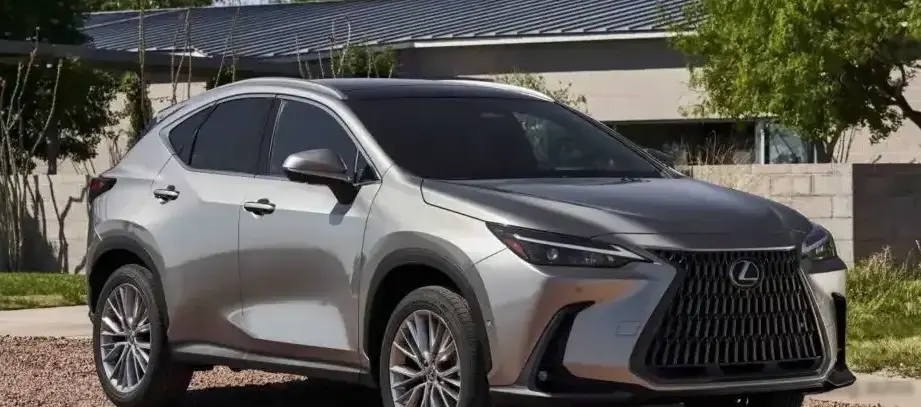
The Lexus NX 350h, part of the NX II (AZ20) generation introduced in September 2021, represents Lexus’s entry into the compact luxury crossover segment with a focus on hybrid efficiency. Positioned as a core model within the NX lineup, the 350h offers a balance between performance, fuel economy, and refinement. It serves as a key competitor to vehicles like the Acura RDX, BMW X3, and Mercedes-Benz GLC, appealing to buyers seeking a premium experience with reduced environmental impact. The AZ20 generation marked a significant redesign for the NX, incorporating updated technology, a more modern interior, and enhanced driving dynamics.
Technical Specifications
| Brand | Lexus |
| Model | NX |
| Generation | NX II (AZ20) |
| Type (Engine) | 350h (244 Hp) Hybrid e-CVT |
| Start of production | September, 2021 |
| Powertrain Architecture | FHEV (Full Hybrid Electric Vehicle) |
| Body type | SUV, Crossover |
| Seats | 5 |
| Doors | 5 |
| Combined fuel consumption (WLTP) | 5.6-5.9 l/100 km (42 – 39.9 US mpg, 50.4 – 47.9 UK mpg, 17.9 – 16.9 km/l) |
| CO2 emissions (WLTP) | 127-133 g/km |
| Fuel Type | Petrol (Gasoline) |
| Acceleration 0 – 100 km/h | 8.7 sec |
| Acceleration 0 – 62 mph | 8.7 sec |
| Acceleration 0 – 60 mph | 8.3 sec |
| Maximum speed | 200 km/h (124.27 mph) |
| Emission standard | Euro 6d |
| Weight-to-power ratio | 7.1 kg/Hp, 141 Hp/tonne |
| Weight-to-torque ratio | 7.2 kg/Nm, 138.2 Nm/tonne |
| Gross battery capacity | 1.6 kWh |
| Battery voltage | 259 V |
| Battery technology | Lithium-ion (Li-Ion) |
| Battery location | Under the rear seats |
| Electric motor power | 182 Hp |
| Electric motor Torque | 270 Nm (199.14 lb.-ft.) |
| Electric motor location | Integrated into the transmission |
| Electric motor type | Synchronous |
| System power | 244 Hp |
| Internal combustion engine power | 190 Hp @ 6000 rpm |
| Internal combustion engine torque | 239 Nm @ 4300-4500 rpm (176.28 lb.-ft. @ 4300-4500 rpm) |
| Engine layout | Front, Transverse |
| Engine Model/Code | A25A-FXS |
| Engine displacement | 2487 cm3 (151.77 cu. in.) |
| Number of cylinders | 4 |
| Engine configuration | Inline |
| Cylinder Bore | 87.5 mm (3.44 in.) |
| Piston Stroke | 103.4 mm (4.07 in.) |
| Compression ratio | 14:1 |
| Number of valves per cylinder | 4 |
| Fuel injection system | Direct injection and Multi-port manifold injection |
| Engine aspiration | Naturally aspirated engine |
| Valvetrain | DOHC |
| Engine oil capacity | 4.5 l (4.76 US qt | 3.96 UK qt) |
| Coolant capacity | 6.2 l (6.55 US qt | 5.46 UK qt) |
| Kerb Weight | 1730-1810 kg (3814 – 3990.37 lbs.) |
| Max. weight | 2320 kg (5114.72 lbs.) |
| Max load | 510-590 kg (1124.36 – 1300.73 lbs.) |
| Trunk (boot) space – minimum | 545 l (19.25 cu. ft.) |
| Trunk (boot) space – maximum | 1436 l (50.71 cu. ft.) |
| Fuel tank capacity | 55 l (14.53 US gal | 12.1 UK gal) |
| Permitted trailer load with brakes (12%) | 1500 kg (3306.93 lbs.) |
| Length | 4660 mm (183.46 in.) |
| Width | 1865 mm (73.43 in.) |
| Height | 1660-1670 mm (65.35 – 65.75 in.) |
| Wheelbase | 2690 mm (105.91 in.) |
| Front track | 1605 mm (63.19 in.) |
| Rear (Back) track | 1625 mm (63.98 in.) |
| Front overhang | 1007 mm (39.65 in.) |
| Rear overhang | 963 mm (37.91 in.) |
| Ride height (ground clearance) | 185-195 mm (7.28 – 7.68 in.) |
| Drag coefficient (Cd) | 0.34-0.35 |
| Minimum turning circle (turning diameter) | 11.6 m (38.06 ft.) |
| Approach angle | 16° |
| Departure angle | 25° |
| Drivetrain Architecture | The Internal combustion engine (ICE) and electric motor drive the front wheels of the car with the ability to work in full electric or mixed mode. |
| Drive wheel | Front wheel drive |
| Number of gears and type of gearbox | automatic transmission e-CVT |
| Front suspension | Independent type McPherson |
| Rear suspension | Double wishbone |
| Front brakes | Ventilated discs, 328×34 mm |
| Rear brakes | Ventilated discs, 317×18 mm |
| Assisting systems | ABS (Anti-lock braking system) |
| Steering type | Steering rack and pinion |
| Power steering | Electric Steering |
| Tires size | 235/60 R18; 235/50 R20 |
| Wheel rims size | 7.5J x 18; 7.5J x 20 |
Powertrain & Engine Architecture
The Lexus NX 350h utilizes a fourth-generation hybrid system. At its heart is the A25A-FXS 2.5-liter inline-four cylinder engine, producing 190 horsepower at 6000 rpm and 239 Nm (176.28 lb-ft) of torque between 4300-4500 rpm. This engine employs a combination of direct injection and multi-port fuel injection for optimized combustion efficiency. The engine features a 14:1 compression ratio and a dual overhead camshaft (DOHC) valvetrain. The electric motor, a synchronous type, contributes an additional 182 horsepower and 270 Nm (199.14 lb-ft) of torque. The combined system output is 244 horsepower. The power is delivered through a unique electronically controlled continuously variable transmission (e-CVT) which doesn’t have traditional gears. Instead, it uses a planetary gearset to seamlessly blend power from the engine and electric motor. The relatively small 1.6 kWh lithium-ion battery pack is located under the rear seats, minimizing impact on passenger or cargo space.
Driving Characteristics
The NX 350h delivers a smooth and refined driving experience. The e-CVT provides seamless acceleration, although it lacks the immediate response of a traditional automatic transmission. The hybrid system prioritizes electric drive at lower speeds, resulting in quiet and efficient operation in urban environments. During more aggressive acceleration, the engine and electric motor work in concert, providing adequate power for highway merging and passing maneuvers. The 0-60 mph time of around 8.3 seconds is respectable for the segment, but not particularly sporty. Compared to the NX 350 with its turbocharged engine, the 350h offers less outright performance but significantly better fuel economy. The front-wheel-drive configuration contributes to a slightly less engaging driving experience than all-wheel-drive variants.
Equipment & Trim Levels
The NX 350h typically comes well-equipped, even in its base form. Standard features generally include Lexus Safety System+ 3.0 (including pre-collision system with pedestrian detection, lane departure alert with intelligent steering assist, and dynamic radar cruise control), an 9.8-inch touchscreen infotainment system, Apple CarPlay and Android Auto compatibility, and a premium audio system. Interior upholstery is typically NuLuxe (synthetic leather), with available upgrades to genuine leather. Higher trim levels add features such as a panoramic sunroof, heated and ventilated front seats, a Mark Levinson premium sound system, and triple-beam LED headlights. Optional extras include a head-up display and wireless smartphone charging.
Chassis & Braking
The NX 350h utilizes a MacPherson strut front suspension and a double wishbone rear suspension, tuned for a balance of comfort and handling. The suspension setup is optimized for the vehicle’s weight and center of gravity. Braking duties are handled by ventilated discs on all four wheels, with the front discs measuring 328×34 mm and the rear discs measuring 317×18 mm. The vehicle is equipped with an Anti-lock Braking System (ABS) and electronic brake-force distribution. The steering system is an electric power-assisted rack and pinion system, providing precise and responsive steering feel.
Market Reception & Comparison
The Lexus NX 350h has been well-received by critics for its fuel efficiency, comfortable ride, and refined interior. Its fuel economy of 5.6-5.9 l/100 km (42-39.9 US mpg) is a significant advantage over non-hybrid competitors. However, some reviewers have noted the e-CVT’s lack of responsiveness and the vehicle’s relatively modest acceleration. Compared to the NX 350, the 350h offers superior fuel economy but less performance. The hybrid model also tends to command a slightly higher price. Reliability ratings for the NX 350h have been consistently positive, reflecting Lexus’s reputation for build quality and dependability.
Legacy
The Lexus NX 350h powertrain, while relatively new, benefits from Lexus’s extensive experience with hybrid technology. The A25A-FXS engine and e-CVT transmission are expected to be durable and reliable, based on the proven track record of previous Lexus hybrid systems. In the used car market, the NX 350h is likely to hold its value well due to its fuel efficiency and Lexus’s strong brand reputation. The hybrid system’s complexity may result in higher maintenance costs for certain components, such as the battery pack, but Lexus offers a comprehensive warranty on the hybrid system, providing peace of mind for owners.