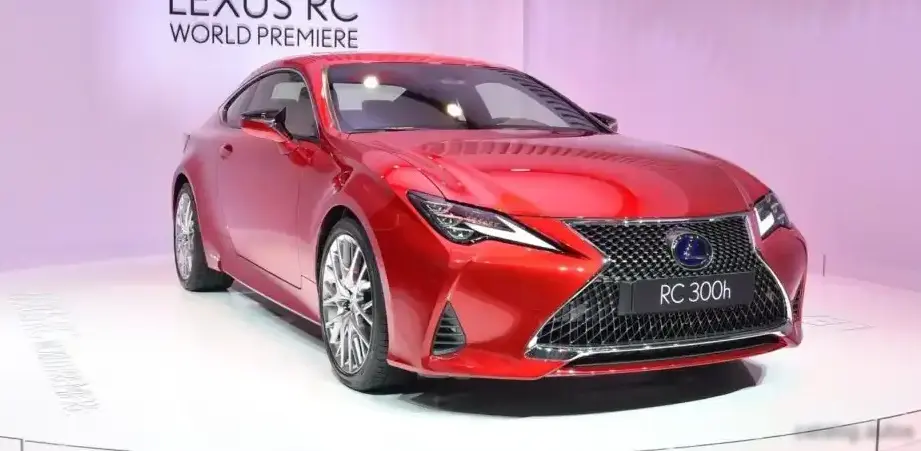
The Lexus RC 300, specifically the V6 260 horsepower all-wheel drive automatic variant, was produced from 2015 to 2018 as part of the first generation (XV70) RC model line. Positioned as a mid-range offering within the RC family, it aimed to provide a balance between performance and luxury, appealing to buyers seeking a stylish coupe with all-weather capability. The RC 300 competed with vehicles like the BMW 4 Series, Audi A5 Coupe, and Infiniti Q60. This particular configuration represented Lexus’s entry into a more performance-oriented coupe segment, leveraging Toyota’s proven V6 engine technology and a sophisticated all-wheel-drive system.
Technical Specifications
| Brand | Lexus |
| Model | RC |
| Generation | RC |
| Type (Engine) | 300 V6 (260 Hp) AWD Automatic |
| Start of production | 2015 |
| End of production | 2018 |
| Powertrain Architecture | Internal Combustion engine |
| Body type | Coupe |
| Seats | 4 |
| Doors | 2 |
| Fuel consumption (economy) – urban | 12.3 l/100 km (19.1 US mpg, 23 UK mpg, 8.1 km/l) |
| Fuel consumption (economy) – extra urban | 9 l/100 km (26.1 US mpg, 31.4 UK mpg, 11.1 km/l) |
| Fuel consumption (economy) – combined | 11.2 l/100 km (21 US mpg, 25.2 UK mpg, 8.9 km/l) |
| Fuel Type | Petrol (Gasoline) |
| Maximum speed | 209 km/h (129.87 mph) |
| Weight-to-power ratio | 6.8 kg/Hp, 147.3 Hp/tonne |
| Weight-to-torque ratio | 5.5 kg/Nm, 181.3 Nm/tonne |
| Power | 260 Hp @ 6600 rpm |
| Power per litre | 75.2 Hp/l |
| Torque | 320 Nm @ 2000-4800 rpm (236.02 lb.-ft. @ 2000-4800 rpm) |
| Engine layout | Front, Longitudinal |
| Engine Model/Code | 2GR-FKS |
| Engine displacement | 3458 cm3 (211.02 cu. in.) |
| Number of cylinders | 6 |
| Engine configuration | V-engine |
| Cylinder Bore | 94 mm (3.7 in.) |
| Piston Stroke | 83 mm (3.27 in.) |
| Compression ratio | 11.8:1 |
| Number of valves per cylinder | 4 |
| Fuel injection system | Direct injection |
| Engine aspiration | Naturally aspirated engine |
| Valvetrain | DOHC, VVT-i |
| Engine oil capacity | 5.7 l (6.02 US qt | 5.02 UK qt) |
| Coolant | 9.5 l (10.04 US qt | 8.36 UK qt) |
| Kerb Weight | 1765 kg (3891.16 lbs.) |
| Max. weight | 2245 kg (4949.38 lbs.) |
| Max load | 480 kg (1058.22 lbs.) |
| Trunk (boot) space – minimum | 294 l (10.38 cu. ft.) |
| Fuel tank capacity | 66 l (17.44 US gal | 14.52 UK gal) |
| Length | 4695 mm (184.84 in.) |
| Width | 1840 mm (72.44 in.) |
| Width including mirrors | 2070 mm (81.5 in.) |
| Height | 1340 mm (52.76 in.) |
| Wheelbase | 2730 mm (107.48 in.) |
| Front track | 1580 mm (62.2 in.) |
| Rear (Back) track | 1570 mm (61.81 in.) |
| Ride height (ground clearance) | 135 mm (5.31 in.) |
| Drag coefficient (Cd) | 0.304 |
| Minimum turning circle (turning diameter) | 10.6 m (34.78 ft.) |
| Drive wheel | All wheel drive (4×4) |
| Number of gears and type of gearbox | 6 gears, automatic transmission |
| Front suspension | Double wishbone |
| Rear suspension | Independent multi-link suspension |
| Front brakes | Ventilated discs |
| Rear brakes | Ventilated discs |
| Assisting systems | ABS (Anti-lock braking system) |
| Steering type | Steering rack and pinion |
| Power steering | Electric Steering |
| Tires size | 235/45 R18 94Y; 235/40 R19 96Y; 265/35 R19 94Y |
| Wheel rims size | 8J x 18; 8J x 19 |
Powertrain & Engine Architecture
The heart of the RC 300 AWD is the 2GR-FKS 3.5-liter V6 engine. This engine is a member of Toyota’s GR family, known for its reliability and smooth operation. The 2GR-FKS utilizes Toyota’s D-4S direct and port fuel injection system, combining the benefits of both technologies for improved efficiency and power delivery. It features a dual overhead camshaft (DOHC) cylinder head with Variable Valve Timing-intelligent (VVT-i) on both intake and exhaust valves, optimizing engine performance across the rev range. The engine produces 260 horsepower at 6,600 rpm and 236 lb-ft of torque between 2,000 and 4,800 rpm. The engine is longitudinally mounted, driving power to all four wheels through a six-speed automatic transmission. This transmission is designed for smooth shifts and responsive performance, although it lacks the sportiness of some dual-clutch transmissions found in competing models.
Driving Characteristics
The RC 300 AWD offers a comfortable and refined driving experience. The automatic transmission provides seamless gear changes, making it well-suited for daily commuting and long highway drives. While the 260 horsepower engine provides adequate acceleration, it doesn’t deliver the same exhilarating performance as the RC 350 with its more powerful V6. The all-wheel-drive system enhances traction and stability, particularly in inclement weather conditions. The gear ratios are tuned for a balance between fuel efficiency and responsiveness, with a focus on providing sufficient torque for everyday driving situations. Compared to the rear-wheel-drive RC 300, the AWD version exhibits slightly heavier handling due to the added weight of the drivetrain components.
Equipment & Trim Levels
The RC 300 AWD typically came standard with features such as Lexus Display Audio with a 7-inch screen, Bluetooth connectivity, a rearview camera, and a ten-speaker audio system. Interior upholstery was generally NuLuxe, a high-quality synthetic leather. Available options included a Mark Levinson premium sound system, a larger 10.3-inch display screen with navigation, heated and ventilated front seats, and a power moonroof. Trim levels were relatively simple, with most variations coming down to option packages rather than distinct model designations. The focus was on providing a luxurious and well-equipped experience, with a strong emphasis on build quality and attention to detail.
Chassis & Braking
The RC 300 AWD utilizes a double wishbone front suspension and an independent multi-link rear suspension, providing a comfortable ride and good handling characteristics. The suspension is tuned for a balance between comfort and control, prioritizing a smooth ride over aggressive cornering. Braking duties are handled by ventilated discs on all four wheels, providing ample stopping power. An Anti-lock Braking System (ABS) is standard, enhancing safety and stability during emergency braking situations. The RC 300 AWD’s chassis is designed to provide a rigid and stable platform, contributing to its overall driving dynamics.
Market Reception & Comparison
The RC 300 AWD was generally well-received by critics, who praised its stylish design, comfortable interior, and refined driving experience. However, some reviewers noted that its performance was not as engaging as some of its competitors, and the infotainment system was criticized for its somewhat cumbersome interface. Fuel economy was considered average for its class. Compared to the RC 350, the RC 300 AWD offered a more affordable entry point into the RC lineup, but at the expense of some performance. The RC 300 AWD’s all-wheel-drive system provided a distinct advantage in regions with harsh winter weather, making it a popular choice for buyers in those areas.
Legacy
The Lexus RC 300 AWD has proven to be a reliable and durable vehicle, with the 2GR-FKS engine known for its longevity. On the used car market, these models generally hold their value well, particularly those in good condition with low mileage. While not a performance standout, the RC 300 AWD remains a desirable option for buyers seeking a stylish, comfortable, and reliable luxury coupe with all-weather capability. The powertrain, while not groundbreaking, is considered robust and relatively inexpensive to maintain, contributing to its continued appeal in the used car market.