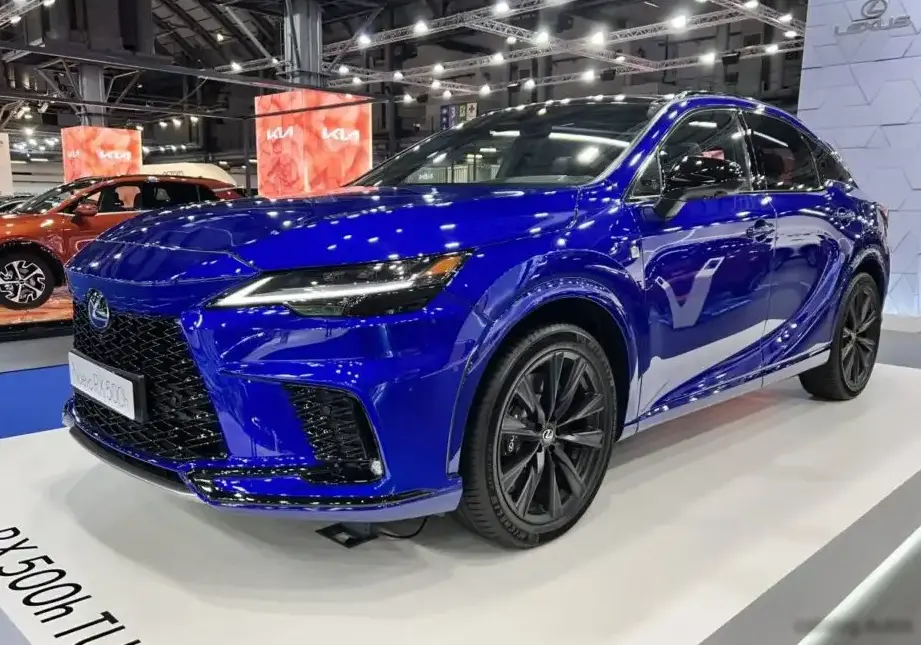
The Lexus RX 500h, introduced in December 2022, represents a significant evolution in the RX lineup, blending a gasoline engine with a sophisticated hybrid system. Part of the fifth generation RX (RX V), this variant distinguishes itself with its DIRECT4 all-wheel-drive system and a combined output of 366 horsepower. Positioned as a mid-to-high range offering within the RX family, the 500h aims to deliver a balance of performance, efficiency, and luxury, appealing to buyers seeking a premium SUV experience. It builds upon the established reputation of the RX series for reliability and refinement, while incorporating cutting-edge hybrid technology.
Technical Specifications
| Brand | Lexus |
| Model | RX |
| Generation | RX V |
| Type (Engine) | 500h (366 Hp) Hybrid DIRECT4 ECT-i |
| Start of production | December, 2022 |
| Powertrain Architecture | FHEV (Full Hybrid Electric Vehicle) |
| Body type | SUV |
| Seats | 5 |
| Doors | 5 |
| Fuel consumption (urban) | 8.7 l/100 km (27 US mpg, 32.5 UK mpg, 11.5 km/l) |
| Fuel consumption (extra urban) | 8.4 l/100 km (28 US mpg, 33.6 UK mpg, 11.9 km/l) |
| Fuel consumption (combined) | 8.7 l/100 km (27 US mpg, 32.5 UK mpg, 11.5 km/l) |
| Fuel Type | Petrol (Gasoline) |
| Acceleration 0 – 60 mph | 5.9 sec |
| Maximum speed | 209 km/h (129.87 mph) |
| Emission standard | SULEV |
| Weight-to-power ratio | 5.9 kg/Hp, 169.8 Hp/tonne |
| Weight-to-torque ratio | 3.9 kg/Nm, 255.2 Nm/tonne |
| Battery voltage | 288 V |
| Battery technology | Nickel-metal hydride (NiMH) |
| Battery location | Under the rear seats |
| Electric motor power (1) | 87 Hp |
| Electric motor Torque (1) | 292 Nm (215.37 lb.-ft.) |
| Electric motor location (1) | Between the combustion engine and the transmission |
| Electric motor type (1) | Synchronous |
| Electric motor power (2) | 103 Hp |
| Electric motor Torque (2) | 169 Nm (124.65 lb.-ft.) |
| Electric motor location (2) | Rear axle, Transverse |
| Electric motor type (2) | Synchronous |
| System power | 366 Hp @ 6000 rpm |
| System torque | 550 Nm @ 2000-3000 rpm (405.66 lb.-ft. @ 2000-3000 rpm) |
| Internal combustion engine power | 271 Hp @ 6000 rpm |
| Power per litre | 113.2 Hp/l |
| Internal combustion engine torque | 460 Nm @ 2000-3000 rpm (339.28 lb.-ft. @ 2000-3000 rpm) |
| Engine layout | Front, Transverse |
| Engine Model/Code | T24A-FTS |
| Engine displacement | 2393 cm3 (146.03 cu. in.) |
| Number of cylinders | 4 |
| Engine configuration | Inline |
| Cylinder Bore | 87.38 mm (3.44 in.) |
| Piston Stroke | 99.57 mm (3.92 in.) |
| Compression ratio | 11:1 |
| Number of valves per cylinder | 4 |
| Fuel injection system | Direct injection and Multi-port manifold injection |
| Engine aspiration | Turbocharger, Intercooler |
| Valvetrain | DOHC, Dual VVT-i |
| Engine oil capacity | 5.3 l (5.6 US qt | 4.66 UK qt) |
| Coolant capacity | 9.4 l (9.93 US qt | 8.27 UK qt) |
| Kerb Weight | 2155 kg (4750.96 lbs.) |
| Max. weight | 2719 kg (5994.37 lbs.) |
| Max load | 564 kg (1243.41 lbs.) |
| Trunk (boot) space – minimum | 838 l (29.59 cu. ft.) |
| Trunk (boot) space – maximum | 1308 l (46.19 cu. ft.) |
| Fuel tank capacity | 65 l (17.17 US gal | 14.3 UK gal) |
| Permitted trailer load with brakes (12%) | 1585 kg (3494.33 lbs.) |
| Permitted trailer load without brakes | 453 kg (998.69 lbs.) |
| Length | 4890 mm (192.52 in.) |
| Width | 1920 mm (75.59 in.) |
| Height | 1710 mm (67.32 in.) |
| Wheelbase | 2850 mm (112.2 in.) |
| Front track | 1655 mm (65.16 in.) |
| Rear (Back) track | 1690 mm (66.54 in.) |
| Front overhang | 1080 mm (42.52 in.) |
| Rear overhang | 960 mm (37.8 in.) |
| Ride height (ground clearance) | 205 mm (8.07 in.) |
| Drag coefficient (Cd) | 0.35 |
| Minimum turning circle (turning diameter) | 10.8 m (35.43 ft.) |
| Approach angle | 15° |
| Departure angle | 25° |
| Drivetrain Architecture | An Internal combustion engine (ICE) drives the front wheels, one electric motor drives the front wheels, one electric motor drives the rear wheels. There is an ability for running in full electric or mixed mode. |
| Drive wheel | All wheel drive (4×4) |
| Number of gears and type of gearbox | 6 gears, automatic transmission ECT-i |
| Front suspension | Independent, type McPherson with coil spring and anti-roll bar |
| Rear suspension | Independent multi-link spring suspension with stabilizer |
| Front brakes | Ventilated discs, 399.8×27.94 mm |
| Rear brakes | Ventilated discs, 340.11×18.03 mm |
| Steering type | Steering rack and pinion |
| Power steering | Electric Steering |
| Wheel rims size | 21 |
Powertrain & Engine Architecture
The RX 500h’s powertrain centers around the T24A-FTS 2.4-liter turbocharged inline-four engine. This engine utilizes both direct injection and multi-port fuel injection to optimize combustion efficiency and power delivery. The engine is paired with a sophisticated hybrid system featuring two electric motors. One motor is integrated between the engine and the six-speed automatic transmission (ECT-i), providing assistance to the engine and enabling electric drive in certain situations. The second electric motor is located on the rear axle, providing on-demand all-wheel drive and further enhancing efficiency. The DIRECT4 system intelligently distributes torque between the front and rear axles, optimizing traction and handling. The nickel-metal hydride (NiMH) battery pack, positioned under the rear seats, provides energy storage for the electric motors. The engine benefits from a dual VVT-i (Variable Valve Timing-intelligent) system, optimizing valve timing for improved performance and fuel economy.
Driving Characteristics
The RX 500h delivers a noticeably more spirited driving experience compared to the naturally aspirated RX 350. The combination of the turbocharger and electric motors results in strong acceleration, with a 0-60 mph time of 5.9 seconds. The six-speed automatic transmission provides smooth and responsive shifts. The DIRECT4 system contributes to confident handling, particularly in adverse weather conditions. While the hybrid system prioritizes efficiency, the 500h doesn’t sacrifice performance. The electric motors provide instant torque, filling in gaps in the engine’s powerband. Compared to a potential V6 variant (not currently offered in the US market), the 500h offers comparable performance with improved fuel economy.
Equipment & Trim Levels
The RX 500h typically comes well-equipped with standard features including a large touchscreen infotainment system, premium audio system, leather upholstery, heated and ventilated front seats, and a comprehensive suite of safety features (Lexus Safety System+ 3.0). Available options include a panoramic sunroof, Mark Levinson premium sound system, advanced park assist, and head-up display. Trim levels generally offer increasing levels of luxury and technology, with higher trims adding features like upgraded interior materials, more advanced driver-assistance systems, and unique exterior styling elements.
Chassis & Braking
The RX 500h utilizes an independent suspension system, with McPherson struts at the front and a multi-link setup at the rear. This configuration provides a comfortable ride while maintaining good handling characteristics. Stabilizer bars are included at both ends to reduce body roll during cornering. The braking system consists of ventilated discs on all four wheels, providing ample stopping power. The electronic braking system is integrated with the hybrid system for regenerative braking, capturing energy during deceleration and returning it to the battery.
Market Reception & Comparison
The RX 500h has been generally well-received by automotive critics, praised for its blend of performance, efficiency, and luxury. Reviewers have highlighted the smooth and refined driving experience, as well as the effectiveness of the DIRECT4 all-wheel-drive system. Compared to the RX 450h (a plug-in hybrid), the 500h offers a more powerful and engaging driving experience, albeit with slightly lower fuel economy. Compared to competitors like the Acura MDX and BMW X5, the RX 500h offers a compelling combination of value, reliability, and refinement.
Legacy
The Lexus RX 500h represents a significant step forward in hybrid SUV technology. The DIRECT4 system and the integration of two electric motors demonstrate Lexus’s commitment to innovation. While long-term reliability data is still emerging, the RX series has a strong reputation for durability, and the hybrid components are expected to be reliable. The 500h is likely to hold its value well in the used car market, appealing to buyers seeking a premium, fuel-efficient, and technologically advanced SUV.