Technical Specifications
| Brand | Lexus |
| Model | UX |
| Generation | UX |
| Type (Engine) | 250h (177 Hp) Hybrid e-CVT |
| Start of production | March, 2019 |
| End of production | April, 2024 |
| Powertrain Architecture | FHEV (Full Hybrid Electric Vehicle) |
| Body type | SUV |
| Seats | 5 |
| Doors | 5 |
| Fuel consumption (combined) | 4.1-4.3 l/100 km (57.4 – 54.7 US mpg, 68.9 – 65.7 UK mpg, 24.4 – 23.3 km/l) |
| CO2 emissions | 96-103 g/km |
| Fuel Type | Petrol (Gasoline) |
| Acceleration 0 – 100 km/h | 8.5 sec |
| Acceleration 0 – 62 mph | 8.5 sec |
| Acceleration 0 – 60 mph | 8.1 sec |
| Maximum speed | 177 km/h (109.98 mph) |
| Emission standard | Euro 6d |
| Weight-to-power ratio | 8.7 kg/Hp, 114.9 Hp/tonne |
| Weight-to-torque ratio | 8.6 kg/Nm, 116.9 Nm/tonne |
| Gross battery capacity | 1.4 kWh |
| Battery voltage | 216 V |
| Battery technology | Nickel-metal hydride (NiMH) |
| Battery location | Under the rear seats |
| Electric motor power | 109 Hp |
| Electric motor Torque | 202 Nm (148.99 lb.-ft.) |
| Electric motor location | Integrated into the transmission |
| Electric motor type | Synchronous |
| System power | 177 Hp |
| Internal combustion engine power | 146 Hp @ 6000 rpm |
| Internal combustion engine torque | 180 Nm @ 4400 rpm (132.76 lb.-ft. @ 4400 rpm) |
| Engine layout | Front, Transverse |
| Engine Model/Code | M20A-FXS |
| Engine displacement | 1987 cm3 (121.25 cu. in.) |
| Number of cylinders | 4 |
| Engine configuration | Inline |
| Cylinder Bore | 80.5 mm (3.17 in.) |
| Piston Stroke | 97.6 mm (3.84 in.) |
| Compression ratio | 14:1 |
| Number of valves per cylinder | 4 |
| Fuel injection system | Direct injection and Multi-port manifold injection |
| Engine aspiration | Naturally aspirated engine |
| Valvetrain | DOHC-VVT-i |
| Engine oil capacity | 4.3 l (4.54 US qt | 3.78 UK qt) |
| Coolant capacity | 6.1 l (6.45 US qt | 5.37 UK qt) |
| Kerb Weight | 1540-1620 kg (3395.12 – 3571.49 lbs.) |
| Max. weight | 2110 kg (4651.75 lbs.) |
| Max load | 490-570 kg (1080.27 – 1256.63 lbs.) |
| Fuel tank capacity | 43 l (11.36 US gal | 9.46 UK gal) |
| Permitted trailer load with brakes (12%) | 750 kg (1653.47 lbs.) |
| Permitted trailer load without brakes | 750 kg (1653.47 lbs.) |
| Length | 4495 mm (176.97 in.) |
| Width | 1840 mm (72.44 in.) |
| Height | 1520-1540 mm (59.84 – 60.63 in.) |
| Wheelbase | 2640 mm (103.94 in.) |
| Front track | 1550-1560 mm (61.02 – 61.42 in.) |
| Rear track | 1550-1560 mm (61.02 – 61.42 in.) |
| Front overhang | 970 mm (38.19 in.) |
| Rear overhang | 885 mm (34.84 in.) |
| Ride height (ground clearance) | 160 mm (6.3 in.) |
| Drag coefficient (Cd) | 0.33 |
| Minimum turning circle | 11.2 m (36.75 ft.) |
| Approach angle | 14° |
| Departure angle | 25° |
| Ramp-over angle | 17° |
| Drivetrain Architecture | The Internal combustion engine (ICE) and electric motor drive the front wheels of the car with the ability to work in full electric or mixed mode. |
| Drive wheel | Front wheel drive |
| Number of gears and type of gearbox | automatic transmission e-CVT |
| Front suspension | Independent, type McPherson with coil spring and anti-roll bar |
| Rear suspension | Double wishbone, Transverse stabilizer, Coil spring |
| Front brakes | Ventilated discs, 305 mm |
| Rear brakes | Disc, 281 mm |
| Assisting systems | ABS (Anti-lock braking system) |
| Steering type | Steering rack and pinion |
| Power steering | Electric Steering |
| Tires size | 215/60 R17 |
| Wheel rims size | 6.5J x 17 |
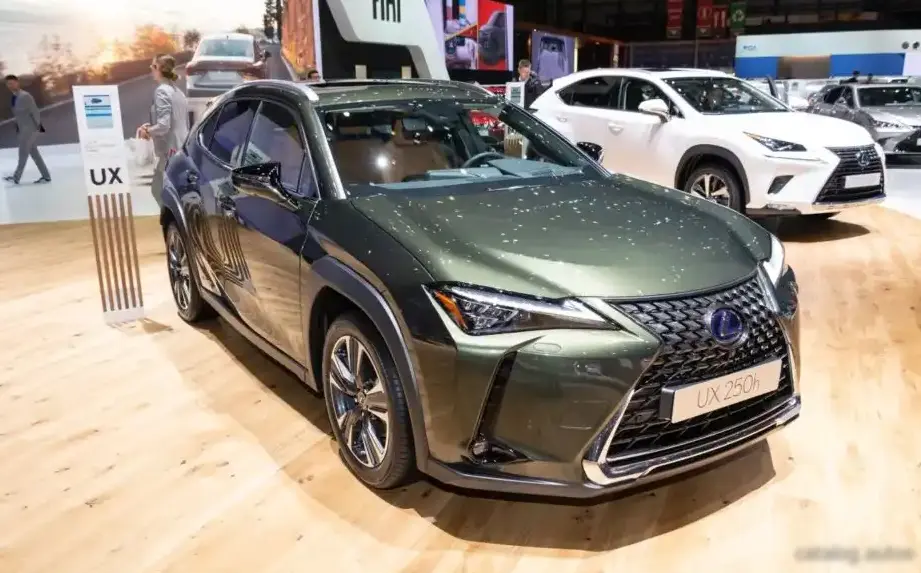
The Lexus UX 250h is a compact luxury hybrid SUV produced by Lexus, the luxury division of Toyota, from March 2019 to April 2024. It represents Lexus’s entry point into the burgeoning subcompact luxury crossover market, designed to appeal to urban consumers seeking fuel efficiency, modern technology, and a premium experience. The UX 250h is part of the UX series, utilizing Toyota’s GA-C platform (also known as the TNGA-C platform) shared with models like the Toyota Corolla and C-HR. This specific 177 horsepower hybrid variant, paired with an electronically controlled continuously variable transmission (e-CVT), was positioned as the sole powertrain option for the UX in most markets, including the United States, emphasizing fuel economy and refinement over outright performance.
Powertrain & Engine Architecture
The Lexus UX 250h utilizes Lexus’s fourth-generation hybrid system. At its heart is the M20A-FXS 2.0-liter inline-four cylinder engine, part of Toyota’s Dynamic Force Engine family. This engine features a high compression ratio of 14:1, direct injection, and a DOHC-VVT-i valvetrain, contributing to improved thermal efficiency. The engine produces 146 horsepower at 6000 rpm and 180 Nm (132.76 lb-ft) of torque at 4400 rpm. Crucially, this engine is not directly connected to the wheels. Instead, it functions primarily as a generator, powering the electric motor. The electric motor itself produces 109 horsepower and 202 Nm (148.99 lb-ft) of torque. The combined system output is 177 horsepower. The e-CVT (electronically controlled continuously variable transmission) doesn’t have traditional gears; it intelligently blends power from the engine and electric motor to provide seamless acceleration. The nickel-metal hydride (NiMH) battery pack, located under the rear seats, has a gross capacity of 1.4 kWh and provides a limited all-electric range, typically sufficient for short urban commutes.
Driving Characteristics
The UX 250h prioritizes fuel efficiency and a smooth driving experience over sporty performance. The e-CVT provides linear acceleration, lacking the stepped shifts of a traditional automatic. While the combined 177 horsepower is adequate for everyday driving, it doesn’t offer particularly brisk acceleration – 0-60 mph takes around 8.1 seconds. The hybrid system’s programming favors electric drive at lower speeds, resulting in quiet and refined operation in city traffic. The steering is light and precise, making it easy to maneuver in tight spaces. Compared to potential higher-output gasoline-only versions (which were not offered in the US market), the UX 250h trades performance for significantly improved fuel economy. The e-CVT, while smooth, can sometimes feel less engaging than a traditional automatic or manual transmission, particularly during more aggressive driving.
Equipment & Trim Levels
The UX 250h was generally well-equipped, even in its base trim. Standard features typically included Lexus Safety System+ 2.0 (including pre-collision system with pedestrian detection, lane departure alert with steering assist, and adaptive cruise control), a 7-inch infotainment display with Apple CarPlay and Android Auto compatibility, dual-zone automatic climate control, and power-adjustable front seats. Higher trim levels, such as the F Sport, added sportier styling cues (unique wheels, mesh grille, and interior trim), adaptive variable suspension, and a larger 10.3-inch infotainment display. Optional extras included a sunroof, heated and ventilated front seats, blind-spot monitoring, and a premium audio system.
Chassis & Braking
The UX 250h utilizes a front-wheel-drive layout. The front suspension consists of independent MacPherson struts with coil springs and an anti-roll bar, while the rear suspension employs a double-wishbone setup with a transverse stabilizer and coil springs. The braking system features ventilated discs at the front (305mm) and solid discs at the rear (281mm). ABS (Anti-lock Braking System) is standard. The suspension tuning is geared towards comfort, providing a relatively compliant ride quality. The relatively low curb weight (1540-1620 kg / 3395-3571 lbs) helps to mitigate the impact of the modest engine output.
Market Reception & Comparison
The Lexus UX 250h was generally well-received by critics, who praised its fuel efficiency, comfortable ride, and refined interior. However, some reviewers noted its relatively modest performance and the sometimes-uninspiring driving experience. Compared to other subcompact luxury crossovers, such as the BMW X1 or Audi Q3, the UX 250h prioritized fuel economy and hybrid technology over outright performance and handling. Its fuel economy figures (4.1-4.3 l/100 km) were consistently among the best in its class. Reliability was also a strong point, consistent with Lexus’s reputation for building durable vehicles.
Legacy
The Lexus UX 250h established Lexus as a player in the growing subcompact luxury crossover segment. The powertrain, while not particularly powerful, proved to be reliable and fuel-efficient. On the used car market, the UX 250h holds its value relatively well, benefiting from Lexus’s strong brand reputation and the increasing demand for fuel-efficient vehicles. The hybrid system’s longevity is a key selling point, and the relatively simple design of the powertrain contributes to lower maintenance costs compared to more complex systems. The UX 250h represents a significant step towards Lexus’s electrification strategy, paving the way for future hybrid and electric models.