Technical Specifications
| Brand | Lexus |
| Model | UX |
| Generation | UX |
| Type (Engine) | 300h (199 Hp) Hybrid ECVT |
| Start of production | April, 2024 |
| Powertrain Architecture | FHEV (Full Hybrid Electric Vehicle) |
| Body type | SUV |
| Seats | 5 |
| Doors | 5 |
| Combined fuel consumption (WLTP) | 5.0-5.2 l/100 km (47 – 45.2 US mpg, 56.5 – 54.3 UK mpg, 20 – 19.2 km/l) |
| CO2 emissions (WLTP) | 113-119 g/km |
| Fuel Type | Petrol (Gasoline) |
| Acceleration 0 – 100 km/h | 8.1 sec |
| Acceleration 0 – 62 mph | 8.1 sec |
| Acceleration 0 – 60 mph | 8.0 sec |
| Maximum speed | 177 km/h (109.98 mph) |
| Emission standard | Euro 6e |
| Weight-to-power ratio | 7.5 kg/Hp, 133.1 Hp/tonne |
| Weight-to-torque ratio | 7.9 kg/Nm, 127.1 Nm/tonne |
| Battery voltage | 222 V |
| Battery technology | Lithium-ion (Li-Ion) |
| Battery location | Below the floor, under the rear seats |
| Electric motor power | 113 Hp |
| Electric motor Torque | 206 Nm (151.94 lb.-ft.) |
| Electric motor model/code | PB10 |
| Electric motor location | Between the combustion engine and the transmission |
| Electric motor type | Synchronous |
| System power | 199 Hp |
| Power | 152 Hp @ 6000 rpm |
| Power per litre | 76.5 Hp/l |
| Torque | 190 Nm @ 4400-5200 rpm (140.14 lb.-ft. @ 4400-5200 rpm) |
| Engine layout | Front, Transverse |
| Engine Model/Code | M20A-FXS |
| Engine displacement | 1987 cm3 (121.25 cu. in.) |
| Number of cylinders | 4 |
| Engine configuration | Inline |
| Cylinder Bore | 80.5 mm (3.17 in.) |
| Piston Stroke | 97.6 mm (3.84 in.) |
| Compression ratio | 14:1 |
| Number of valves per cylinder | 4 |
| Fuel injection system | Direct injection and Multi-port manifold injection |
| Engine aspiration | Naturally aspirated engine |
| Valvetrain | DOHC, VVT-iE, VVT-i |
| Engine oil capacity | 4.3 l (4.54 US qt | 3.78 UK qt) |
| Coolant | 6.1 l (6.45 US qt | 5.37 UK qt) |
| Kerb Weight | 1495-1575 kg (3295.91 – 3472.28 lbs.) |
| Max. weight | 2110 kg (4651.75 lbs.) |
| Max load | 535-615 kg (1179.47 – 1355.84 lbs.) |
| Trunk (boot) space – minimum | 315-433 l (11.12 – 15.29 cu. ft.) |
| Fuel tank capacity | 43 l (11.36 US gal | 9.46 UK gal) |
| Permitted trailer load with brakes (12%) | 750 kg (1653.47 lbs.) |
| Permitted trailer load without brakes | 750 kg (1653.47 lbs.) |
| Length | 4495 mm (176.97 in.) |
| Width | 1840 mm (72.44 in.) |
| Height | 1540 mm (60.63 in.) |
| Wheelbase | 2640 mm (103.94 in.) |
| Front track | 1550-1560 mm (61.02 – 61.42 in.) |
| Rear (Back) track | 1550-1560 mm (61.02 – 61.42 in.) |
| Front overhang | 970 mm (38.19 in.) |
| Rear overhang | 885 mm (34.84 in.) |
| Ride height (ground clearance) | 160 mm (6.3 in.) |
| Drag coefficient (Cd) | 0.33 |
| Minimum turning circle (turning diameter) | 11.2 m (36.75 ft.) |
| Approach angle | 14° |
| Departure angle | 25° |
| Ramp-over (brakeover) angle | 16° |
| Drivetrain Architecture | The Internal combustion engine (ICE) and electric motor drive the front wheels of the car with the ability to work in full electric or mixed mode. |
| Drive wheel | Front wheel drive |
| Number of gears and type of gearbox | automatic transmission ECVT |
| Front suspension | Independent type McPherson |
| Rear suspension | Double wishbone |
| Front brakes | Ventilated discs, 305×28 mm |
| Rear brakes | Disc, 281×12 mm |
| Assisting systems | ABS (Anti-lock braking system) |
| Steering type | Steering rack and pinion |
| Power steering | Electric Steering |
| Tires size | 215/60 R17; 225/50 R18 |
| Wheel rims size | 17; 18 |
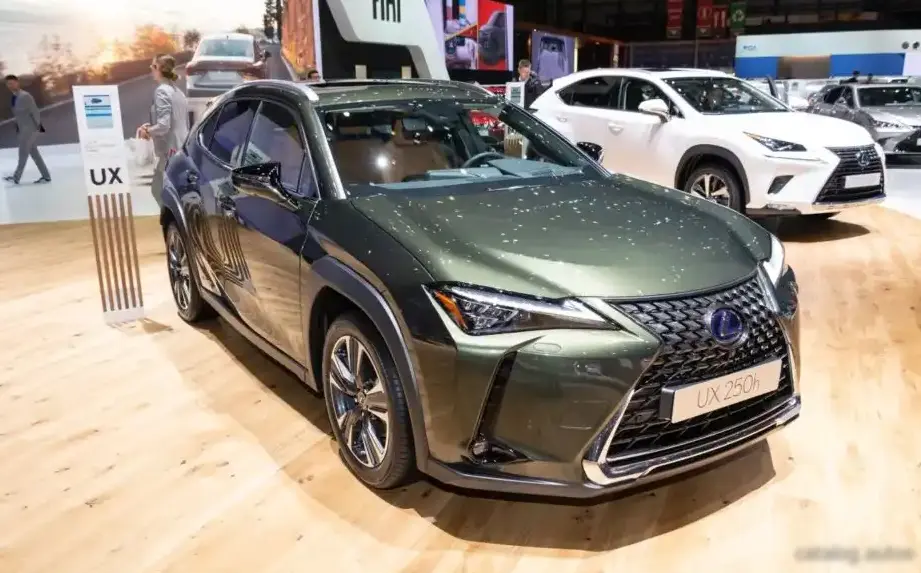
The Lexus UX 300h is a subcompact luxury crossover SUV introduced by Lexus in 2024. It’s the first model to utilize the GA-C platform, a compact version of the Toyota New Global Architecture (TNGA), and represents a key component of Lexus’s strategy to expand its hybrid offerings. The UX 300h distinguishes itself through its focus on fuel efficiency, compact dimensions, and a relatively accessible price point within the luxury segment. It’s designed to appeal to urban drivers and those prioritizing a blend of practicality, comfort, and environmental consciousness. The ECVT (Electronically Controlled Continuously Variable Transmission) is central to the UX 300h’s hybrid operation, optimizing fuel economy and providing a smooth driving experience.
Powertrain & Engine Architecture
At the heart of the UX 300h lies the M20A-FXS 2.0-liter inline-four cylinder engine, part of Toyota’s Dynamic Force Engine family. This engine employs a direct-injection and multi-port fuel injection system, maximizing combustion efficiency. It produces 152 horsepower at 6000 rpm and 190 Nm (140.14 lb-ft) of torque between 4400-5200 rpm. The engine features a high compression ratio of 14:1, contributing to its thermal efficiency. The engine is paired with a permanent magnet synchronous electric motor (PB10 code) generating 113 horsepower and 206 Nm (151.94 lb-ft) of torque. The combined system output is 199 horsepower. The ECVT transmission, unique to Lexus hybrids, doesn’t have fixed gear ratios but instead utilizes a belt-and-pulley system to provide a seamless and continuously variable gear ratio. This transmission is crucial for optimizing engine efficiency and delivering smooth acceleration. The 222V lithium-ion battery pack is located under the rear seats, minimizing intrusion into passenger or cargo space.
Driving Characteristics
The UX 300h delivers a refined and comfortable driving experience, prioritizing smoothness and fuel efficiency over outright performance. The ECVT transmission provides linear acceleration, although it can sometimes feel less responsive than a traditional automatic transmission. The combined output of the engine and electric motor provides adequate power for everyday driving situations, with a 0-60 mph time of around 8.0 seconds. The hybrid system seamlessly transitions between electric, gasoline, and combined power modes, often operating in electric-only mode at lower speeds and during gentle acceleration. The suspension is tuned for comfort, absorbing bumps and imperfections in the road effectively. While not a sporty vehicle, the UX 300h offers predictable handling and a stable ride. Compared to a hypothetical UX with a more powerful gasoline engine, the 300h prioritizes fuel economy and lower emissions, sacrificing some performance in the process.
Equipment & Trim Levels
The UX 300h typically comes well-equipped with standard features including Lexus Safety System+ 2.5 (including pre-collision system with pedestrian detection, lane departure alert with intelligent steering assist, and dynamic radar cruise control), a 7-inch touchscreen infotainment system, Apple CarPlay and Android Auto compatibility, and LED headlights. Higher trim levels add features such as a larger 12.3-inch touchscreen display, navigation system, premium audio system, heated and ventilated front seats, and a power rear door. Interior upholstery options typically include NuLuxe (synthetic leather) and genuine leather. Available options include a panoramic sunroof, blind spot monitor, and rear cross-traffic alert.
Chassis & Braking
The UX 300h utilizes a front-wheel-drive layout. The front suspension consists of an independent McPherson strut setup, while the rear employs a double-wishbone suspension. This configuration provides a balance of ride comfort and handling stability. The braking system features ventilated discs at the front (305×28 mm) and solid discs at the rear (281×12 mm). Anti-lock braking system (ABS) is standard. The chassis is designed to be lightweight, contributing to improved fuel efficiency and handling. The vehicle’s relatively low center of gravity, due to the battery pack’s placement, enhances stability.
Market Reception & Comparison
The Lexus UX 300h has been generally well-received by critics for its fuel efficiency, comfortable ride, and refined interior. However, some reviewers have noted the relatively modest acceleration and the sometimes-unintuitive infotainment system. Compared to other subcompact luxury crossovers like the BMW X1 or Audi Q3, the UX 300h stands out with its standard hybrid powertrain and focus on fuel economy. It typically achieves better fuel economy than its gasoline-powered competitors. Reliability is expected to be strong, consistent with Lexus’s reputation for quality and durability. The UX 300h’s pricing is competitive within the luxury segment, making it an attractive option for buyers seeking a premium hybrid crossover.
Legacy
The Lexus UX 300h represents a significant step in Lexus’s electrification strategy. The powertrain, while not groundbreaking in terms of raw power, is known for its reliability and longevity. The ECVT transmission, while sometimes criticized for its feel, has proven to be durable and efficient. In the used car market, the UX 300h is expected to hold its value well due to its fuel efficiency, Lexus brand reputation, and the growing demand for hybrid vehicles. The UX 300h has established itself as a compelling option for buyers seeking a fuel-efficient, comfortable, and technologically advanced subcompact luxury crossover.