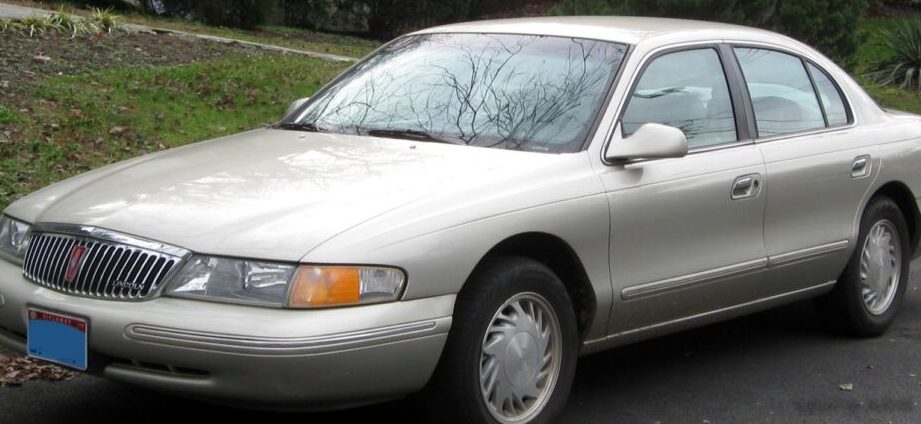
The Lincoln Continental IX, produced between 1995 and 2002, represented a significant attempt by the Ford Motor Company to revive the iconic Continental nameplate. This generation, designated the IX, aimed to blend traditional American luxury with contemporary design and technology. The 4.6-liter V8 32V variant, producing 279 horsepower, occupied a prominent position in the lineup, offering a balance of performance and refinement. It served as a step up from the base engine options, targeting buyers who desired a more substantial driving experience without venturing into the territory of the higher-performance models. The Continental IX was primarily marketed in North America, representing Lincoln’s flagship sedan during this period.
Technical Specifications
| Brand | Lincoln |
| Model | Continental |
| Generation | Continental IX |
| Type (Engine) | 4.6 V8 32V (279 Hp) |
| Start of production | 1995 |
| End of production | 2002 |
| Powertrain Architecture | Internal Combustion engine |
| Body type | Sedan |
| Seats | 5 |
| Doors | 4 |
| Fuel consumption (urban) | 13.8 l/100 km (17 US mpg, 20.5 UK mpg) |
| Fuel consumption (extra urban) | 9.8 l/100 km (24 US mpg, 28.8 UK mpg) |
| Fuel Type | Petrol (Gasoline) |
| Maximum speed | 215 km/h (133.59 mph) |
| Weight-to-power ratio | 6.3 kg/Hp, 159.9 Hp/tonne |
| Weight-to-torque ratio | 4.7 kg/Nm, 213.8 Nm/tonne |
| Power | 279 Hp @ 5750 rpm |
| Power per litre | 60.6 Hp/l |
| Torque | 373 Nm @ 4750 rpm (275.11 lb.-ft. @ 4750 rpm) |
| Engine layout | Front, Longitudinal |
| Engine Model/Code | InTech |
| Engine displacement | 4601 cm3 (280.77 cu. in.) |
| Number of cylinders | 8 |
| Engine configuration | V-engine |
| Cylinder Bore | 90.2 mm (3.55 in.) |
| Piston Stroke | 90 mm (3.54 in.) |
| Compression ratio | 9.85:1 |
| Number of valves per cylinder | 4 |
| Fuel injection system | Multi-port manifold injection |
| Engine aspiration | Naturally aspirated engine |
| Valvetrain | DOHC |
| Engine oil capacity | 5.7 l (6.02 US qt | 5.02 UK qt) |
| Coolant | 15 l (15.85 US qt | 13.2 UK qt) |
| Kerb Weight | 1745 kg (3847.07 lbs.) |
| Trunk (boot) space – minimum | 515 l (18.19 cu. ft.) |
| Fuel tank capacity | 76 l (20.08 US gal | 16.72 UK gal) |
| Length | 5260 mm (207.09 in.) |
| Width | 1870 mm (73.62 in.) |
| Height | 1420 mm (55.91 in.) |
| Wheelbase | 2770 mm (109.06 in.) |
| Front track | 1600 mm (62.99 in.) |
| Rear (Back) track | 1560 mm (61.42 in.) |
| Drivetrain Architecture | The Internal combustion engine (ICE) drives the front wheels of the vehicle. |
| Drive wheel | Front wheel drive |
| Number of gears and type of gearbox | 4 gears, automatic transmission |
| Front suspension | Coil spring |
| Rear suspension | Coil spring |
| Front brakes | Ventilated discs |
| Rear brakes | Disc |
| Assisting systems | ABS (Anti-lock braking system) |
| Steering type | Steering rack and pinion |
| Power steering | Hydraulic Steering |
| Tires size | 225/60 R16 |
| Wheel rims size | 16 |
Powertrain & Engine Architecture
The heart of the Continental IX 4.6 V8 was the InTech engine, a Ford-developed 4.6-liter, 32-valve V8. This engine utilized a single overhead camshaft (SOHC) design per cylinder bank, a relatively conservative valvetrain choice for the time, prioritizing reliability and low-end torque over high-revving performance. The engine employed multi-port fuel injection, delivering fuel directly to each intake port for improved combustion efficiency. The 4R70W four-speed automatic transmission was the standard pairing for this engine. This transmission was known for its smoothness and durability, though it lacked the efficiency of more modern transmissions with additional gears. The engine’s longitudinal mounting and front-wheel-drive configuration were typical for American luxury sedans of the era.
Driving Characteristics
The 279 horsepower and 275 lb-ft of torque provided by the 4.6 V8 delivered adequate, though not exhilarating, performance. Acceleration from 0 to 60 mph was typically in the 7.5-8.5 second range. The four-speed automatic transmission, while smooth, contributed to a somewhat relaxed driving experience. Gear ratios were tuned for comfortable cruising rather than aggressive acceleration. Compared to the base V6 engine, the V8 offered a noticeable improvement in responsiveness and passing power. However, it didn’t match the performance of the later supercharged versions of the Continental. The front-wheel-drive layout provided good traction in most conditions, but it didn’t offer the handling balance of a rear-wheel-drive platform.
Equipment & Trim Levels
The Continental IX 4.6 V8 typically came standard with a generous array of features, befitting its luxury positioning. These included leather upholstery, power-adjustable front seats, automatic climate control, a premium sound system, and alloy wheels. Optional extras included a sunroof, upgraded sound systems, and various convenience packages. Trim levels varied slightly over the production run, but generally, the 4.6 V8 was offered in well-equipped configurations, often positioned as a mid-range offering within the Continental lineup. The interior design emphasized comfort and spaciousness, with a focus on high-quality materials and a refined aesthetic.
Chassis & Braking
The Continental IX utilized a traditional body-on-frame construction, a hallmark of American luxury cars of the time. The suspension consisted of coil springs all around, providing a comfortable ride. Front suspension featured independent components, while the rear utilized a solid axle. Braking duties were handled by ventilated discs at the front and solid discs at the rear. Anti-lock braking system (ABS) was standard. The chassis was tuned for a smooth and isolated ride, prioritizing comfort over sporty handling. Stabilizer bars were included to reduce body roll during cornering, but the overall handling characteristics were geared towards relaxed cruising.
Market Reception & Comparison
The Continental IX 4.6 V8 received generally positive reviews, with critics praising its comfortable ride, spacious interior, and smooth powertrain. However, it was often criticized for its somewhat dated design and lack of sporty handling. Fuel economy was also a concern, with the V8 engine consuming a significant amount of gasoline. Compared to European luxury sedans, the Continental IX offered a different driving experience, prioritizing comfort and space over agility and fuel efficiency. Within the Continental lineup, the 4.6 V8 offered a compelling alternative to the base V6, providing a noticeable performance upgrade without the higher price tag of the supercharged models.
Legacy
The Lincoln Continental IX 4.6 V8 has become a relatively affordable entry point into the classic American luxury car market. The InTech V8 engine is known for its durability and reliability, although regular maintenance is essential. Parts availability is generally good, thanks to the engine’s widespread use in other Ford vehicles. While not a performance icon, the Continental IX 4.6 V8 represents a significant chapter in Lincoln’s history, embodying the brand’s commitment to comfort, luxury, and spaciousness. Today, well-maintained examples are sought after by enthusiasts who appreciate the classic American automotive experience.