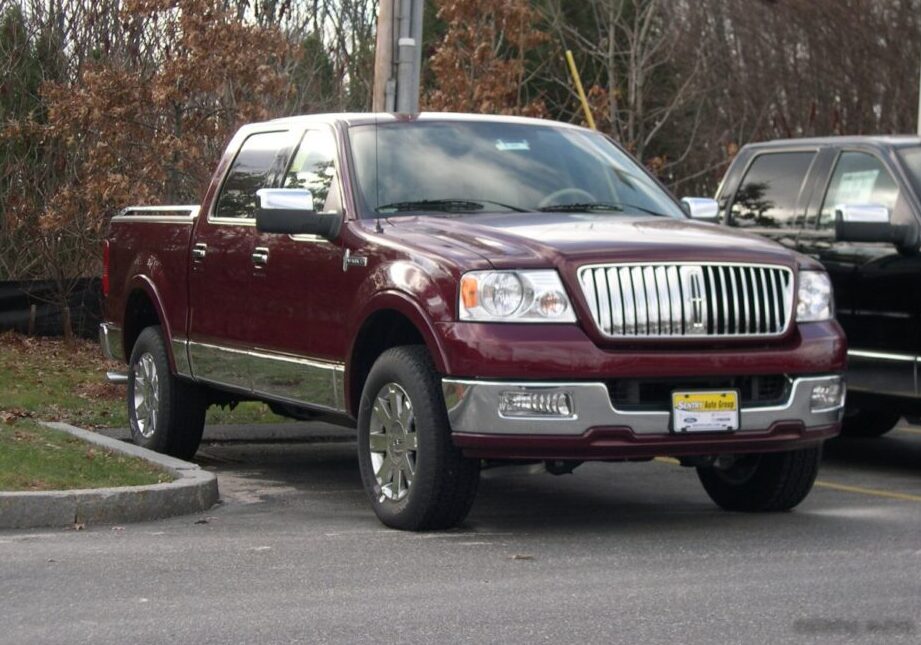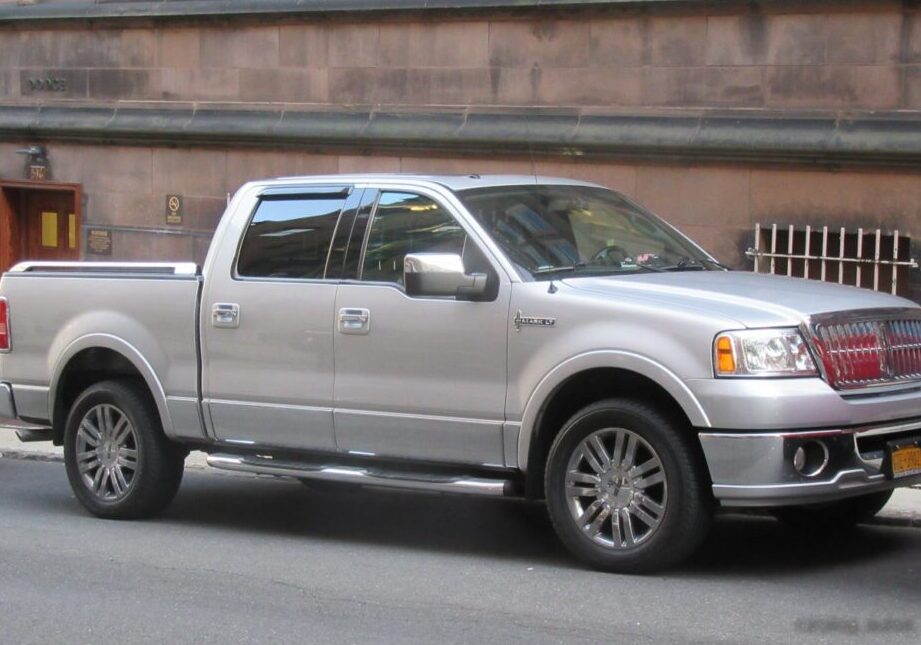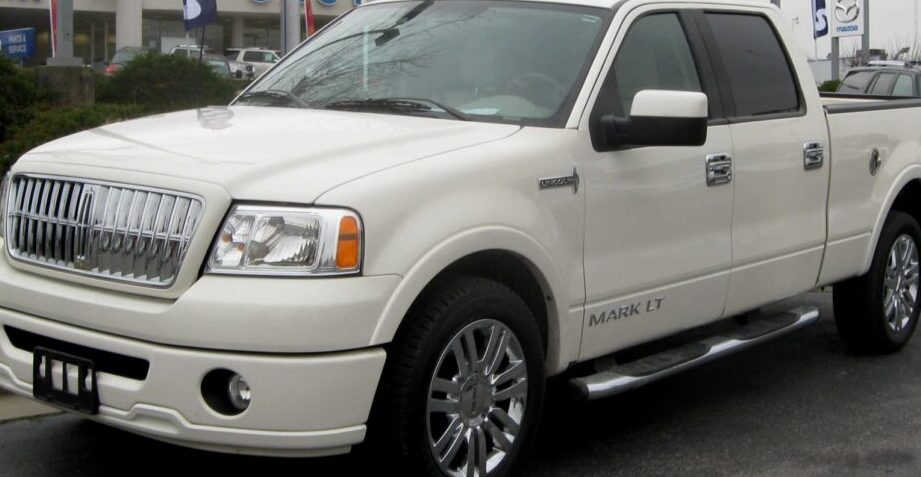
The Lincoln Mark LT (facelift 2006) with the 5.4-liter V8 engine and four-speed automatic transmission, coupled with a four-wheel-drive system, represented Lincoln’s entry into the luxury pickup truck market. Produced from 2006 to 2008, this iteration of the Mark LT was a mid-cycle refresh of the original model introduced in 2005. It was based on the Ford F-150 chassis, but offered a more refined interior and a focus on comfort and convenience features, aiming to attract buyers who desired the capability of a pickup without sacrificing luxury. The “Long Bed” designation refers to the extended cargo box, providing increased utility compared to the standard bed length. This particular configuration, with its substantial power output, positioned itself as a capable work and tow vehicle, while still maintaining the Lincoln brand’s emphasis on a premium driving experience.
Technical Specifications
| Brand | Lincoln |
| Model | Mark LT |
| Generation | Mark LT (facelift 2006) Long Bed |
| Type (Engine) | 5.4 V8 (300 Hp) 4WD Automatic |
| Start of production | July, 2006 |
| End of production | 2008 |
| Powertrain Architecture | Internal Combustion engine |
| Body type | Pick-up |
| Seats | 5 |
| Doors | 4 |
| Fuel consumption (economy) – urban (EPA) | 16.8-18.1 l/100 km (14 – 13 US mpg, 16.8 – 15.6 UK mpg, 6 – 5.5 km/l) |
| Fuel consumption (economy) – extra urban (EPA) | 13.1-13.8 l/100 km (18 – 17 US mpg, 21.6 – 20.5 UK mpg, 7.6 – 7.2 km/l) |
| Fuel consumption (economy) – combined (EPA) | 15.7-16.8 l/100 km (15 – 14 US mpg, 18 – 16.8 UK mpg, 6.4 – 6 km/l) |
| Fuel Type | Petrol (Gasoline) |
| Weight-to-power ratio | 8.5 kg/Hp, 118.1 Hp/tonne |
| Weight-to-torque ratio | 5.1 kg/Nm, 194.9 Nm/tonne |
| Power | 300 Hp @ 5000 rpm |
| Power per litre | 55.5 Hp/l |
| Torque | 495 Nm @ 3750 rpm (365.09 lb.-ft. @ 3750 rpm) |
| Maximum engine speed | 5400 rpm |
| Engine layout | Front, Longitudinal |
| Engine Model/Code | Triton |
| Engine displacement | 5409 cm3 (330.08 cu. in.) |
| Number of cylinders | 8 |
| Engine configuration | V-engine |
| Cylinder Bore | 90.2 mm (3.55 in.) |
| Piston Stroke | 105.8 mm (4.17 in.) |
| Compression ratio | 9.8:1 |
| Number of valves per cylinder | 3 |
| Fuel injection system | Multi-port manifold injection |
| Engine aspiration | Naturally aspirated engine |
| Valvetrain | SOHC, VCT |
| Engine oil capacity | 6.6 l (6.97 US qt | 5.81 UK qt) |
| Coolant | 20 l (21.13 US qt | 17.6 UK qt) |
| Kerb Weight | 2540-2590 kg (5599.74 – 5709.97 lbs.) |
| Max. weight | 3266 kg (7200.3 lbs.) |
| Max load | 676-726 kg (1490.32 – 1600.56 lbs.) |
| Trunk (boot) space – maximum | 1855 l (65.51 cu. ft.) |
| Fuel tank capacity | 135 l (35.66 US gal | 29.7 UK gal) |
| Permitted trailer load with brakes (12%) | 3901 kg (8600.23 lbs.) |
| Permitted towbar download | 386 kg (850.98 lbs.) |
| Length | 5989 mm (235.79 in.) |
| Width | 2004 mm (78.9 in.) |
| Width including mirrors | 2459 mm (96.81 in.) |
| Height | 1930 mm (75.98 in.) |
| Wheelbase | 3823 mm (150.51 in.) |
| Front track | 1699-1702 mm (66.89 – 67.01 in.) |
| Rear (Back) track | 1699-1702 mm (66.89 – 67.01 in.) |
| Front overhang | 937 mm (36.89 in.) |
| Rear overhang | 1229 mm (48.39 in.) |
| Ride height (ground clearance) | 206-231 mm (8.11 – 9.09 in.) |
| Minimum turning circle (turning diameter) | 14.6 m (47.9 ft.) |
| Approach angle | 25-26.3° |
| Departure angle | 25.2-26.2° |
| Ramp-over (brakeover) angle | 19.6° |
| Drivetrain Architecture | The Internal combustion engine (ICE) drives the rear wheels permanently, and the front wheels are driven through an electrically or mechanically operated clutch if necessary. |
| Drive wheel | All wheel drive (4×4) |
| Number of gears and type of gearbox | 4 gears, automatic transmission |
| Front suspension | Double wishbone, Independent coil spring, Transverse stabilizer |
| Rear suspension | Rigid axle suspension, Leaf spring |
| Front brakes | Ventilated discs, 330 mm |
| Rear brakes | Ventilated discs, 348 mm |
| Assisting systems | ABS (Anti-lock braking system) |
| Steering type | Steering rack and pinion |
| Power steering | Hydraulic Steering |
| Tires size | 275/65 R18; 275/55 R20 |
| Wheel rims size | 8J x 18; 8.5J x 20 |
Powertrain & Engine Architecture
The heart of the 2006-2008 Lincoln Mark LT was the Ford Triton 5.4-liter V8 engine. This engine, designated as the 3V version due to its three valves per cylinder, produced 300 horsepower at 5000 rpm and 495 lb-ft of torque at 3750 rpm. The engine featured a cast iron block with aluminum cylinder heads, a long stroke and relatively narrow bore configuration (90.2 mm x 105.8 mm), and a 9.8:1 compression ratio. Fuel delivery was handled by a multi-port fuel injection system. The valvetrain utilized a single overhead camshaft (SOHC) design with variable valve timing (VCT) on both intake and exhaust valves, optimizing performance and efficiency across the engine’s operating range. The engine was longitudinally mounted in the chassis. The four-speed automatic transmission, a Ford 4R75E unit, was chosen for its durability and ability to handle the engine’s torque output. This transmission featured electronic control and overdrive, contributing to improved fuel economy at highway speeds.
Driving Characteristics
The 5.4-liter V8 and four-speed automatic combination in the Mark LT delivered a smooth and powerful driving experience. While not as quick as some lighter pickups, the Mark LT offered ample acceleration for everyday driving and confident towing capabilities. The automatic transmission provided seamless gear changes, although it lacked the responsiveness of a manual transmission. The gear ratios were tuned for a balance of towing power and highway cruising. The 4WD system provided enhanced traction in inclement weather or off-road conditions. Compared to a potential smaller engine option (had one been offered), this configuration prioritized power and capability over fuel economy.
Equipment & Trim Levels
The Lincoln Mark LT, even in its base configuration, was well-equipped with luxury features. Standard amenities included leather upholstery, power-adjustable front seats, automatic climate control, a premium audio system, and alloy wheels. The facelifted 2006 model received updated interior trim and exterior styling cues. Optional extras included a navigation system, a power moonroof, heated and cooled front seats, and a rear-seat entertainment system. The Mark LT was positioned as a premium trim level, offering a more luxurious experience than the base Ford F-150 models.
Chassis & Braking
The Mark LT’s chassis was based on the Ford F-150’s fully boxed frame, providing a solid foundation for its substantial weight. The front suspension utilized an independent double wishbone setup with coil springs and a stabilizer bar, while the rear suspension employed a traditional leaf spring configuration. This setup provided a comfortable ride quality, although it wasn’t as refined as some independent rear suspension designs. Braking duties were handled by ventilated disc brakes on all four wheels, with larger rotors at the rear (348mm) compared to the front (330mm). An anti-lock braking system (ABS) was standard equipment.
Market Reception & Comparison
The Lincoln Mark LT was generally well-received by critics, who praised its luxurious interior and powerful engine. However, some reviewers noted its relatively high price compared to other luxury pickups and its somewhat dated platform. Fuel economy was a common criticism, as the 5.4-liter V8 was not particularly efficient. Compared to the Ford F-150, the Mark LT offered a more refined driving experience and a higher level of standard equipment. Compared to other luxury pickups like the Cadillac Escalade EXT, the Mark LT offered a more traditional pickup truck experience with a focus on utility.
Legacy
The Lincoln Mark LT, despite its relatively short production run, has gained a following among collectors and enthusiasts. The 5.4-liter Triton V8 engine, while known for its power, has also been subject to some reliability concerns, particularly regarding spark plug breakage and timing chain issues. However, with proper maintenance, these engines can be quite durable. Today, well-maintained examples of the 2006-2008 Mark LT are sought after for their unique combination of luxury, capability, and American heritage. The vehicle represents a unique chapter in Lincoln’s history, as the brand’s only foray into the luxury pickup truck segment.