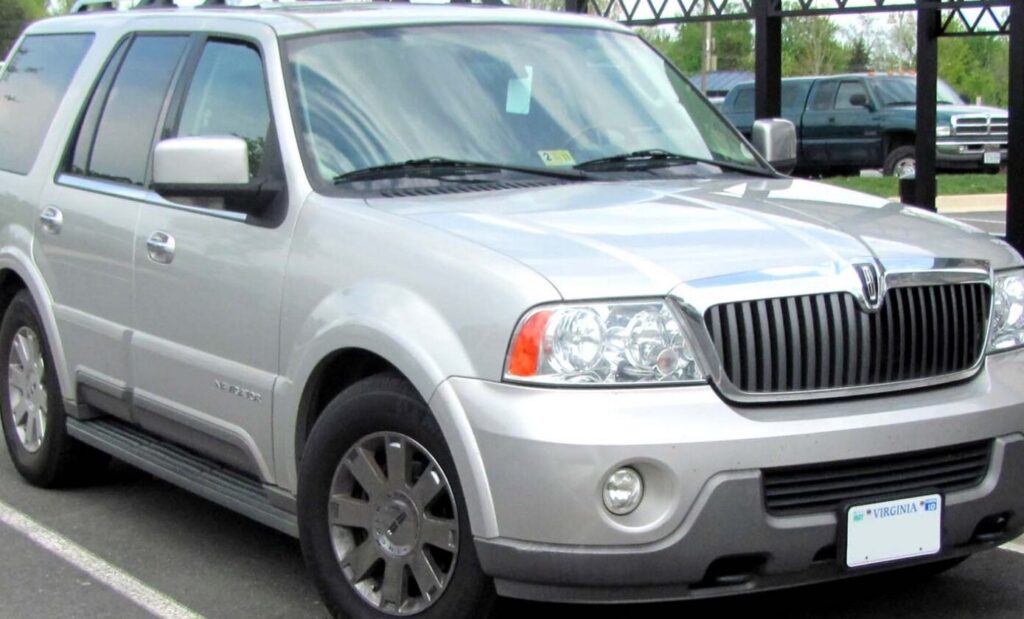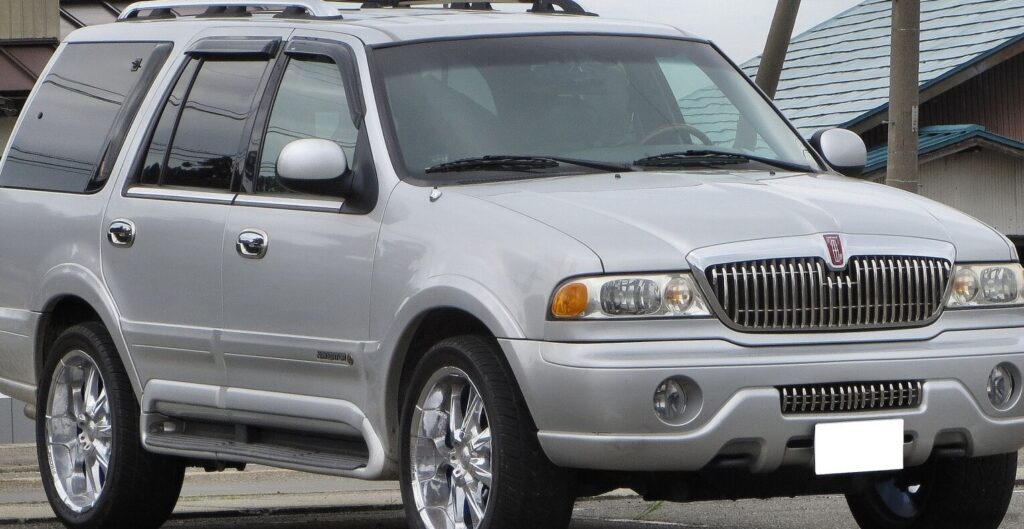
The Lincoln Navigator of the first generation, produced from 1997 to 1998, represented Lincoln’s entry into the burgeoning full-size SUV market. Built on a modified Ford F-150 chassis, the Navigator aimed to provide a more luxurious and refined experience than its Ford counterpart, competing directly with vehicles like the Cadillac Escalade and Chevrolet Suburban. The 5.4-liter V8 engine paired with a four-speed automatic transmission was a key configuration for the Navigator, offering a balance of power and convenience for buyers seeking a capable and comfortable family vehicle. This variant occupied a central position in the Navigator lineup, as it was the standard engine offering, with no smaller displacement options available.
Technical Specifications
| Brand | Lincoln |
| Model | Navigator |
| Generation | Navigator I |
| Type (Engine) | 5.4 V8 (230 Hp) Automatic |
| Start of production | 1997 |
| End of production | 1998 |
| Powertrain Architecture | Internal Combustion engine |
| Body type | SUV |
| Seats | 8 |
| Doors | 5 |
| Fuel consumption (economy) – urban | 18.1 l/100 km (13 US mpg, 15.6 UK mpg, 5.5 km/l) |
| Fuel consumption (economy) – extra urban | 13.8 l/100 km (17 US mpg, 20.5 UK mpg, 7.2 km/l) |
| Fuel consumption (economy) – combined | 16.8 l/100 km (14 US mpg, 16.8 UK mpg, 6 km/l) |
| Fuel Type | Petrol (Gasoline) |
| Acceleration 0 – 100 km/h | 10.3 sec |
| Acceleration 0 – 62 mph | 10.3 sec |
| Acceleration 0 – 60 mph | 9.8 sec |
| Maximum speed | 190 km/h (118.06 mph) |
| Weight-to-power ratio | 10.2 kg/Hp, 98 Hp/tonne |
| Weight-to-torque ratio | 5.3 kg/Nm, 187.8 Nm/tonne |
| Power | 230 Hp @ 4250 rpm |
| Power per litre | 42.5 Hp/l |
| Torque | 441 Nm @ 3000 rpm (325.26 lb.-ft. @ 3000 rpm) |
| Engine layout | Front, Longitudinal |
| Engine Model/Code | Triton |
| Engine displacement | 5408 cm3 (330.02 cu. in.) |
| Number of cylinders | 8 |
| Engine configuration | V-engine |
| Cylinder Bore | 90.2 mm (3.55 in.) |
| Piston Stroke | 105.7 mm (4.16 in.) |
| Compression ratio | 9:1 |
| Number of valves per cylinder | 2 |
| Fuel injection system | Multi-port manifold injection |
| Engine aspiration | Naturally aspirated engine |
| Valvetrain | SOHC |
| Engine oil capacity | 5.7 l (6.02 US qt | 5.02 UK qt) |
| Coolant | 19.7 l (20.82 US qt | 17.33 UK qt) |
| Kerb Weight | 2348 kg (5176.45 lbs.) |
| Trunk (boot) space – minimum | 1832 l (64.7 cu. ft.) |
| Trunk (boot) space – maximum | 3295 l (116.36 cu. ft.) |
| Fuel tank capacity | 114 l (30.12 US gal | 25.08 UK gal) |
| Length | 5202 mm (204.8 in.) |
| Width | 2027 mm (79.8 in.) |
| Height | 1847 mm (72.72 in.) |
| Wheelbase | 3023 mm (119.02 in.) |
| Front track | 1661 mm (65.39 in.) |
| Rear (Back) track | 1664 mm (65.51 in.) |
| Ride height (ground clearance) | 210 mm (8.27 in.) |
| Drag coefficient (Cd) | 0.43 |
| Minimum turning circle (turning diameter) | 12.3 m (40.35 ft.) |
| Drive wheel | All wheel drive (4×4) |
| Number of gears and type of gearbox | 4 gears, automatic transmission |
| Front suspension | Air suspension |
| Rear suspension | Air suspension |
| Front brakes | Ventilated discs |
| Rear brakes | Disc |
| Assisting systems | ABS (Anti-lock braking system) |
| Power steering | Hydraulic Steering |
| Tires size | 245/75 R16 |
| Wheel rims size | 16 |
INTRODUCTION
The 1997-1998 Lincoln Navigator, powered by the 5.4-liter Triton V8 and a four-speed automatic transmission, was Lincoln’s initial foray into the full-size SUV segment. Positioned as a more upscale alternative to the Ford Expedition (with which it shared its platform), the Navigator aimed to attract buyers seeking luxury, space, and towing capability. The first-generation Navigator (designated as the 1HX0 series) was a significant vehicle for Lincoln, establishing the brand’s presence in a rapidly growing market segment. The combination of the large displacement V8 and the automatic transmission was the sole powertrain option offered during these initial production years.
Powertrain & Engine Architecture
At the heart of the Navigator was Ford’s 5.4-liter Triton V8 engine. This engine, designated as the engine code 460, was a member of Ford’s modular engine family, known for its robust construction and relatively smooth operation. The engine featured a single overhead camshaft (SOHC) design with two valves per cylinder. Fuel delivery was handled by a multi-port fuel injection system, optimizing fuel atomization and combustion efficiency. The 9:1 compression ratio was a compromise between performance and the ability to run on readily available gasoline grades. The four-speed automatic transmission (4R70W) was chosen for its durability and ability to handle the engine’s substantial torque output. This transmission featured electronic control for smoother shifting and improved fuel economy. The transmission was calibrated to provide comfortable cruising and adequate acceleration, prioritizing ease of use over outright performance.
Driving Characteristics
The Navigator 5.4L Automatic offered a comfortable and capable driving experience, though it wasn’t particularly sporty. The 230 horsepower and 441 lb-ft of torque provided sufficient power for everyday driving and towing, but the Navigator’s substantial weight (over 5,000 pounds) limited its acceleration. The 0-60 mph time of around 9.8 seconds was typical for a full-size SUV of the era. The automatic transmission’s gear ratios were optimized for towing and cruising, resulting in a relaxed driving experience at highway speeds. Compared to a manual transmission-equipped Expedition, the Navigator’s automatic offered less driver engagement but greater convenience. Higher-output versions of the Triton V8, found in later Navigator models, provided noticeably quicker acceleration, but at the expense of fuel economy.
Equipment & Trim Levels
The Lincoln Navigator was well-equipped for its time, offering a range of comfort and convenience features as standard. Base models typically included features such as air conditioning, power windows and locks, cruise control, and an AM/FM stereo with a cassette player. Leather upholstery, heated front seats, a power sunroof, and upgraded audio systems were available as options. The interior design emphasized luxury and spaciousness, with comfortable seating for up to eight passengers. Woodgrain trim and a leather-wrapped steering wheel added to the upscale ambiance. The Navigator’s trim levels were relatively simple, with most buyers opting for a well-equipped version with a few key options.
Chassis & Braking
The Navigator’s chassis was based on the Ford F-150’s fully boxed frame, providing a solid foundation for its substantial weight. The suspension system utilized air suspension on both the front and rear axles, offering a smooth and comfortable ride. The air suspension also allowed for automatic load leveling, maintaining a consistent ride height regardless of cargo or passenger load. Braking duties were handled by ventilated discs on all four wheels, providing adequate stopping power. An anti-lock braking system (ABS) was standard, enhancing safety and control during emergency braking situations. The Navigator’s relatively large turning circle was typical for a vehicle of its size.
Market Reception & Comparison
The Lincoln Navigator was generally well-received by critics and consumers alike. It was praised for its spacious interior, comfortable ride, and luxurious features. However, its fuel economy was a common criticism, as the 5.4-liter V8 was not particularly fuel-efficient. Compared to the Ford Expedition, the Navigator offered a more refined interior and a more luxurious driving experience. Compared to competitors like the Cadillac Escalade, the Navigator offered a similar level of luxury and capability at a competitive price point. The Navigator quickly became a popular choice for families and those seeking a capable towing vehicle.
Legacy
The first-generation Lincoln Navigator established the brand as a serious contender in the full-size SUV market. The 5.4-liter Triton V8 and four-speed automatic transmission proved to be a reliable powertrain combination, with many Navigators still on the road today. While the engine is known for potential spark plug issues and timing chain wear with age, proper maintenance can mitigate these concerns. The Navigator’s spacious interior and comfortable ride continue to appeal to used car buyers. The first-generation Navigator paved the way for subsequent generations of the Navigator, which have continued to evolve and refine the formula of luxury, space, and capability.