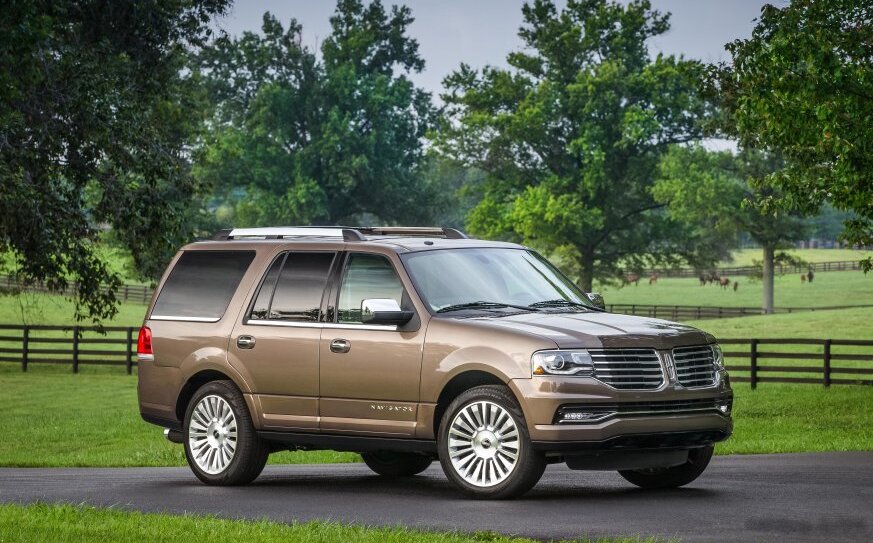
The Lincoln Navigator III, specifically the facelifted version introduced for the 2015 model year, represented a significant step forward for Lincoln’s full-size SUV offering. Produced from 2014 through 2017, this generation Navigator aimed to blend luxury, capability, and technology in a highly competitive segment. The 3.5 GTDI V6 Automatic variant, powered by the EcoBoost engine, was a key component of the Navigator lineup, positioned as a strong performer offering a balance between power and efficiency. It served as the primary powertrain option during its production run, replacing the older, less efficient engines of previous generations.
Technical Specifications
| Brand | Lincoln |
| Model | Navigator |
| Generation | Navigator III (facelift 2015) |
| Type (Engine) | 3.5 GTDI V6 (380 Hp) Automatic |
| Start of production | 2014 |
| End of production | 2017 |
| Powertrain Architecture | Internal Combustion engine |
| Body type | SUV |
| Seats | 8 |
| Doors | 5 |
| Fuel consumption (economy) – urban | 14.7 l/100 km (16 US mpg, 19.2 UK mpg, 6.8 km/l) |
| Fuel consumption (economy) – extra urban | 10.7 l/100 km (22 US mpg, 26.4 UK mpg, 9.3 km/l) |
| Fuel consumption (economy) – combined | 13 l/100 km (18.1 US mpg, 21.7 UK mpg, 7.7 km/l) |
| Fuel Type | Petrol (Gasoline) |
| Weight-to-power ratio | 7 kg/Hp, 143.7 Hp/tonne |
| Weight-to-torque ratio | 4.2 kg/Nm, 236 Nm/tonne |
| Power | 380 Hp @ 5250 rpm |
| Power per litre | 108.7 Hp/l |
| Torque | 624 Nm @ 2750 rpm (460.24 lb.-ft. @ 2750 rpm) |
| Maximum engine speed | 6100 rpm |
| Engine layout | Front, Longitudinal |
| Engine Model/Code | EcoBoost |
| Engine displacement | 3496 cm3 (213.34 cu. in.) |
| Number of cylinders | 6 |
| Engine configuration | V-engine |
| Cylinder Bore | 92.5 mm (3.64 in.) |
| Piston Stroke | 86.7 mm (3.41 in.) |
| Compression ratio | 10:1 |
| Number of valves per cylinder | 4 |
| Fuel injection system | Direct injection |
| Engine aspiration | Twin-Turbo, Intercooler |
| Valvetrain | DOHC, Ti-VCT |
| Engine oil capacity | 5.7 l (6.02 US qt | 5.02 UK qt) |
| Coolant | 17 l (17.96 US qt | 14.96 UK qt) |
| Kerb Weight | 2644 kg (5829.02 lbs.) |
| Max. weight | 3352 kg (7389.9 lbs.) |
| Max load | 708 kg (1560.87 lbs.) |
| Trunk (boot) space – minimum | 512 l (18.08 cu. ft.) |
| Trunk (boot) space – maximum | 2925 l (103.3 cu. ft.) |
| Fuel tank capacity | 106 l (28 US gal | 23.32 UK gal) |
| Length | 5268 mm (207.4 in.) |
| Width | 2002 mm (78.82 in.) |
| Width with mirrors folded | 2024 mm (79.69 in.) |
| Width including mirrors | 2332 mm (91.81 in.) |
| Height | 1984 mm (78.11 in.) |
| Wheelbase | 3023 mm (119.02 in.) |
| Front track | 1702 mm (67.01 in.) |
| Rear (Back) track | 1707 mm (67.2 in.) |
| Ride height (ground clearance) | 206 mm (8.11 in.) |
| Drag coefficient (Cd) | 0.37 |
| Minimum turning circle (turning diameter) | 11.89 m (39.01 ft.) |
| Approach angle | 22° |
| Departure angle | 21.3° |
| Ramp-over (brakeover) angle | 18.3° |
| Drivetrain Architecture | The Internal combustion engine (ICE) drives the rear wheels of the vehicle. |
| Drive wheel | Rear wheel drive |
| Number of gears and type of gearbox | 6 gears, automatic transmission SelectShift |
| Front suspension | Independent coil spring |
| Rear suspension | Independent multi-link suspension |
| Front brakes | Ventilated discs |
| Rear brakes | Ventilated discs |
| Assisting systems | ABS (Anti-lock braking system) |
| Steering type | Steering rack and pinion |
| Power steering | Electric Steering |
| Tires size | 275/55 R20 |
| Wheel rims size | 20 |
INTRODUCTION
The 2015-2017 Lincoln Navigator III represented a significant overhaul for the model, moving away from the body-on-frame construction of its predecessors to a more modern unibody platform (shared with the Ford Expedition). The 3.5 GTDI V6 Automatic variant was the flagship powertrain, offering a substantial increase in power and refinement compared to earlier Navigator models. This version aimed to compete directly with luxury SUVs from Cadillac, Acura, and Lexus, offering a spacious interior, advanced technology, and a comfortable ride. The “GTDI” designation signifies Gasoline Turbocharged Direct Injection, highlighting the engine’s key features.
Powertrain & Engine Architecture
At the heart of the Navigator 3.5 GTDI is Ford’s EcoBoost 3.5-liter V6 engine. This engine, designated as the 3.5L EcoBoost, utilizes a twin-turbocharger setup to deliver a robust 380 horsepower and 460 lb-ft of torque. The engine employs direct fuel injection, a double overhead camshaft (DOHC) valvetrain with Ti-VCT (Twin Independent Variable Camshaft Timing), and an intercooler to manage intake air temperatures. The engine code is crucial for identifying specific components and service intervals. The 6-speed automatic transmission, marketed as SelectShift, was the sole transmission option. This transmission was designed to handle the engine’s substantial torque output and provide smooth, responsive shifts. It featured a manual shift mode for greater driver control.
Driving Characteristics
The 3.5 GTDI V6 Automatic Navigator offered a noticeable improvement in acceleration and overall performance compared to previous generations. While not a sports car, the engine provided ample power for merging onto highways, overtaking, and towing. The automatic transmission was generally smooth and responsive, although some reviewers noted a slight hesitation during downshifts. The Navigator’s substantial weight (over 5,800 lbs) did limit its agility, but the independent suspension provided a comfortable and controlled ride. The rear-wheel-drive configuration contributed to a balanced feel, while four-wheel drive was available as an option for enhanced traction in inclement weather.
Equipment & Trim Levels
The Navigator III offered a range of trim levels, with the 3.5 GTDI engine typically found on the higher-end models. Standard features included leather upholstery, tri-zone automatic climate control, a rearview camera, and a premium audio system. Optional extras included power-folding running boards, a panoramic sunroof, and advanced safety features such as adaptive cruise control and lane-keeping assist. Interior color schemes varied depending on the trim level, with options ranging from light beige to dark charcoal. The dashboard featured a large touchscreen display for infotainment and vehicle settings.
Chassis & Braking
The Navigator III’s unibody construction provided a stiffer and more refined chassis compared to the body-on-frame designs of earlier models. The independent front and rear suspension systems contributed to a comfortable ride and improved handling. The braking system consisted of ventilated discs on all four wheels, providing adequate stopping power for the vehicle’s weight. Anti-lock brakes (ABS) were standard, along with electronic stability control. The Navigator’s relatively large size and weight necessitated a robust braking system to ensure safe and controlled stops.
Market Reception & Comparison
The 2015-2017 Lincoln Navigator 3.5 GTDI was generally well-received by critics, who praised its powerful engine, spacious interior, and comfortable ride. However, some reviewers noted that its fuel economy was relatively poor compared to some competitors. Compared to the base V8 engine offered in earlier Navigator generations, the EcoBoost V6 provided a significant improvement in both power and efficiency. Against rivals like the Cadillac Escalade and the Acura MDX, the Navigator offered a compelling combination of luxury, capability, and value.
Legacy
The 3.5 GTDI V6 powertrain proved to be relatively reliable, although some owners have reported issues with the turbochargers and fuel injectors. Regular maintenance, including oil changes and spark plug replacements, is crucial for ensuring the longevity of this engine. In the used car market, the 2015-2017 Lincoln Navigator 3.5 GTDI remains a popular choice for buyers seeking a spacious, comfortable, and capable full-size SUV. Its strong engine and well-equipped interior continue to appeal to those who prioritize luxury and performance.